





petter.rekstad retweeted

En Reddit un tío contó que había vendido unas 200 webs en 12 meses.
Él y su pareja.
Sin agencia de 15 personas.
El truco no es diseñar mejor:
Scrapean negocios.
Un sistema les señala la web fea, lenta, que no carga en el móvil o que no tiene una página que el cliente está buscando.
El outreach sale de esos fallos, no de "hola, hacemos webs bonitas".
El build lo saca Claude Code.
Lo sirven en Cloudflare.
Stack que soltaron:
Apollo para leads.
Una tool de auditoría y campañas.
Otra para el blog SEO.
Claude Code para montar.
Cloudflare para hospedar.
La frase que me quedé:
el mejor diseñador del mundo acaba perdiendo contra un chaval con sistema.
Si te estás pegando 3 semanas con una landing de 8 secciones, esa es la cagada.
La unidad de trabajo ya no es "una web artesana".
Es un pipeline que analiza, escribe, construye y cobra.
Yo no clonaría su stack entero.
Sí clonaría la idea: primero el fallo medible del cliente, después la página.
Guárdalo 🔖

petter.rekstad retweeted

Meta Muse will probably create 1000+ millionaires
This is the most slept on arbitrage I’ve seen in years and it’s not even close.
Here’s how i’d build a 1 person business powered by AI/Muse with with $0 and 0 social following
petter.rekstad retweeted

HOLY SHIT 😭
beehiiv's CEO challenged people to vibe-code his platform over a weekend.
24 hours later, @marclou dropped an open-source, agentic version that's 83% cheaper ($19 vs $109/mo)


I vibe-coded beehiiv, and it's 83% cheaper.
✨✨ Introducing MailCheap.ai ✨✨
Everything you need to run a newsletter...
✍️ Editor
📅 Scheduling
📈 Stats
🌐 A website for every issue
🛡️ Deliverability guardrails
🔗 Send from your own domain (and keep your reputation)
And it's not a dinosaur tool:
+ It's open source; you can run it for free
+ It's agentic; everything in the UI is available to your AI
Import from beehiiv, Substack, or Mailchimp in 2 minutes.
You pay for the emails you send, not for dormant subscribers. From $19/month.
Oh, and no "Powered By" badge at the bottom of your emails.

petter.rekstad retweeted

The moment you realize it was your RAS all along and now you can be rich forever



petter.rekstad retweeted

i literally got +4 fresh startup ideas after reading this

I spent 48 hours in SF hanging out with billionaires, data labs and AI founders and execs running $1B to $100B companies.
My observations:
1. Sooo MANY stories of data brokers making like $2M a WEEK selling company data to labs. I can't tell if it's the beginning or a bubble, and I kept wondering which niches are left. Digging into it actively.
2. At dinner, someone asked the table, "If a new model drops next month, does your company get better or worse?" HALF the table went quiet! I think that's the best question to ask about any AI startup right now.
3. The bar people talk about now is hitting $1B in revenue in 12 months (I guess that's the new unicorn?). What I didn't hear much about is retention. AI revenue can come in fast and leave fast, and I think we're going to see a lot of stories of AI companies with huge revenue and terrible retention.
4. It's pretty clear we're living through the reinvention of the computer. The model is the CPU, the harness is the operating system, and skills and plugins are the apps. Thinking about it that way makes it easier to see where the whitespace is.
5. We're maybe 12 months from an agent that can watch you work for a week and then do your job without any instructions. The screen recording plus agent memory plus local model combination makes this possible right now.
6. Agent harnesses feel like the new GPT wrappers, in a good way, especially vertical ones. The best teams I talked to treat the model as swappable. One founder walked me through routing different models to different jobs: one for taste and visuals, a cheaper one for the everyday stuff, another for text.
They use prompts they can move across models over fine-tuning, and A/B test the output on what users actually do with it: do they edit it, export it, share it? A vertical harness is basically four things: the connectors for that industry's data, evals written by people who know the work, rules for what the agent can and can't touch, and a clean screen for a human to review. The model is maybe 20% of it.
7. There's a lot of reverse engineering going on/cloning going on more than I've ever seen. People are decompiling software and rebuilding it with agents, and someone showed a suite of like 10 apps that are worth $5B+ each all that he cloned open source. Me and everyone are still thinking through what it means when software gets this easy to copy.
8. My guess is the value moves to data. If the software can be rebuilt quickly, what's worth paying for in a legacy SaaS company is the years of customer data and workflows inside it. Some SaaS companies are secretly data companies.
Gets me thinking about how do you truly value data for this saas companies? Like if we were buying these dying saas companies at 2x ARR before (as example), maybe there is a better metric. Idk, just thinking out loud here.
9. It feels like a good chunk of legacy software won't make it to the agentic era, especially anything built around people clicking through a lot of screens.
10. Every company I talked to wants to pipe its internal data into one place and expose it to agents through MCP. Then they look at the data and realize it's a mess: five versions of the same customer, old Slack channels, PDFs nobody can search. Cleaning that up feels like a big consulting opportunity!
11. A lot of founders are building the basic building blocks for agents: APIs, data layers and tools. Some of the companies I saw barely have a UI because the main user is an agent. I really believe the startups that build primitives to this agentic era will do extremely well. Building blocks is the best way to think about it.
12. Labs can get plenty of training data, but it's harder to get real examples of agents failing inside companies. Whoever has those logs has something valuable.
13. Someone running a big consumer company told me the next fight is over memory. The model that remembers the most about you wins, and the smartest model matters less than people think.
14. Physical AI came up a lot. Astra I think was the first model that got people into AI can actually do CAD, and I think a lot of people are thinking what does vibe manufacturing really look like. The line I keep thinking about came from a robotics founder: the hardest problems in AI are deployment problems now, not research problems. Their robots work on their own, call a human when they get stuck, and every one of those calls becomes training data.
15. Cybersecurity companies are having a moment and are actually cool companies to build now, especially the ones that clean up after a breach. Every agent with access to your systems is a new door into your company, and a lot of those doors were left open.
16. Some startups are worth more dead than alive now. A shutdown company with 5 years of Slack, email and code can get paid for licensing all of it. I wouldn't be surprised if founders start factoring that into when they shut down.
17. People are starting to talk about monetizing the agent web. It feels really early, but when the most popular user of the internet is an agent, what startups should you be building?
18. I think agent insurance is coming. Once an agent makes an expensive mistake, insurers will want audits before they cover anyone.
19. Several people said the hire they want most is someone with taste who can write evals. The models are getting good at generating ideas, so the hard part is judging which ones are good.
20. New trend I observed: startup raises VC, uses venture dollars to become a creator, startup fails, founder falls back on being a full-time creator and incubates other products bootstrapped.
21. Getting SIGNIFICANT distribution is HARD right now. Founders are sponsoring buses, buying billboards like crazy and throwing parties with famous DJs to get noticed. Kinda feels dotcom era in that sense.
Attention is what's scarce! The growth guy going viral sharing his UGC strategy from Wispr Flow is a good example. It's the sauce everyone wants, and I truly believe there are probably only 50 people on the planet who know how to scale these types of businesses efficiently in this era.
Always good to get that dose of SF. I felt sooo lucky to have such an incredible trip during such an incredible time in building businesses. Surreal in so many ways.
Happy to be home and locked in.
Until next time!


petter.rekstad retweeted


I am a member of the Norwegian Nobel Committee.
There are five of us. Five people, appointed by a parliament most of the planet could not find on a map, who decide, once a year, which human being the world has agreed to call good.
I know. I know. I think about it on the tram.
We meet in a building on Henrik Ibsens gate, a street named after a man who wrote almost exclusively about people discovering they are frauds, which nobody on the committee finds funny except me. There is a room with a long table and the portraits of the dead laureates looking down, Mandela, the Dalai Lama, a great many earnest men in spectacles, and one portrait we do not discuss, which is Kissinger, 1973, awarded while the bombs were still falling, after which two of our predecessors resigned and the satirist Tom Lehrer said political satire was now obsolete. We keep him on the wall. A reminder. Every family has the uncle.
It is October in Oslo, which means the sun gives up around four in the afternoon like a civil servant, and it rains the particular Norwegian rain that isn’t quite falling, just hanging there, judging you. I arrive with wet shoes. I always arrive with wet shoes. There is coffee, because this is Norway and there is always coffee, we drink more of it per person than almost anyone alive, and someone’s wife has sent kanelboller, the cinnamon buns, and we sit, five Norwegians, damp, caffeinated, sugared, and we decide the moral standing of the entire species.
Let me tell you how it actually works, because the world imagines a cathedral and it is, I promise you, a book club with a mandate.
287 nominations this year. 208 people, 79 organizations. Anyone can nominate, that’s the secret nobody understands: a professor, a parliamentarian, a former laureate, so the “nominee” list is meaningless, it’s a suggestion box, and every autumn some congressman nominates his own golden retriever and the press writes “SHORTLISTED.” Nobody is shortlisted. There is no short list the public ever sees. There is us, and the coffee, and the rain, and the portraits, and a Norwegian stubbornness that is older than the prize itself.
We read reports. The institute’s advisers write them, thick dull documents, and we argue. Our chairman told the BBC once that in the final meeting “there is a high temperature.” High temperature, for a Norwegian, means someone slightly raised an eyebrow and then apologized for it. We don’t do high temperature. We do a long silence, and then Kristin says “well,” and everyone knows exactly what “well” meant, and it’s settled. That’s our shouting. “Well.” You’d have to be raised here to hear the violence in it.
Now. This year. I will not say the name, because we never say the name, but you know the name.
A certain head of state wanted this prize the way a child wants a thing in a shop window, which is to say loudly, and in public, and with the full belief that wanting it was itself the argument. He said he deserved it. He said he’d ended eight wars, a number that grew most times he said it, like a fish. He had other heads of state phone us. Israel’s prime minister posted it on the internet, “Give him the Nobel.” The leaders of Cambodia and Pakistan announced they’d nominated him, as though announcing it were part of it, as though we tally mentions. A man flew around the globe collecting endorsements for a Norwegian committee the way you’d collect signatures for a petition to the council about a noisy dog.
And here, uff da, is the detail I treasure, the one that makes me smile into my coffee. The nomination deadline is the 31st of January. He took office on the 20th. So for all the phone calls, all the posts, all the gilded lobbying, the only nominations that could possibly count for this year’s prize were filed in the first eleven days of his term, before he had, by his own arithmetic, ended a single one of the eight wars. He campaigned all year for a prize whose window had shut while he was still hanging up his coat. We didn’t have to reject him. The calendar did. We just watched. Norwegians are very good at watching. We have long winters.
People think we sit there weighing his deeds. We don’t. That’s the thing I can’t make the world understand. We’re not grading his homework. We don’t owe anyone the prize for a ceasefire, however real, however loud the announcement. “He made peace” is not a sentence that ends in a medal, the way he believes it does, the way he believes every good thing ends in his name on it. The will of a dead Swede says the prize goes to whoever did the most for fraternity between nations. A dead Swede, I should add, who made his entire fortune inventing dynamite and selling arms, and spent his last years horrified at his own obituary, which called him a merchant of death, and so bought his way to immortality as a man of peace. The whole prize is one guilty arms dealer’s attempt to launder his name. We are, all of us, administering a dead man’s public relations. I find this clarifying. It keeps me humble. It should keep everyone humble, and it keeps, by my count, no one humble at all.
So who did we give it to?
An eighty-five-year-old woman. A judge. Born in Durban, under apartheid, granddaughter of a Tamil man who came to South Africa as indentured labor, a bus driver’s daughter from the poor Indian quarter, who became the first non-white woman to run a law practice in her province, who defended Mandela’s people when defending them was dangerous, who sat on the Rwanda tribunal and the court at the Hague, and who, at eighty-five, is right now a judge weighing whether a genocide is a genocide. When we told the world, our chairman said the rule of law “underpins the system we have set up to ensure peace,” and that “peace requires justice.” She wasn’t even in Oslo. She was in Nuremberg. In courtroom 600. The actual room where they tried the Nazis. You cannot stage that. God staged that, and God, it turns out, is a better satirist than any of us.
She did not phone us. She did not post. No prime minister demanded it for her on the internet. She had, as far as our deliberations are concerned, the one qualification the loud man could never manufacture, which is that she wanted the work and not the medal. The medal finds those people. It flees the ones who chase it. This is not a rule we wrote. It’s just the only pattern the hundred-odd years of our mistakes has ever shown.
The reaction from across the ocean was immediate. His spokesman posted that we “place politics over peace.” Ja. Perhaps. We’re five damp pensioners in a rainy city; of course it’s political, it was always political, it was political when we gave it to a sitting American president nine months into his first term for the promise of things he had not yet done, and we have been quietly embarrassed about that one for fifteen years, so believe me, we had a particular reason this year to prefer a woman with fifty years of verdicts behind her over a man with eight wars in front of him and a deadline already behind him.
Here is what he will never understand, the thing I’d tell him on the tram if he ever took one. We are the one prize he cannot buy, cannot post his way to, cannot have a friendly dictator phone in for him. Not because we’re incorruptible, nei, we’re as vain and wrong and human as the portraits on our wall. But because the entire point of the thing, the only power a small cold country’s book club has ever held, is that it goes to the person not performing the wanting. The moment you demand it, you’ve proven you don’t understand what it’s for, and proving that is itself the disqualification. He ran the most expensive campaign in the history of the prize and the campaign was the reason. He was never losing to Navi Pillay. He was losing to the concept.
It’s dark now. Four o’clock dark. The buns are gone. Kristin said “well” an hour ago and we all went home. I’m on the tram with my wet shoes, and somewhere across the water a very powerful man is explaining to a camera that the prize is rigged, that we’re corrupt, that he’ll win it next year, and he genuinely might, we’re only five idiots and we’ve been wrong before, Kissinger is still on the wall.
But not this year. This year an old woman in Nuremberg, in the room where the law once stared down the exact kind of man who thinks wanting a thing loudly enough should make it his, got a phone call she didn’t ask for.
That’s the job. We don’t reward the man who ends the war and announces it.
We reward the woman who spent fifty years deciding what a war was.
He’ll never see the difference. That’s rather the whole point of him.
Takk for i dag. I have to change trams.


petter.rekstad retweeted

hector is 1/1. can’t imagine the number of companies trynna get him now. hope he gets a big salary bump by wispr flow for this!

petter.rekstad retweeted

Sam Altman (OpenAI CEO) just released a prompt that turns GPT-6 Sol into a one-person company.
It's f*cking unreal...
Send it to GPT-6 Sol, and thank me later. Then read the full guide for GPT-6 Sol Graph Engineering.


Readers added context they thought people might want to know
Sam Altman did not release this prompt. The image states it was created by the poster and is "Not written or endorsed by Sam Altman." Altman announced GPT-6 Sol improvements but no such prompt.
x.com/sama/status/21…
axios.com/2026/09/07/axi…
petter.rekstad retweeted

Mark Cuban says if he were 20 today, he'd skip venture capital entirely.
His reasoning: a $100K/month AI consulting business for small businesses beats chasing a 0.1% VC lottery ticket.
The math is brutal and obvious once you say it out loud.
Most founders spend years grinding for a shot at diluted equity, a 10-year exit, and a 95% failure rate. Cuban is pointing at a different path — one where AI tools let a 20-year-old build real cash flow fast, without giving up ownership or control.
The contrarian insight isn't "consulting is underrated." It's that the AI moment has made consulting scalable in ways it never was before. One person can now deliver what used to take an agency.
$100K/month is $1.2M/year. Profitable from day one. No board. No cap table. No begging for a Series A.
That's the business Cuban wishes he'd had access to at 20.
petter.rekstad retweeted

Cancel your plans tonight.
Do this instead:
• Go on Reddit
• Find problem people are struggling with
• Turn those problems into digital assets
You can hit your first $8,000 in 60 days.
Here are the 7 steps to get you started:
petter.rekstad retweeted

This guy. Is a. Fucking. Animal.

Tomorrow marks 30 days since acquiring our 2nd HVAC company.
The results so far:
MoM Revenue: +285%
YoY Revenue: +200%
YoY Sales: +362% (almost 4x)
How we did it:
• Ditched paper files & migrated to Service Titan
• Merged call centers
• Grew GMB reviews by 30% by asking for reviews
• Launched outbound SMS campaigns (sellers voicemail announcing retirement and partnership with my company)
• Brought in proven techs from company #1 (already hired high producing techs to backfill)
• Added dedicated sales support
Simple playbooks, executed well.


petter.rekstad retweeted

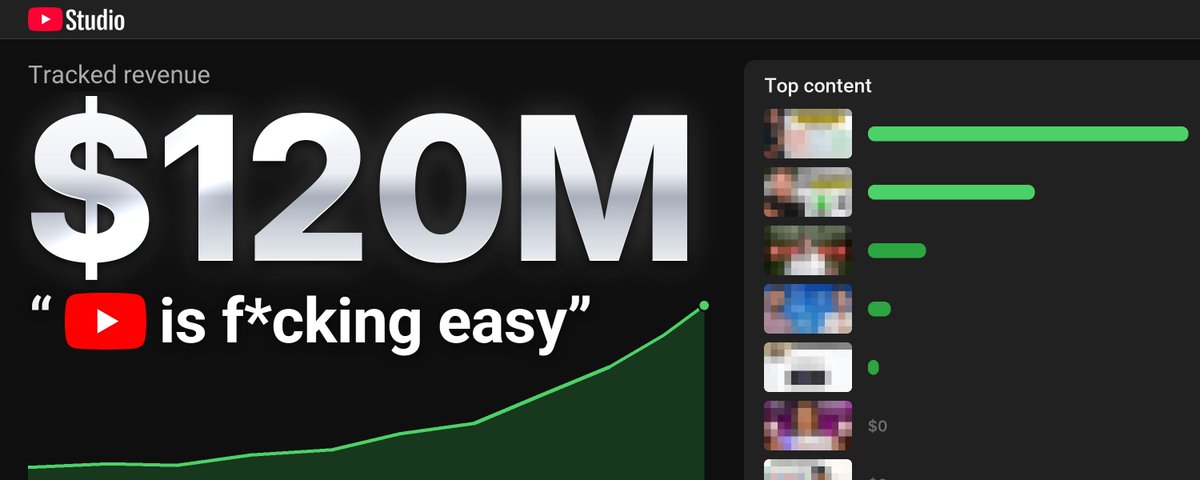
THIS IS F**KING INSANE
This guy just dropped a method for finding little to no competition YouTube niches using Claude Code.
Bookmark this you'll need it.


petter.rekstad retweeted

🚨NEW EXPERIMENT 🚨
Playground is an experimental gaming platform that lets you create your own games with zero coding experience. If you can think it, you can play it.
Go to labs.google/playground to learn more! Available to users 18+ in the US.