

Software Architect | 18 yrs in Backend, AI & Data Systems | I explain Architecture, AI Engineering & real product building with simple visuals.
Islamabad
Joined May 2014
- Tweets1.8K
- Following2.3K
- Followers612
- Likes1.9K






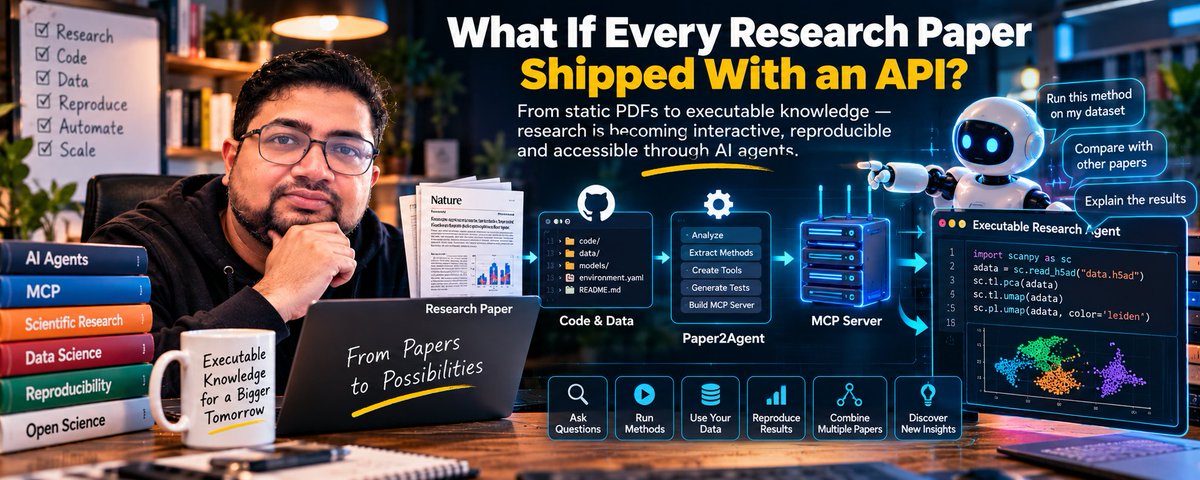
AI coding agents don’t just need better prompts. They need strong tests, deterministic verification and a clear PASS/FAIL loop. Better feedback can make even imperfect agents far more reliable. #AI #AIAgents #SoftwareEngineering

I’ve been thinking about AI costs the same way I once thought about cloud costs. At the beginning, everything feels cheap. A few API calls, a little RAG, one agent, maybe a second agent to review the first one… and suddenly the monthly bill starts looking a lot less experimental. The funny part is that AI agents don’t have salaries, but they still have a cost every time they reason, call tools, search vectors, rerank results, or ask another model for help. 😄
For me, the next serious AI engineering skill is going to be cost discipline. Not “how many agents can we run?” but “where is intelligence actually worth paying for?” Can a smaller model do the job? Can we cache this? Does this need an LLM at all? Why is the agent calling the same tool five times? Why are we using a frontier model for a yes/no classification? The companies that win with AI won’t be the ones using the most tokens. They’ll be the ones turning the fewest expensive decisions into the most business value.
#AI #AgenticAI #AIEngineering #AIArchitecture #EnterpriseAI #CloudComputing #FinOps #GenerativeAI #SoftwareArchitecture #ArtificialIntelligence #FutureOfAI

Farrukh Naveed Anjum retweeted

WHOEVER LEAKED THIS HAS BIGGER BALLS THAN SENSE
someone turned $100 → $2,500 in 48 hours using Claude + QuantGPT for AI powered trading.
but most people focus on the AI and ignore what actually makes the system work.
QuantGPT connects Claude to real trading infrastructure through MCP.
→ access historical market data
→ build and backtest trading strategies
→ test for overfitting and weak performance
→ paper trade before risking real capital
→ deploy strategies with a monitored execution runner
the AI proposes the strategy. the infrastructure tests it. risk controls help keep execution disciplined.
that’s the difference between asking AI for trading ideas and building a real quant workflow.
full breakdown on how to set it up below


Farrukh Naveed Anjum retweeted

REA + Opus 5.5 can take apart a million-dollar company in 15 minutes with one free repo, and it's f**king unreal
a friend of mine took apart Microsoft and Anthropic this way, built the same systems in his own business from scratch and saved over $100k
REA is a reverse-engineering agent: you give it a company name, and it finds everything that company has shipped on its own, the website, the desktop app, the phone app
then Opus 5.5 reads their code and figures out how everything works inside: login, payments, where the data is stored
you get a blueprint of a product hundreds of engineers spent years on, and next to every point is the exact place in the code where it's written
then Opus 5.5 writes your version from scratch, and a second agent keeps fixing it until it works like the original
save the repo before big companies get it taken down ↓


Farrukh Naveed Anjum retweeted

REA (Reverse Engineer Anything) is the MOST dangerous MCP for traders
i am literally SHOCKED...
REA (Reverse Engineer Anything) could crack apart any trading system from scratch & inspect its source code along with its binaries for completely FREE
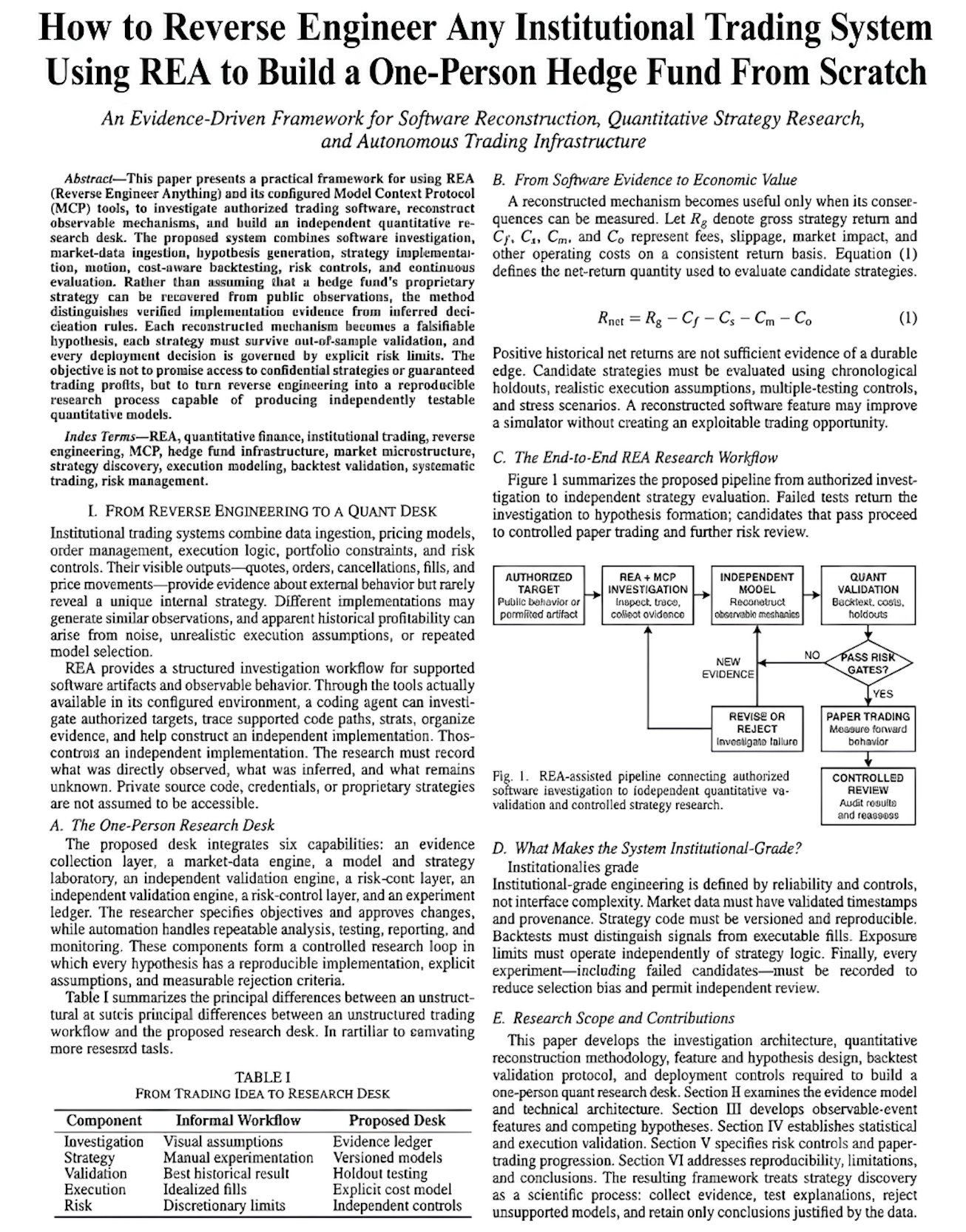
i wrote a 6-page research paper on using REA + Opus 5.5 to reverse-engineer trading mechanics & build your own trading agents in RUST
here is how you do it:
1. the REA workflow investigates application behavior, traces code paths, maps dependencies and reconstructs how trading systems operate
2. the source-code and binary analysis layer examines functions, recovers program structure, and traces implementation details in authorized targets
3. the behavioral analysis engine studies order submissions, cancellations, market-data updates and execution events to infer trading mechanics
4. the Opus 5.5 research agent turns findings into Python models, trading bots and testable strategy hypotheses
5. the backtesting engine evaluates strategies against historical data, fees, slippage, out-of-sample periods, and predefined validation criteria
6. the autonomous research loop logs experiments, investigates failures, monitors performance, and refines strategies under explicit risk limits
the full research framework is in my article below:


Farrukh Naveed Anjum retweeted

An Anthropic engineer just released a 12-page PDF that turns Claude Opus 5.5 into a reverse-engineering team with an AI memory stack
This is f*cking insane...
Send the PDF to Opus 5.5, give it one app and one feature to rebuild, and let it track the evidence across every session
Then read the article below for the exact team and memory-stack setup


I’ve been thinking a lot about what actually survives in the service industry as AI keeps getting better. My view is that trying to compete with AI on raw effort is a dead end. Drafts, routine research, basic code, summaries and repetitive support are all getting cheaper. If your value is mostly “I can do this task for you,” the market will keep pushing the price down. The safer place to build is around the things clients still want a human to own: judgment, domain knowledge, integration, trust, accountability and difficult decisions when there is no obvious answer.
So if I were building a service business today, I would use AI aggressively behind the scenes but I would stop selling hours. I would sell outcomes. If AI can do 80% of the work, I would not spend my energy defending that 80%. I would build the business around the remaining 20% where experience, context and responsibility actually matter. That is probably the real shift: smarter tools, smaller teams, faster delivery, but more value placed on the person who can still say, “This is the right decision, and I’m willing to own it.”
#AI #FutureOfWork #Consulting #ProfessionalServices #AITransformation #BusinessStrategy #SoftwareArchitecture #TechLeadership #DigitalTransformation #ArtificialIntelligence

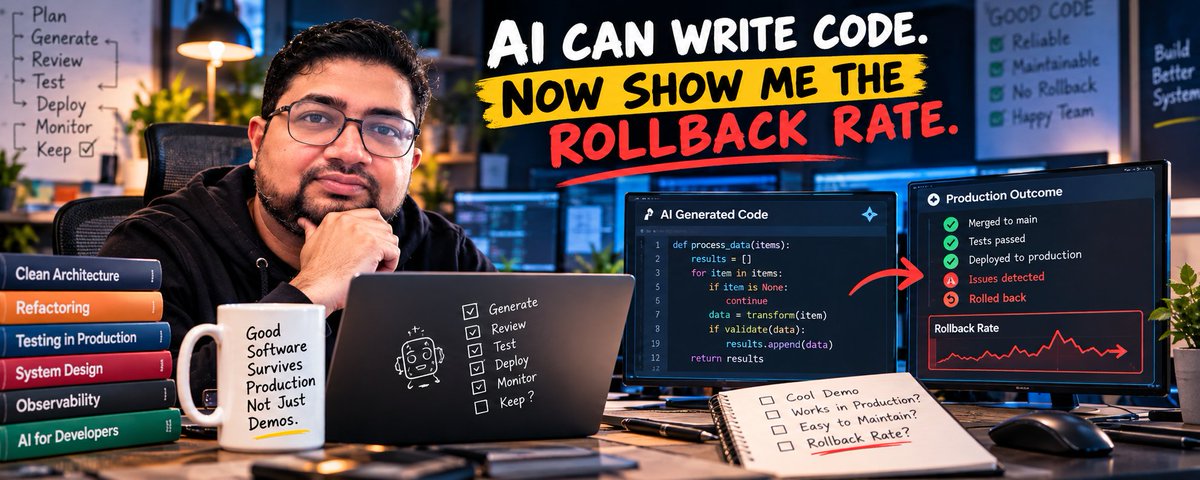
AI can write code fast. That’s no longer the interesting part. I want to know what survives review, deployment, real users and the next 90 days. The best coding agent may simply be the one that creates the least cleanup. #AI #SoftwareEngineering #AICoding
Farrukh Naveed Anjum retweeted

Jev as a judge for LLM evals!
JevEval uses Jev as the judge for custom LLM evals instead of relying on another generative LLM for every evaluation.
The idea is pretty simple.
You define the exact decisions you want the evaluator to make, Jev evaluates each one and returns probabilities, and DeepEval uses those results to calculate the final score.
For example, with an AI agent you can evaluate the trace itself, checking whether the agent selected the right tools, followed the expected sequence of actions, and actually completed the task.
Jev handles those semantic judgments, while the scoring logic stays outside the model.
That is the main difference from a normal LLM-as-a-judge setup.
With a generative judge, the model often has to interpret the rubric, reason about the response, and generate the evaluation itself.
With JevEval, you define the decision structure upfront.
You can also assign different weights to different checks or use `strict_mode` when every requirement needs to pass.
So if one part of the agent workflow matters more than another, you can reflect that directly in the scoring logic instead of leaving the entire evaluation to the judge model.
Key capabilities:
- Evaluate agent outputs and traces with Jev
- Define custom checks as bounded decisions
- Use yes/no, score, and closed-choice questions
- Weight different checks or require all of them to pass
- Evaluate both single-turn outputs and multi-turn conversations
This is where Jev makes a lot of sense for evals.
If you already know what needs to be checked, you can define those decisions upfront, let Jev handle the semantic judgment, and keep the final scoring deterministic.
I’ve shared the DeepEval post in the comments.


Farrukh Naveed Anjum retweeted

You’re still pay $700/year for TradingView Premium?
I rebuilt it with one MPC and Opus 5.5 premium indicators,alerts,backtesting- all FREE
The MPC is called REA (Reverse Engender Anything) and it’s #1 on GitHub trending right now here is the playbook:
• install REA and connect its MCP to Claude Code to investigate authorized software & trace how features work
• map the core workflows: symbol search, timeframes, indicators, drawing tools, alerts and chart layouts
• build independent data connectors for stocks, crypto, forexand indices using documents APIs
• add premium-style indicators, multi-timeframe signals, custom alerts and a Python backtesting engine with fees, slippage and drawdowns
• test every module, compare outputs against real charts, fix failures and ship a working platform
Link to try it the article below:



Farrukh Naveed Anjum retweeted

Learn to build custom harnesses, folks!
Here is an impressive paper showing the impact of a good custom harness on long-context work.
GLM-5.3-Flash goes from 4.4% to 61.1% exact match on OfficeQA Pro V2 with the same model.
The authors report that the gain comes from the harness.
The model-agnostic harness name is LongHarness, built for corpora of 100M tokens and more.
Why it works:
Standard agent harnesses keep evidence and conclusions mixed into one growing chat history. Retrieval keeps expanding without closing the actual gap, and corrections stop reaching the answer.
LongHarness stores both as explicit state. Open conclusions decide what to retrieve next, and each new piece of evidence confirms or revises the conclusions that asked for it.
On the same benchmark, it beats Claude Code by 12.1 points on V1 and Codex by 18.9 points on V2.
arxiv.org/abs/2610.13075
Chat with Paper: academy.dair.ai/papers/longh…

One thing that stood out to me today is how model security is changing. We used to think mostly about protecting weights, servers, credentials, and infrastructure. But with distillation attacks, an attacker may never need to breach your systems at all. They can simply keep querying the model, study the outputs at scale, and use those responses to train something that imitates part of the capability. In other words, your API can become part of the attack surface even when everything behind it is technically secure.
From an architecture point of view, that changes the defense model. Rate limits are not enough. You start thinking about identity, abnormal query patterns, response shaping, extraction detection, watermarking, and how much useful signal the model is exposing over time. The funny version is that someone can spend billions training a model, then discover another team is trying to photocopy it one prompt at a time. 😄 My takeaway is simple: protecting the model is no longer just about protecting the weights. You also have to protect the behavior the model reveals.
#AI #AISecurity #LLMSecurity #ModelSecurity #AIArchitecture #CyberSecurity #GenerativeAI #AIEngineering #ArtificialIntelligence #SoftwareArchitecture #FutureOfAI

Farrukh Naveed Anjum retweeted

if we haven’t met yet, let’s connect #connect
i’ve been drawing little circles of people i meet here. here are 9 more people i’m glad to know.
one made an AI game about destroying AI datacenters. apparently the agent had no questions 😂
what are you working on?
@Ukhan1243 @ciirgliano @eldorastudio @wolfitway @Skye_Kim_25 @GeneStoneGames @hello_code_ @farrukh_codes @fcuk112

Farrukh Naveed Anjum retweeted

Building Software? Make it SOLID!
Ever worked on a codebase that felt like a tangled mess? Changes break everything, adding features take forever, and debugging is a nightmare.
That’s where SOLID Principles come in - five simple rules that make software more scalable, maintainable, and flexible.
Here’s SOLID, simplified:
1. Single Responsibility Principle (SRP) – One class, one job. Just like a specialist who does one task well.
2. Open/Closed Principle (OCP) – Extend functionality without changing existing code, like adding toppings to a pizza without remaking the base.
3. Liskov Substitution Principle (LSP) – Subclasses should work as expected, like swapping a tire without breaking the car.
4. Interface Segregation Principle (ISP) – Keep interfaces focused—order only what you need from a menu, not a full meal.
5. Dependency Inversion Principle (DIP) – Depend on abstractions, not concrete implementations, like using a universal adapter instead of a fixed plug.
Master these principles, and you’ll write cleaner, smarter, and future-proof code.
P.S. Preparing for a software engineering role? Check out my book, System Design and Behavioral Intelligence.
It will help you:
• Build strong System Design foundations and approach design problems with confidence
• Develop practical frameworks to navigate complex behavioral and leadership challenges
Get Your Copy anywhere internationally:
US: lnkd.in/eVy2ACxQ
UK: lnkd.in/evzmHKm4
India : lnkd.in/e25PthqU


We keep comparing AI models, but the next big advantage may come from somewhere less glamorous: power, chips, cooling, and infrastructure efficiency. At scale, the real benchmark may be how much useful intelligence you get per megawatt. #AI #DataCenters

Farrukh Naveed Anjum retweeted

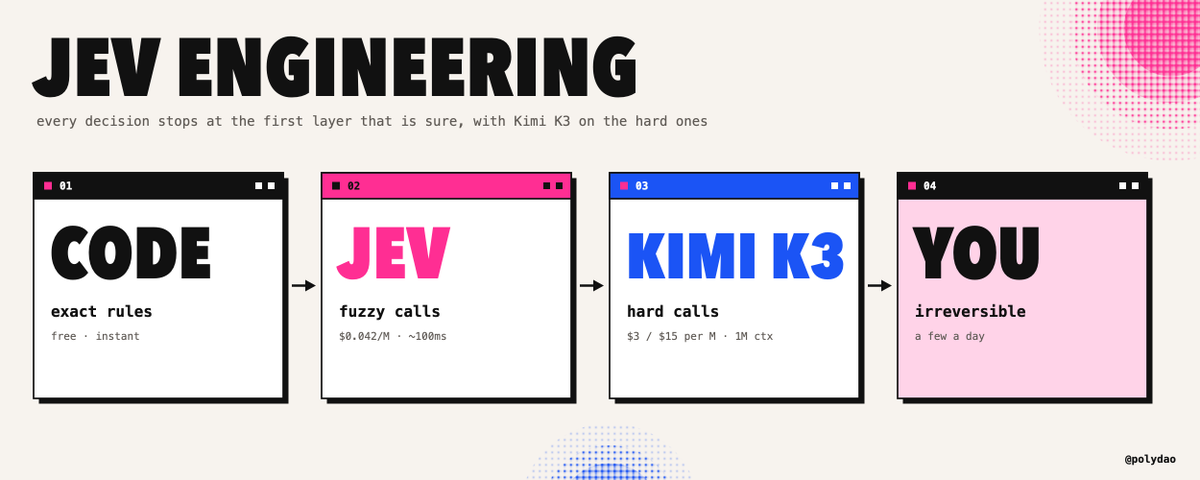
Jev + Claude Opus 5.5 is certified f*cking gold... i can't understand why everyone isn't wiring this up yet
the forks alone drop from about $110 a day to $4 once Jev takes them over. right now it's the best way i know to run Opus
the jobs Jev takes off Opus:
-> deciding which project notes are worth loading before the context fills up
-> routing the easy steps to a faster worker
-> choosing how to recover when a tool breaks, so nothing retries on autopilot
-> running the narrow checks first and saving the full test suite for last
Opus keeps the hard reasoning. Jev only picks between options the harness already laid out and tested
each pick lands in about 100 ms, and Jev's output tokens cost nothing
Jev engineering in a sentence: let the expensive model think and the cheap one choose
$106 a day saved on identical work is the kind of win that comes up at your next salary review
read the paper first, then the full Jev guide below

Something I’ve been thinking about lately is that AI is making perfection very cheap. A clean sentence, a polished paragraph, a decent summary, a smooth design draft — none of that feels rare anymore. And honestly, that changes what I value. I’m starting to care less about whether something looks perfectly produced and more about whether there is an actual person behind it with a real point of view. AI can help with structure, speed, and polish, but it still can’t replace lived experience, judgment, taste, or the strange little human details that make an idea worth reading in the first place.
I use AI myself, so I’m not interested in the fake debate of “AI vs humans.” The more useful question is whether a human actually brought something meaningful to the final result. Did they think? Did they challenge the output? Did they add perspective? Did they say something only they could say? For me, that is where the value is moving now. AI can give almost everyone a polished sentence. It still can’t give everyone something worth saying. Maybe that’s the real premium now: not perfection, but perspective.
#AI #ArtificialIntelligence #GenerativeAI #HumanCreativity #AIWriting #SoftwareArchitecture #TechLeadership #FutureOfWork #HumanPerspective
