

Horror writer-filmmaker. German Gothic IP: Cursed Hometown Boy · lean_art, our AI platform behind my films · Hybrid production is the future. @TheFunkatorium
Berlin-Brandenburg, Germany
Joined March 2026
- Tweets3.8K
- Following562
- Followers345
- Likes2.7K



Pinned Tweet
A back cover has one job: make a stranger need to know what happens. Most of them summarize the plot instead.
Four things I did on mine:
1. Open in the book's voice, not the author's. Mine starts: "Good morning. Attendance is mandatory."
2. Sell wants. Three people who want each other and can't say it. Nobody ever bought a book for a plot summary.
3. One line that breaks the pattern. "The husky wants snacks." (It also tells the reader that comedy is a sub-genre)
4. Straight left edge, white on black, big enough to read at arm's length. Legible beats clever every time.
I drew the art with a black marker. Time-lapse below.
The blurb went through the same rule as the book: if I don't miss a sentence when it's gone, it goes.
How that works, and who's holding the knife, is in the article. 👇
#writingwithAI #writingtips #HorrorArt


People ask why one AI shot takes me so long.
Because the model had never seen a German machine gun rigged to a dentist's chair inside a VW van. So I built it in 3D first, measured the door, and worked out how the belt feeds.
Then I put a crew on it. Every one of my AI colleagues has one job:
→ Sibyl reads theme and subtext as a separate layer from plot
→ Halina frames the shot
→ Rosita joins when the scene is intimate, and two men waiting to fight is intimate
They gave me a visual bible I couldn't have written alone. None of them could tell me the shot looked robotic. That part is still the human's job.
Hybrid is the future. Part 3 👇
1
2
112

Gaaah I cannot wait to get started on this hybrid project 🙌🏽🔥
it's in the details that make our software such an intentional experience for filmmakers.

We have really cool features at lean_art to empower you to deliver high quality AI movies.
But we also have the best upload animation. Sometimes it's the little joys.
@TheFunkatorium
1
81
"Make it cinematic" is not a note. This is a note:
I asked my AI cinematographer how to shoot two men in a van, waiting for an ambush. Her answer, shortened:
→ Red belongs to the driver. Teal belongs to the gunner. Red never washes the cabin. When the two colours meet on the gun, the image says their intentions are about to become one act.
→ Frame the driver inside nested rectangles: windscreen, mirror, door pillar. Always see him through something.
→ Build the gunner into the machine. The shield is his horizon line.
→ Two lenses, no more. A 15 for the travelling shot, a locked 85 for the hands. A medium close-up, not a macro fetish shot.
→ Negative space is threat pressure. Keep one dead black wedge in the frame and never fill it with set dressing.
A visual bible is repeatable sentences, not one-off pretty frames.
Part 2 of the mini masterclass 👇
1
4
231
My co-founder @luke_ashford watched my AI shot and said one word: robotic. 🤖
He was right. I'd spent two weeks making the model follow the camera move, and forgot to ask what the shot is for.
So I stopped generating and wrote the rules first. Here's the visual bible for one scene: two men in a van, waiting for an ambush.
The order of priorities:
1. Performance, from a good script
2. Composition: framing, blocking, light, colour, lens
3. Camera movement. Last. It only earns its place once the first two are arguing.
The rules we landed on:
→ The van is a pressure chamber, not a cool apocalypse van.
→ Colour is ideology. Red belongs to the driver, who turns danger into performance. Teal belongs to the gunner, who turns it into procedure. When the two colours meet on the gun, their intentions are about to become one act.
→ Frame people through things. Door frames, the windscreen, a gun shield. We look at them through structures. They look out through compromised glass.
→ Keep one black wedge in every frame and never fill it. The viewer keeps checking the dark because the frame taught them to.
→ Don't cut when the action is complete. Cut when the viewer has started searching the darkness around it. The horror lives in that search.
→ A cut should change what we're allowed to see, never just magnify it.
→ Don't show the monster. Once the threat is visible, the frame can't accuse you of imagining it.
The one question the whole scene answers:
Who gets to see clearly, and who is being watched while they try?
My AI crew brainstormed this with me (you can work with them today. Link in bio). But they still couldn't tell me the shot was robotic. That part is the human's job.
📺 The first 7 minutes of the working session below.
Full 22-minute version on YouTube in the comments.👇
🎥 made in lean_art.
#AIfilmmaking #screenwritingtips #cinematography
1
2
55
2 years ago I had a brief brush with death. After that, I realized all I care about was bringing out my stories.
I quit my job at corporate without savings, and restarted life with nothing but a handful of dreams 😂
Now, I know that it's a struggle just selling books well. So I created a media tech company. Six months ago, I merged with my co-founder's product, who is also fellow filmmaker.
We got accelerated and now have access to the heart of Studio Babelsberg, which was a dream of mine ever since I could think about filmmaking.
Long story short, I am finally in the industry working my dream job as a filmmaker. I don't have kids, never will, so I dedicate myself to art 24/7 wether it's in tech, on set or writing.
At the same time, having a business model that doesn't at all depend on writing is something 99% of writers need to hear.
1. Have more than one passion.
2. Know what you are willing to sacrifice for it and what to prioritize.
3. But mostly... What do you want to be known as? How do you want to spend your limited time on this planet?

"And if they can’t make a living as a writer (which is the overwhelmingly majority of people who try to write) then at least they still have a real job."
This is the writing advice a lot of folks don't want to hear, but it's real as real can be.
I'm at a frustrating phase of my writing career (is there a phase that isn't?) where I've got some stuff published, it's been reasonably well-received, and I have made great connections with folks who are both helpful in the industry and who are also just great friends, but the economic reality is that even after clearing that gate, which isn't a small thing, I'm going to be writing in my free time, AFTER my day job, AFTER I take care of my family, for many years, likely a couple decades, to come. So even though I'm, "in," the time I spend writing is miniscule compared to the time I spend fulfilling my other duties.
There's nothing actually unjust about that. I'm a husband and a father (and thus a provider) first and foremost, I'm not entitled to make a living at writing just because I want to. That being said, I do get the longing to spend your hours of labor on something you love. Scrimping and scraping for a few hours a week to write is a grind, not having your full faculties when you do sit down at the keyboard is frustrating.
But because I made cold blooded, economic decisions about what to do after the Army, I'm doing that grind and dealing with that frustration from inside a pretty nice house, with full medical and dental coverage for myself and my family, rather than courting poverty because I HAVE to chase my dream with no regard to the consequences for those I love.
Will I complete fewer books before I die as a result? Probably, but I will complete as many as I can while maintaining my self-respect and fulfilling my duty of care to my wife and children, who matter more than the best possible novel I could write even if I had a century of uninterrupted concentration to write it.
I suspect the books I do write will be richer for the struggle, as well.
3
4
295
Most horror covers show too much 💀
Every tooth, every drop of blood, rendered to death. They all look the same and none of them scare anyone.
German cinema fixed this a hundred years ago with black shapes and one light.
Nosferatu, 1922: the scariest shot is a shadow climbing the stairs, not the vampire. Caligari, 1920: they painted the shadows straight onto the sets. Lang's M, 1931: you meet the killer as a shadow falling across his own wanted poster.
Four rules you can steal for a cover tonight:
1. One light, one hard diagonal. No glow, no fog.
2. The monster is a silhouette. One or two cut-outs at most, an eye, teeth. The reader finishes the rest, and they'll draw something worse than you can.
3. Scale does the work. Tiny human, enormous shape.
4. Three colours. If you need a fourth, the idea isn't finished.
5. I drew mine with a black marker in one evening. Time-lapse below.
Made with Photopea.
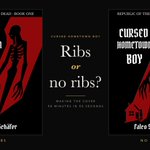
Final cover: Ribs or no Ribs? Poll below.
#HorrorArt #BookCoverDesign #GermanExpressionism


My co-founder @luke_ashford watched my AI shot and said one word: robotic. 🤖
He was right. I'd spent two weeks making the model follow the camera move, and forgot to ask what the shot is for.
So I stopped generating and wrote the rules first. Here's the visual bible for one scene: two men in a van, waiting for an ambush.
The order of priorities:
1. Performance, from a good script
2. Composition: framing, blocking, light, colour, lens
3. Camera movement. Last. It only earns its place once the first two are arguing.
The rules we landed on:
→ The van is a pressure chamber, not a cool apocalypse van.
→ Colour is ideology. Red belongs to the driver, who turns danger into performance. Teal belongs to the gunner, who turns it into procedure. When the two colours meet on the gun, their intentions are about to become one act.
→ Frame people through things. Door frames, the windscreen, a gun shield. We look at them through structures. They look out through compromised glass.
→ Keep one black wedge in every frame and never fill it. The viewer keeps checking the dark because the frame taught them to.
→ Don't cut when the action is complete. Cut when the viewer has started searching the darkness around it. The horror lives in that search.
→ A cut should change what we're allowed to see, never just magnify it.
→ Don't show the monster. Once the threat is visible, the frame can't accuse you of imagining it.
The one question the whole scene answers:
Who gets to see clearly, and who is being watched while they try?
My AI crew brainstormed this with me (you can work with them today. Link in bio). But they still couldn't tell me the shot was robotic. That part is the human's job.
📺 The first 7 minutes of the working session below.
Full 22-minute version on YouTube in the comments.👇
🎥 made in lean_art.
#AIfilmmaking #screenwritingtips #cinematography
🤖 Made with AI
Last week I wrote that restraint is the scariest special effect. A few of you said: show me what you mean.
So here it is. Two weeks on one shot of two men in a van, and it still isn't finished. My co-founder called it robotic. He was right.
This is me and my AI crew starting the visual bible for that scene. No explosions. One question:
Who gets to see clearly, and who is being watched while they try?
Full mini masterclass below. 👇
youtu.be/KqoJPpUl0OY

The first look behind the scenes for a heist shoot short film. Set built deliberately scarce to test how far we can push human and AI performances.
3 locations all within one grey room.
6 scenes shot in 6 hours.
A vault. A bank. A shootout with a getaway "car" filmed on a couch. Three actors.
The making of documentary coming soon. 👀😈
@SBabelsberg x @TheFunkatorium


I keep saying hybrid productions are the future.
When done right, you won't notice the difference.
I am on et today inside a grey room to create a demo short film to show what we can do with AI.
3 actors. A skeleton crew. And a script about a heist.
I am part of making the little documentary to show the making of. There's a few things you need to be aware of while filming to make it easier in post.


We offer Seedream 5.5 for free for all users of lean_art until 11.12 👀
It's a dream to work with. Pun intended. Go create something cool 😎
🔗 in bio
🚨 Seedream 5.5 is out!
I put Michael from my novel in a fringe jacket to test ByteDance's new image model. The room behind him didn't move.
The shot behind the wheel turned out cinematic af. For photorealism a real win imo.
Honestly impressed. The skin texture is really nice.
We are offering Seedream 5.5 for free in lean_art over the next 30 days. Come test it with us, break it if you can 😄
link in the comments 👇


I keep seeing the discussion on AI films lacking storytelling and relying too much on sensation and action.
I agree. But then I've learned the gift of restraint from 15 years of novel writing.
Nuremberg is great example. Nice individual shots, but it tells me zero about the quality of writing, nor why I should care about the characters and story.
What does the camera focus on?
What is said, wanted, and feared?
Make them contradict each other in gazes and body language. None of that is present.
Load objects (iconography) as layering subtext. Then mundane objects like a lighter, or keys can carry so much tension and impact on plot depending in whose hands they land.
We need more of that in AI film. I get visual fatigue and I am not impressed by high sci-fi content anymore. Give me a tense dinner scene that has me at the edge of my seat.
That's when you own and learned to weaponize the gaze of the viewer as well.
This? It won't age well.

For everyone asking what I mean by "weaponizing the gaze" and "less is more":
Here are the receipts. One location. One woman. One pair of headphones. Zero jump scares.
The movie loads the gun and never pulls the trigger by weaponizing genre conventions against the viewer. And it's the most tension filled 90 min on screen I've seen in a decade.
This is restraint doing the work. 👇
A 4K file isn’t automatically a 4K image.
We approved a 480p draft, then paid to regenerate it in 4K using that clip as the reference.
Same soft foliage. Same soft van. Two attempts at 19 seconds. $40 gone. 😭💸
The lesson: your reference can carry its softness into the next generation.
Before paying for the final:
Promote the original draft through its task ID, where supported. Regenerating from the exported clip is a different process.
Separate look from motion. Supply a sharp image for detail and the video for movement.
Test 5 seconds before buying 19.
Our check: downscale the “4K” to 480p, enlarge it again, compare. Virtually identical.
Ask before the expensive button: am I promoting the draft, or generating from its limitations?
🤖 Made with AI
Yesterday we showed the set we built in code.
Today we filmed it.
A camera test asks one question: does the move survive? Look how faithful it is 😍
Super 35, 90s feel. I really like the grain. It's what makes it look real. Plus, it fits the German gothic feel.
What's still missing: the light, which should be 15 to 20 minutes before dawn. The performances. The mic, and a few smaller things.
A shot like this would have cost a fortune to film. The previs was worth every bit of the effort.
🎥 First take with Seedance 2.5 480p.
📸 Environmental reference plate with Nano Banana.
🚨 Seedream 5.5 is out!
I put Michael from my novel in a fringe jacket to test ByteDance's new image model. The room behind him didn't move.
The shot behind the wheel turned out cinematic af. For photorealism a real win imo.
Honestly impressed. The skin texture is really nice.
We are offering Seedream 5.5 for free in lean_art over the next 30 days. Come test it with us, break it if you can 😄
link in the comments 👇

ByteDance just released Seedream 5.5.
We asked it to change one man's wardrobe twice. Same man, light & room.
It's in lean art now, and for the next 30 days it costs you nothing. Unlimited images.
Come break it with us 😈
lean-art.funkatorium.org


Yesterday we showed the set we built in code.
Today we filmed it.
A camera test asks one question: does the move survive? Look how faithful it is 😍
Super 35, 90s feel. I really like the grain. It's what makes it look real. Plus, it fits the German gothic feel.
What's still missing: the light, which should be 15 to 20 minutes before dawn. The performances. The mic, and a few smaller things.
A shot like this would have cost a fortune to film. The previs was worth every bit of the effort.
🎥 First take with Seedance 2.5 480p.
📸 Environmental reference plate with Nano Banana.

The whole Jensen scandal has a brought a wave of God tier memes and AI slopcore videos. It's gotten to the point where this has turned into pure entertainment.
I feel bad for the wife, but goddamn the content has been great 🤣

3
814
Blender?
Who is she? 😂
Three.js beats Blender any day for building 3D scenes in a web browser. Fast. Built within a few minutes.
Behind the scenes of our progress in the comments 👇🧵
In my novel Cursed Hometown Boy, a man sits in a cracked dentist chair welded to a steel arm in the back of a VW van, behind a German museum-piece MG3.
One pedal swings chair, gun and gunner out the side door like a sidecar, while the driver sings into a headset through a roof full of stolen amps.
German Gothic apocalypse tech. We're adapting the scene as a music video, because the song Grimm Rider is in the book.
The AI couldn't do it.
Image models have seen a million vans and a million guns, and never this. They gave us beautiful pictures of a machine that can't move, and the video models drifted from there. You can't prompt your way out of physics that isn't in the image.
So the set has to exist first. That's what we build lean_art for.
Blender was the obvious answer. But Blender is GPL: build it into your product and your product has to be open source too. So we wrote our own blocking tool. It's good for blocking. It ran out of road on a shot like this, where the mechanism has to follow real life physics.
We didn't want a pipeline where rebuilding a scene takes 45 minutes. We wanted minutes.
So we built the set in the browser with three.js and it beats Blender any day! One file, real metres, a collision solver.
The fix was in the book all along: turn the chair to the door, push it out, turn it back, lock. Tightest clearance: 4.5 cm.
What we learned: if a shot depends on something the models were never trained on, don't describe it. Build it, prove it works, and hand them a set that can't lie.
This is my first hybrid production (I will be playing both boys ha!). Code builds the set, AI films it. Next: the before and after.


Order Cursed Hometown Boy here
xitter.cf/falcothebard/status/21…
Good morning. Attendance is mandatory. 😈
The dead are the easy part. 🧟
Cursed Hometown Boy is a post-apocalyptic psychological horror dramedy. Queer longing, gallows humor, and tenderness with terrible timing.
Three people who can't stop wanting each other, one husky who wants snacks, and a hometown that's saved one of them a seat.
Love a thing and you'd die for it.
None of them has ever been good at math.
Out Halloween. 🎃
Pre-order on @AethrBooks and Kindle, with the paperback right behind it.
🔗 below

1
41