

posting animals that have gone extinct in the Holocene ~ no AI, all images Public Domain or Creative Commons
The 6th Mass Extinction
Joined September 2026
- Tweets92
- Following23
- Followers13.6K
- Likes194






Snail-Eating Coua
(Coua delalandei)
~ lived in: Île Sainte-Marie off the coast of Madagascar
~ cause of decline: complete deforestation of Île Sainte-Marie, over-hunting, decline of snails due to invasive rats
~ last record: 1834
~ status: extinct
📸: Nicolas Huet

SURVIVOR SUNDAY
The Hispaniolan solenodon (Solenodon paradoxus) is a venomous, nocturnal insectivore. It's also one of the last two endemic terrestrial mammals of Hispaniola.
In 1981, it was declared functionally extinct. Now it's Least Concern.
📸: Pedro Genaro Rodriguez
1/3

Solenodons are a unique family of mammals. 73 million years ago, they diverged from shrews, moles, and hedgehogs.
In the last 500 years, two solenodon species went extinct. Now there are just the Hispaniolan and Cuban solenodons.
📸: commons.wikimedia.org/wiki/F…
2/3


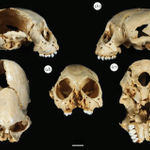
Hispaniola monkey
(Antillothrix bernensis)
~ lived in: Dominican Republic, Hispaniola
~ cause of decline: unknown
~ last record: c. 1850 BC
~ status: extinct
📸: First skull of Antillothrix bernensis, an extinct relict monkey from the Dominican Republic (Rosenberger et al)

Extinct Animal of the Day retweeted

No black-footed ferrets found in Meeteetse, 40 years after a rescue saved the species apnews.com/article/blackfoot…

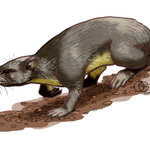
Marcano's Solenodon
(Solenodon marcanoi)
~ lived in: Dominican Republic
~ cause of decline: likely invasive rats; possibly deforestation and introduced cats and dogs
~ last record: after 1492
~ status: extinct
📸: Solenodon paradoxus (close relative), by Glover M. Allen

Gerson's Hispaniola Tortoise
(Chelonoidis gersoni)
~ lived in: Southern Hispaniola
~ cause of decline: overhunting
~ last record: ~8000 - 5800 BCE
~ status: extinct
📸: red-footed tortoise (close relative), by Wikimedia user H. Zell

Extinct Animal of the Day retweeted

Someone bring him back please


Hispaniolan Island-Shrew
(Nesophontes zamicrus)
~ lived in: Hispaniola
~ cause of decline: likely invasive rats
~ last record: 1400s
~ status: extinct
~ smallest known non-volant endemic Caribbean land mammal
📸: Nesophontes edithae (close relative), commons.wikimedia.org/wiki/F…

Haitian Woodcock
(Scolopax brachycarpa)
~ lived in: Haiti, possibly all of Hispaniola
~ cause of decline: unknown
~ last record: 400 - 1400 CE (possibly lived into the 18th century)
~ status: extinct
📸: Eurasian Woodcock (close relative), by JJ Harrison

Hispaniolan Four-lined Skink
(Spondylurus haitiae)
~ lived in: Jérémie, Haiti
~ cause of decline: invasive mongooses and rats, deforestation
~ last record: 1857–58
~ status: critically endangered, likely extinct
📸: Spondylurus nitidus (close relative), commons.wikimedia.org/wiki/F…

SURVIVOR SUNDAY
Ridgeway's Hawk
(Buteo ridgwayi)
Once found across Hispaniola, this hawk is now extirpated from 96% of its range
Fewer than 500 remain due to slash-and-burn deforestation and persecution, but their populations are now recovering
📸: Ron Knight

Ancient Gold Rim Swallowtail
(Battus polydamas antiquus)
~ lived in: Antigua
~ cause of decline: unknown
~ last record: 1770
~ status: extinct
📸: Dru Drury

Extinct Animal of the Day retweeted


Fun historical fact: dodo birds were shipped from Mauritius to menageries across the world. Including one possibly in Nagasaki Japan in 1647.
You know what this means? A samurai could have met a living dodo!


Wild Dromedary Camel
(Camelus dromedarius)
~ lived in: Arabian Peninsula
~ cause of decline: desertification, hunting, domestication
~ last record: 404 BC
~ status: extinct (domesticated and feral populations survive and thrive)
📸: Peter Dowley

Tunisian Barb
(Luciobarbus antinorii)
~ lived in: an artesian well in Chott el Djerid salt lake basin, southern Tunisia
~ cause of decline: drying of Chott el Djerid
~ last record: 1989
~ status: extinct
📸: Algerian Barb (closest relative), by Albert Boulenger

Indian Javan Rhinoceros
(Rhinoceros sondaicus inermis)
~ lived in: northeastern India, Bangladesh, and Myanmar
~ cause of decline: possibly habitat loss and hunting
~ last record: before 1925
~ status: extinct
📸: J. Wolf

Extinct Animal of the Day retweeted
A scary thought is all the species that have gone extinct in modern times that science never got to fully document.
With some cryptids perhaps being explained away by this. If true, the effects of anthropogenic changes could be far more severe than previously thought.


