

AI stocks + agents, through a trader's lens. What AI can actually do and what it means for the money.
Joined January 2024
- Tweets756
- Following273
- Followers82
- Likes108





Pinned Tweet
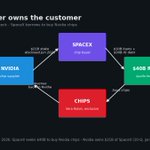
I think $SPCX is being misunderstood because investors are still looking at the individual businesses instead of the infrastructure stack being assembled.
The AI bottleneck is rapidly moving beyond GPUs.
It’s becoming:
POWER.
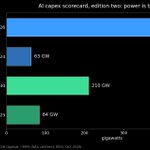
SpaceXAI is already operating around 1.4 GW of compute, and @elonmusk has discussed a path toward roughly 10 GW by the end of 2027.
Going from 1.4 → 10 GW in ~18 months is not a GPU procurement problem.
It’s an industrial infrastructure problem.
You need:
• turbines
• transformers
• substations
• power electronics
• cooling
• land
• transmission
• grid interconnects
• enormous construction capacity
And this is where the SpaceXAI combination gets extremely interesting.
Most AI companies wait on utilities.
SpaceXAI is increasingly saying:
We’ll build around the grid.
The Southaven/Memphis buildout includes a planned ~1.2 GW permanent natural-gas generation facility with 41 turbines, after already using large amounts of behind-the-meter mobile generation to accelerate Colossus.
That matters because gas turbine supply itself is becoming a bottleneck.
GE Vernova, Siemens Energy and others are seeing massive demand as hyperscalers suddenly realize that securing chips is useless if you can’t secure the electricity to run them.
So what is SpaceXAI actually assembling?
POWER
Behind-the-meter generation instead of waiting years for grid capacity.
COMPUTE
Potentially moving from ~1.4 GW toward ~10 GW.
GROK
Frontier intelligence.
CURSOR
Distribution directly into developers and enterprises.
@BOT
An autonomous labor layer capable of actually performing work.
X
Consumer distribution + enormous real-time information flow.
STARLINK
A global communications network.
SPACEX / STARSHIP
The launch infrastructure that creates an option almost nobody else has:
orbital compute.
And this is where the thesis gets really interesting.
Terrestrial AI eventually runs into physical constraints:
power availability
land
permitting
cooling
transmission
local grid capacity
Orbital compute is NOT the base case today.
It is the asymmetric option.
If Starship achieves sufficiently low launch costs and high flight cadence, SpaceX becomes one of the only companies on Earth that could realistically attempt large-scale compute infrastructure in orbit.
Solar energy is abundant in space.
Land and grid interconnection disappear as constraints.
The tradeoff becomes engineering:
mass
radiation
thermal rejection
servicing
latency
launch economics
Those are brutally difficult problems.
But they are exactly the kind of problems SpaceX has spent 20+ years learning how to solve.
That’s why I think people calling $SPCX a “rocket company” are missing the entire evolution of the business.
The long-term stack could become:
electrons → compute → models → agents → software → connectivity → launch → orbital infrastructure
Most companies rent several layers of that chain.
$SPCX is trying to own nearly all of it.
And THAT is the real global domination thesis.
Not Mars memes.
Not rockets.
Owning the physical infrastructure required to produce, distribute and eventually scale intelligence.
The risk is obvious: 10 GW is an insanely aggressive target, capex will be enormous, supply chains can bottleneck, and Starship/orbital compute timelines can slip badly.
But if they execute even reasonably close to the vision, I think today’s valuation could look completely detached from what this platform eventually becomes.
$SPCX
Neon now burns 12 percent less quota per task and finishes 17 percent faster. The agent race is quietly becoming a meter race. The model that wins is the one you can afford to leave running.

We've optimized the AGY harness even more in the new release.
On Neon, it now consumes 12% less quota per task and finishes tasks 17% faster!
We are relentlessly making Antigravity better, cheaper, and faster for our users.
More to come today 👀
16
Nobody doubted the demand. Dell doubled revenue and the stock still fell 12 percent on Tuesday. The $132 billion backlog is only worth what memory prices let it convert at.

$DELL TECHNOLOGIES Q3’27 EARNINGS HIGHLIGHTS
🔹 Revenue: $54.9B (Est. $49.32B) 🟢; +103% YoY
🔹 Adj. EPS: $9.45 (Est. $6.59) 🟢; +265% YoY
🔹 AI Orders: $60.2B
Raises FY27 Guide:
🔹 Revenue: $202.0B (Est. $194.48B) 🟢; from $192.0B
🔹 Adj. EPS: $29.68 (Est. $26.01) 🟢; from $25.50
Q4 Guide:
🔹 Revenue: $56.3B (Est. $53.61B) 🟢
🔹 Adj. EPS: $8.40 (Est. $7.50) 🟢
Other Q3 Metrics:
🔹 Cash Flow from Operations: $4.5B; +280% YoY
🔹 AI Backlog: $132.3B
🔹 AI Factory Customers: More than 7,500
Segment Net Revenue:
🔹 ISG: $42.0B; +198% YoY
🔹 AI-Optimized Servers: $22.0B; +291% YoY
🔹 Traditional Servers & Networking: $15.0B; +235% YoY
🔹 Storage: $4.9B; +24% YoY
🔹 CSG: $12.9B; +3% YoY
Capital Return:
🔹 Returned $4.9B to shareholders
🔹 Added $25.0B to repurchase authorization
Comments:
🔸 “We ended the quarter with a record $132.3 billion AI backlog after booking $60.2 billion of orders, each rigorously vetted for customer quality and access to capital, land and power.”

28
The agent economy has an identity problem before it has a scale problem. Fake agents probing for secrets grew 2,600% in six months, and nearly two in three of those visits impersonated Perplexity.

Bots Hide Behind AI Agent Names to Hunt for Secrets: Cequence found bots using AI agent names to probe for secrets as agents moved from reading to acting www.infosecurity-magazine.com/news/secrethunting-trafficai-agent/ #cybersecurity #infosec #hacking

27

Fully funded, sure. Oracle sold ten billion of stock at $116 and ten billion of debt at 7 to 8.65 percent to get there, and the stock closed Friday at $101.

Oracle has secured all the funding we need to fulfill our contract with OpenAI. With our final capital raise earlier this month, we became the first hyperscaler fully funded for this investment cycle. The financing we outlined at Oracle Investor Day, including vendor financing, is in place. Any further private discussions with vendors are just additional options. Our ability to deliver on our OpenAI contract does not depend on those discussions. Any media reports that will come out and say the contrary are incorrect and wrong.
Oracle and OpenAI are making rapid progress on our infrastructure partnership. Our Abilene campus, where Astra-6 was trained, is nearly complete. Shackelford, our next gigawatt-scale campus, is fully permitted. The handover of NVIDIA Vera Rubin racks in its data halls is on track for the coming weeks.
We continue to expect positive free cash flow in the second half of FY2028. We are targeting more than $30 billion in free cash flow in FY2029 and expect to self-fund future growth beginning that year.
39
Up 18.7% at the October high. Now down for the year. About $8.7 trillion gone since October 6, and the S&P just put in seven straight down days.

40
The loudest bear in the trade just took half his bet off. Burry sold 50% of his Nvidia and chip puts on Friday, after the worst week since 2008. When the short banks half, the crowded side is the short side.

Breaking: Michael Burry’s updated positions
He:
• Sold 50% Semiconductor ETF $SMH puts
• Sold 50% Nvidia $NVDA puts
• Sold 30% of Zoetis $ZTS calls
• Holding his Nasdaq 100 April 2027 puts
• Increased shares in MercadoLibre $MELI by 20%
Burry says this could be a signal of what’s to come if the market falls further


53
Anyway, the biggest IPO ever came within five cents of its own price on day two. Thursday it touched $115.10. Friday it touched $83.05. More than half the first-day gain, gone in one session.

Anthropic stock closed down 8.5% at $88.91 on its second day of trading, trimming gains from its $83 IPO price (Bloomberg)
(Visit Techmeme dot com for the link and full context!)
26

The biggest IPO ever did not save the tape either. Anthropic opened at $111.50, up 34% on its $83 price, and closed at $97.17. The Dow fell 1,100 points the same day. Only 38 stocks in the S&P rose.
1
26
I have been watching agents get cheaper to build and pricier to run. Microsoft will unveil a system at Ignite to cut what agents cost on Azure.

You're going to want to keep this tab open. 👀 Follow the Microsoft Ignite live blog starting November 17. #MSIgnite msft.it/6001xDgJJ

1
1
478
Anyway, six beats in eight prints, plus 6% on average, and the stock is sitting at its 52-week low. Tonight the margin and the guide do the talking.


43
The weights are open. The hardware is not. Meituan's sample setup runs on 194 Huawei Ascend chips, and the docs have no Nvidia path.

A 1.6-trillion-parameter AI model trained without a single Nvidia GPU. Meituan's LongCat-2.5 runs on Huawei Ascend chips, scores 88.4 on Terminal-Bench, and is open-weight under MIT. The AI hardware race just got a second lane.
1
1
58
Wall Street expects $109 billion. Nvidia guided $108 billion. The bar tomorrow is the street number, and the street already moved past the guide.

🚨 🇺🇲 Next week, Nvidia could absolutely crush earnings expectations on Tuesday and still see its stock collapse.
📊 Wall Street expects around $109 billion in third-quarter revenue representing 90% YoY growth followed by almost $125 billion in the fourth quarter. Absolutely insane numbers but how much longer its customers can afford to keep buying its GPUs ? Nvidia has become much more than a chip supplier as it's now actively financing parts of its own ecosystem through investments, financial guarantees, and massive supply commitments. Its latest financial filings revealed approximately $530 billion in commitments and exposures of various kinds, including $279 billion in supply and capacity commitments. Nvidia helps finance companies building data centers that ultimately purchase Nvidia's own GPUs. As long as capital keeps flowing, the machine works, but if these infrastructure investments fail to generate sufficient returns, the entire system becomes much more vulnerable.
➡️ Jensen Huang's departure changes many things. We're talking about a CEO who personally controlled an extraordinary number of Nvidia's strategic, commercial, and financial decisions. Colette Kress, now serving as interim CEO, had reportedly already pushed back against some of Huang's more aggressive financing initiatives. If she decides to scale back the guarantees and investments Nvidia provides to its partners, from a growth perspective, it could create serious problems. Less financing potentially means fewer data centers getting built, which means GPU orders being pushed further into the future, and all of this is happening while financing conditions are tightening, major technology companies are borrowing heavily, and the Democrats' takeover of Congress could introduce additional obstacles for certain infrastructure projects.
⚠️ The stock has already corrected significantly and the company continues to generate extraordinary amounts of cash. A strong quarter combined with reassuring guidance could easily trigger a violent relief rally. However, if Nvidia delivers exceptional results but starts talking about delayed projects, reduced visibility into 2027–2028, or a reassessment of its financial commitments, I would take that extremely seriously.
Next Tuesday will especially be about how long the company can sustain this kind of growth without having to help finance the demand for its own products.
*Bloomberg link: bloomberg.com/news/articles/…


31
Seen this movie before. OpenAI killed its robotics team for the second time. GPT-6 Astra runs the robot now, 74.8% on Nvidia's simulated test against 51% for the best specialist. The specialist team became overhead.

🚨 BREAKING: OpenAI has officially disbanded its robotics team, just five months after relaunching it
it’s over


49
Anthropic is raising $87 billion. It owes $901 billion for compute. The raise covers a tenth of the bill.

HERE IS EVERYTHING YOU NEED TO KNOW ABOUT ANTHROPIC HEADING INTO THE IPO
The IPO:
- Price range: $70 to $78 per share
- 825M shares for sale
- On top of the 825M shares Anthropic is selling $26B of stock to Google, Nvidia, AMD, Broadcom, Micron, Microsoft, and TSMC at the IPO price
- Anthropic is raising ~$87B at the $74 per share midpoint, more than SpaceX's record $86.2B IPO
- Ticker: $ANT on the Nasdaq
The valuation:
- Based on shares outstanding after the IPO: ~$916B to $1.02T
- Fully diluted (including options and unvested stock): ~$1.26T to $1.41T
The numbers (first 9 months of 2026):
- Revenue: $33.2B, ~13x a year ago
- Adjusted operating income: $4.08B (12% margin)
- GAAP operating loss: $1.26B
- Net loss: $104.0B, mostly from a $94.3B non-cash charge on convertible notes due to its valuation increase
- Cash and short-term investments: $131.8B, about $212.7B after the IPO
The customers:
- 11,900+ paying $100K+ a year
- 1,900+ paying $1M+ a year
- ~250 paying $10M+ a year
- Revenue per employee: $6.6M, up from $1.4M a year ago
The efficiency:
- Q3 revenue grew 1,127% from a year ago, while compute costs grew 382%
- Anthropic says Opus 5.5 cut customer costs per task by about 40% vs Opus 5
The spending:
- Anthropic has signed $900.9B worth of compute and infrastructure commitments
- $451.6B of that is expected before the end of 2030, and $70.7B is due in the next 12 months
Who controls Anthropic:
- The 7 co-founders hold one special share with 50.1% of the vote
- An independent trust elects a majority of the board
- Public shareholders get 1 vote per share
- Strategic partners like Google and Nvidia get no vote
The lockups:
- Most insiders can't sell for 180 days, and co-founders and large holders for 365 days
- But employees can sell up to 10% of their locked-up shares on the first day of trading
This was all taken from their IPO filing which came out today
AS ALWAYS
I will be posting all the major news around this IPO, so if you want to keep up with the news make sure you are following
@StockMKTNewz

ALT Photo Credit: Don Feria/AP Content Services for Anthropic
1
49
Third payer, the customer twice over. CoreWeave has about $9 billion in prepayments and deposits from its customers. The customers pay before the capacity exists.
1
17