

Official handle of evo India magazine; India's best enthusiast magazine!
India
Joined October 2011
- Tweets21.1K
- Following1.4K
- Followers17.7K
- Likes1.5K






Pinned Tweet
The cover story for issue 155 puts six 2010s performance icons to the test: McLaren 650S Spider, Porsche 911 Carrera GTS, Nissan GT-R, Alpine A110, Ford Fiesta ST200, and Renault Mégane 265 Cup — to answer the question of whether this was the decade that took everything too far, or the last era in which you could truly revel in a performance car. Closer to home, we rewind to2016-2020 — the half-decade that built India's modern car market. The Vitara Brezza broke the dam. The Venue brought a turbo GDI and an embedded SIM to the compact SUV segment. The Kia Seltos walked in with zero baggage and within months was outselling Toyota, Honda, and Renault with one model. The Jeep Compass, Tata Harrier, Mahindra Thar, Ford Endeavour, Audi Q8, and the Mercedes-Benz E-Class LWB — India becoming the first right-hand-drive market to get it — are all here.
Also in this issue: the Ferrari 849 Testarossa Spider, the Jaguar Type 01 prototype at Gaydon, the Mercedes-AMG E 53 Hybrid with the same power as the old E 63 S, the Norton Atlas in Iceland, and the Nissan Tekton on a 700km drive to Leh. First drives of the Maserati GranTurismo Trofeo, Range Rover Sport Electric, Tata Sierra EV, Toyota Hilux, Honda ZR-V, Mini Countryman C, Kia Syros EV, and Maruti Brezza Turbo.
All this and more in the 155th issue of the evo India mag-book, grab your copy here - evoindia.com/magazine

Nat-asp V8 legends. The cars and bikes that built modern India. That's Issue 154 of the evo India mag-book.
On the cover: the Audi RS4, BMW M3, Mercedes-AMG C 63 and Lexus IS F — four naturally aspirated V8 icons from an era we'll never see again.
We also revisit 2011–2015, the years that transformed Indian motoring. From the Renault Duster, Hyundai Creta, Ford EcoSport and Mahindra XUV500 to the Yamaha R15 V2, KTM Duke 390, Honda CBR250R, Pulsar NS200 and more.
Also inside:
• BMW X6 M60i
• Skoda Kodiaq RS
• Mercedes-Benz V-Class vs Toyota Vellfire
• Renault Duster Turbo 100
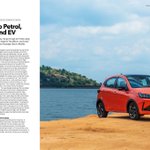
• Tata Tiago Petrol, iCNG & EV
• Triumph Tracker 400
• Bajaj Dominar & Pulsar NS400Z
• Kawasaki Teryx KRX 1000
• Volkswagen Golf GTI
…and much more.

Triumph Tracker 400
Distinct character, heritage sports styling, and a strong enough personality to differentiate itself from the Speed 400 it sits alongside. We find out if the Tracker makes sense at the money.


evo Eras: Cars of 2011–2015, India
The half-decade that changed how India drives — compact and mid-size SUVs arrived, luxury got accessible, one MPV proved Tata could design a world-class car while still not selling one, and through it all, the Alto continued to set sales charts on fire. Featuring the Maruti Suzuki Alto, Renault Duster, Hyundai Creta, Ford EcoSport, Mahindra XUV500, Tata Aria, Mitsubishi Pajero Sport, Audi Q3, BMW 1 Series, Volkswagen Passat, Mercedes-Benz GLA, and Honda Mobilio.

The cover story for issue 153 takes us back to 2006-2010, the years when India's car scene grew up — sedans went mainstream, hatchbacks went premium, and the first useable mid-size SUVs arrived. Editor Sirish Chandran navigates the cars of the decade, starting with the Volkswagen Polo, the car that not only redefined what a small car's road manners could be in India but also led directly to the creation of this magazine — without the Polo's rally programme, there's no evo India. Elsewhere there's the Mitsubishi Cedia that dominated INRC rally grids in wild N+ spec, the Abarth Grande Punto and the skunk-works engineering story behind it, the Honda Civic with its afterburner taillights, the Tata Nano's one-lakh-rupee promise, the Skoda Yeti that arrived years ahead of the mid-SUV boom, and more. Real owners of these cars — some still running them after a decade or two — share what it's been like to live with them.
As a companion to the India feature, evo Eras also looks back at the performance icons of 2000s UK — Murcielago, 997-gen 911, Audi R8, Golf GTI — plus the bikes that shaped Indian motorcycling between 2005 and 2010.

Former Red Bull power unit technician and pit crew member Calum Nicholas takes us inside the team's sub-two-second pitstops, what made Max Verstappen exceptional from the start, and the chaos of the 2021 Abu Dhabi Grand Prix from a perspective the cameras never showed
Order now: pages.razorpay.com/evoindia

AMG's flagship goes all-electric, with three axial-flux motors producing up to 1153bhp and a system that recreates the sound and feel of a V8 through speakers and seat-vibration motors. We break down what this radical overhaul means for the brand's combustion future
Order now: pages.razorpay.com/evoindia

A second facelift brings a light bar, a larger 10.1-inch screen, 360-degree camera and ventilated seats, but the underlying car remains unchanged. We find out if mild updates are enough to hold the line against the segment-leading Virtus
Order now: pages.razorpay.com/evoindia
