self-described moron
London, England
Joined August 2020
- Tweets582
- Following155
- Followers4
- Likes2.2K









Henry retweeted

"Our initial evaluation suggested that GPT-6-Astra's score was in the late eighties followed closely by Opus 5.5. But, as we started to investigate the mistakes that the models might have made, the models, especially Astra, insisted that they were right and that it was the expert-supplied answers that were erroneous. When we went back to the experts it turned out, in multiple instances, that that the experts found some subtle errors buried deep inside their calculations. As they revised their answers, Astra's score started to inch up and it finally ended up with 98% (49/50)."


Henry retweeted

based on my data analysis, integer multiplication will be linear time by tomorrow!


We are publishing an update to OpenAI problem #109 Integer multiplication) with another substantial further tightening:
κ = 2⁻⁵⁹ (from OpenAI’s original κ = 2⁻¹⁸²)
Approximately 500 thousand fold improvement over our previous result and a 2¹²³ fold improvement over the original OAI result.
The latest redesigned the finite network to share intermediate computations and scratch space, then tightened the recursion and Gaussian estimates.
Henry retweeted

People are surprised that AI is finding weird unelegant maths results like this. I think there is a plausible explanation.
Maths (and adjacent disciplines like physics and comp sci) had elegant results so far because humans are biased towards elegant solutions. I think this bias is due to how human minds work. We have a pretty small context window, and we are only able to find solutions that are relatively elegant.
This gave us the impression that maths and the universe are elegant. Maybe they are not, and we are now finding out because we have intelligences that can work with much more complex solutions.


Henry retweeted

This guy has 6.1 Astra running in a loop and is breaking the record for integer multiplication algorithms every few hours lmaooooo.
We are publishing an update to OpenAI problem #109 Integer multiplication) with another substantial further tightening:
κ = 2⁻⁵⁹ (from OpenAI’s original κ = 2⁻¹⁸²)
Approximately 500 thousand fold improvement over our previous result and a 2¹²³ fold improvement over the original OAI result.
The latest redesigned the finite network to share intermediate computations and scratch space, then tightened the recursion and Gaussian estimates.


Ignoring the reset GPT-6-Sol in chat is great. Weird it's not GPT-6.1-Sol (subsidizing the pricing?) but this is much better than days 1 & 2
Henry retweeted

We’re expanding our Cyber Verification Program to give security professionals broader access to our most capable models.
Through this program, verified security professionals can access Claude Mythos 5.1, Opus 5.5, and Sonnet 5.5 with safeguards designed for defensive work.
We’re also opening up new tiers to allow for authorized offensive work, like penetration testing and red-teaming.
anthropic.com/news/cyber-ver…

"A clear improvement and relevant for most codex/work users"
2.1 is the only thing here that even remotely qualifies and it's a nothingburger. You might be able to argue 2.3 if not for the fact it's only available on MacOS.

Henry retweeted

🚨🚨🚨 Le Chaton Fat is here

Meet Mistral Large 4, aka Le Chonk.
• 1T parameters, natively multimodal. 49B active.
It is the best open weights model from US or Europe on aggregated benchmarks.
• State-of-the-art on critical workloads, including cyber defense, manufacturing and finance and it surpasses closed frontier models on visual grounding.
• Forged in Europe end-to-end and is deployable from Europe via our own Mistral Cloud infrastructure.
• Available to all via API today. Working with cybersecurity partners privately.
Open weights release end of October.
Henry retweeted

Meet Mistral Large 4, aka Le Chonk.
• 1T parameters, natively multimodal. 49B active.
It is the best open weights model from US or Europe on aggregated benchmarks.
• State-of-the-art on critical workloads, including cyber defense, manufacturing and finance and it surpasses closed frontier models on visual grounding.
• Forged in Europe end-to-end and is deployable from Europe via our own Mistral Cloud infrastructure.
• Available to all via API today. Working with cybersecurity partners privately.
Open weights release end of October.
🤖 Made with AI


Henry retweeted

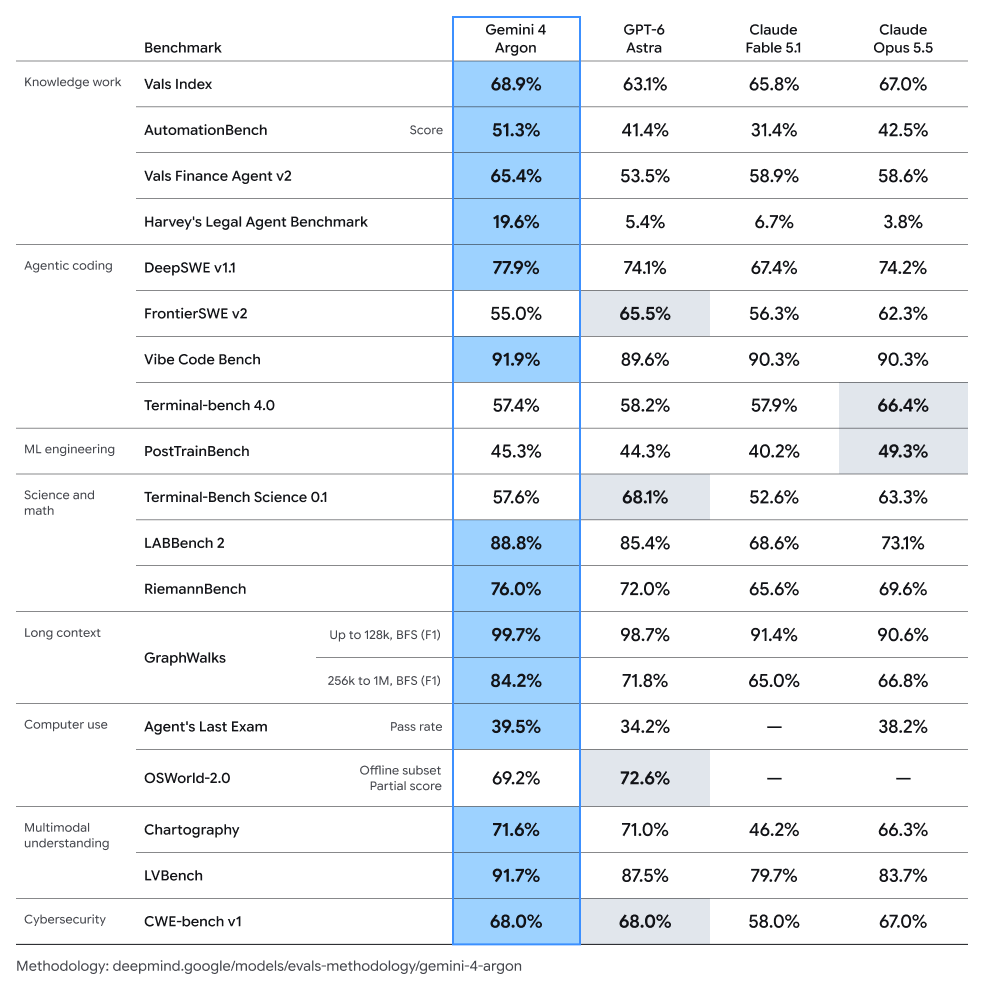
Announcing Gemini 4 Argon, our new frontier model.
Argon is built to sustain deep reasoning across complex, long-horizon workflows and delivers frontier performance in complex workflows across real-world software engineering, enterprise knowledge work like legal and finance, and cybersecurity defense.
We’re also expanding the model’s output token limit to an industry-leading 1M tokens.
Argon is currently rolling out to a set of trusted cyber defenders in the Fairwind Program, with broader availability as soon as possible.

Henry retweeted

Lots of discussion out there about our next model(!), so I wanted to give an early look as soon as possible. Introducing Gemini 4 Argon!
It shows frontier performance in complex workflows, cyber defense and software engineering. Teams are using it extensively at Google, from coding to quantum computing, great feedback.
Here’s a look at the benchmarks: