

Agents, AI systems and release gates, from inside the work. CTO and co-founder of @framebrightai. I build @goodqaapp. AI consulting at @Transition2ai.
Langford, BC
Joined July 2009
- Tweets1.6K
- Following2.6K
- Followers19.4K
- Likes49




Fast mode for Opus 4.8 goes away Nov 30. After that, Claude Code's changelog says fast mode requests on Opus 4.8 return an error and don't fall back to standard Opus 4.8. A removal with no fallback is an outage with a date on it. Check every pinned config and script now.

1
117
When one part of a system is known to be broken, every nearby symptom gets blamed on it. Agents do it too.
A review stalled for two hours. The known login error took the blame. The reviewer was fine and one resume fixed it.
State a cause only with the check that proves it.

118
My agent's computer-use clicks took 5 seconds each. The obvious fix was a push channel. Timed two ways, the split was clear: the server and desktop agent accounted for about 0.3 seconds. Queue delivery was 33 to 100 ms. Push would have saved under 0.1 s.
2
190
An AI account has several training switches. OpenAI's help page, updated in late October, said Daybreak sessions on personal accounts may be used to improve its models, for cyber safeguards, "even when 'Improve the model for everyone' is off." I check each switch by name.

111
Five agent steps at 95% each.
End to end: about 77 of 100 runs complete.
Every step looks fine. Almost a quarter of runs still fail.
So I check every step, not just the end.
Connect if you're scoping a multi-step flow.
1
1
142
Public boards are a shortlist; your eval is the decision. Fireworks' index ranks models per domain, no overall score, and says a purpose-built harness will typically beat its numbers. Top AutomationBench score as of Oct 28: 51.3%. I test on my workflow and keep the review gate.

1
130
A test that proves your code cannot loop is most dangerous when the guard is missing. Without its own cap and process group, one left about 49,000 orphans. Before I trust a test timeout, I check that it kills the whole process group, not one child.
1
180
Start from the KPI, not the model.
Write two labels first:
- the outcome that moves the number
- the outcome that must never happen
Those are your success and severe-error labels.
Connect and tell me where your team starts.
1
257
Your LLM judge agrees with humans 95% of the time.
Kappa: 0.26.
Almost everything passes, so most of that agreement is chance.
I check every judge against blind human labels first.
Tell me how you validate yours. Let's connect.
1
1
127
A step that passes 90% of the time feels solid.
Run it 8 times. All 8 pass about 43% of the time.
One check I always run on an agent step: consistency.
Connect if your team is measuring this.
1
119
Your eval is a point estimate wearing a suit.
49 of 50 reads as 98%.
The Wilson range runs 89.5% to 99.6%.
Gate on the 89.5. Not the 98.
Working through this? Connect and compare notes.
1
165
A typed-in test-count floor passes a run that silently lost 10 tests. I ratchet it instead: derive the floor, remember the best passing run, make lowering it a decision. #EricFieldNotes
2
2
146
Right-size each lane. Liquid's own benchmarks put its 1.7B open-weight LFM3 ahead of Qwen3.5-9B on WebArena-Verified, AutomationBench and BFCL V4, behind on MCP-Atlas, SWE-bench and long context. Triage gets a small local model. Coding escalates on a written, tested rule.

1
1
257
12 of 12 passed. The dashboard is green.
The textbook error bar says you're now certain the agent is perfect. The honest one says roughly 76 to 100 percent.
Twelve clean runs is consistent with an agent that fails one time in four.

1
139
A gate that has never failed proves nothing. Plant a known defect in a throwaway copy and require the gate to go red. If it stays green, block the release and fix the check. The full method is in my field notes: an eval that runs on every change.
1
228
Coding agents' self-reports run optimistic.
So completion is checked in order: git state and running processes first. Then hooks. Then nudges. Then a fresh closer instance. Then a sweep. Then a human.
Don't trust the agent's report. Check the artifact.

5
2
224
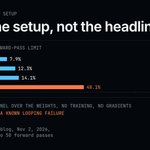
On Nov 2, 2026, a research blog reported a frontier model editing a small model's weights in a Python kernel, no training, lifting MATH-500 from 7.9% to 48.1% with 50 forward passes. At 10 and 25: 12.3%, 14.1%. Mostly it fixed a known looping failure. Setup first, then score.

1
3
208
