

Established by Dr. G. S. Gai in 1974, then Chief Epigraphist of Archaeological Survey of India, Mysore. Account maintained by @SK_epigraphist
Mysore, India
Joined November 2021
- Tweets149
- Following73
- Followers348
- Likes42


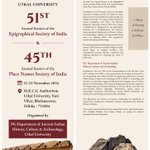



The 51st volume of Studies in Indian Epigraphy, is published and released today in the inaugural function of the 51st Annual Congress organised by the P. G. Department of Ancient Indian History Culture and Archaeology, Utkal University, Bhubaneswar, Odisha.

Inaugural Function of the 51st Annual Congress of ESI & 45th Annual Congress of PNSI organized by the P. G. Department of Ancient Indian History, Culture and Archaeology, Utkal University, Bhubaneswar, Odisha.


51st ESI & 45th PNSI ANNUAL CONGRESS, 2026*
*Dates:* 21st to 23rd November 2026
*Last date to submit papers and enroll as member:* 31st October 2026
*Venue:* Utkal University, Bhubaneswar, Odisha


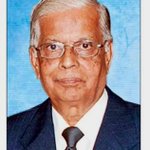
With profound grief, we share the sad news of the demise of Prof. C Somasundara Rao, a distinguished historian & epigraphist specialising in Andhra history, epigraphy, palaeography & numismatics.

He joined Andhra University’s Department of History & Archaeology in 1963 and became Professor in 1985.
He is a distinguished member of the Epigraphical Society of India and chaired its 35th Annual Congress in 2010 as General President.
1
2
51
Extremely sad to inform that Prof. A. V. Narasimha Murthy, is no more with us.
Prof. A. V. Narasimha Murthy, former HoD of Ancient Indian History & Archaeology, University of Mysore & one of the founder of the Epigraphical Society of India has attained his heavenly abode today.

It is in his chamber, in a discussion among eminent epigraphists, viz Prof A.K. Narain of BHU, Dr.G.S.Gai, Chief Epigraphist, ASI, Mysore & others such as Dr. K.G .Krishnan, Dr. K. V. Ramesh, etc., the Society took its birth in 1974.
1
3
73
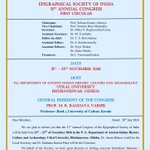
FIRST CIRCULAR 51st ESI & 45th PNSI Annual Congress
Dates: 21st to 23rd November 2026
Venue: Utkal University, Bhubaneswar, Odisha
Hosted by: P.G. Department of Ancient Indian History, Culture and Archaeology, Utkal University, Bhubaneswar, Odisha.


51st Annual Congress of the Epigraphical Society of India scheduled from 21st to 23rd November 2026
Hosted by: P.G. Department of Ancient Indian History, Culture and Archaeology, Utkal University, Bhubaneswar, Odisha.
Details will follow soon in the 1st and 2nd circulars.
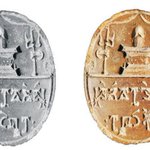
The inscription in Sanskrit & Brāhmī characters of 5th CE, reads _Devadāruvane Svāmi Koṭeśvaraḥ_, indicating a Śaiva temple dedicated to the deity Svāmi Koṭeśvara, situated at Devadāruvana (Forest of the Devadāru trees, i.e. _Cedrus deodara_, the Himalayan Cedar).


This seal can be regarded as the oldest inscriptional and artistic depiction of the legend of Śiva roaming in the Devadāru forest as described in _Skandapurāṇa_.
*Photo courtesy:* Françoise Mandeville, Hong Kong.
*For more details visit:*
persee.fr/doc/befeo_0336-151…
Found from Danesar Khera, U.P, it registers it's gift by
Mahādevī the queen of Śrī Harirāja born in the Gupta lineage. 6th c CE.
© The Trustees of the British Museum. Shared under a Creative Commons Attribution-NonCommercial-ShareAlike 4.0 International (CC BY-NC-SA 4.0) licence.


Click here to know more v britishmuseum.org/collection…

86
The Epigraphical Society of India retweeted

This is one of the earliest copper-plate inscriptions of the Thanjavur Maratha rulers. It records the donations granted to the Thyagaraja Swamy Temple for daily offerings, rituals, and Anna Dhaanam by King Shahuji Bhonsle in 1695 CE.
The endowment was entrusted to Abhisheka Pandaram, who was assigned the responsibility of administering and overseeing these expenditures.
The copper plate is artistically remarkable. At the top, it features a detailed diagram depicting Thyagaraja Swami and Kamalambha with Skanda seated between them in the form of Somaskanda Murti. Ganapathi and Murugan are represented on either side. Thyagaraja Swami is shown being worshipped by the revered sages Patanjali and Vyagrapatha.
Beneath this sacred panel appears a historically significant illustration of the three successive Maratha rulers of Thanjavur — Shahuji, Serfoji I, and Tukkoji. They are portrayed in a posture of reverence and prostration before Abhisheka Pandaram and his assistant, visually underscoring the temple’s central authority in sacred and administrative matters.
The inscription further records that the donation was formally made in the Devasriya Mandapam, in the presence of the devotees of Thiruvarur, and entrusted to Abhisheka Pandaram to execute the specified services and charitable activities.
This copper plate stands as yet another testimony to the Maratha rulers’ deep engagement with and patronage of Tamil sacred institutions. Far from being mere political successors, the Thanjavur Maratha kings actively upheld and sustained Tamil religious, cultural, and temple traditions.
(Pic courtesy : Thanjai Maratiyar Seppedugal - Tamil University)
#CopperPlateInscriptions


𝗗𝗮𝘁𝗲 & 𝗧𝗶𝗺𝗲: 16th January 2026 | 05:00 PM
𝗝𝗼𝗶𝗻 𝗭𝗼𝗼𝗺 𝗠𝗲𝗲𝘁𝗶𝗻𝗴: us06web.zoom.us/j/8584249944…
𝗠𝗲𝗲𝘁𝗶𝗻𝗴 𝗜𝗗: 858 4249 9447
𝗣𝗮𝘀𝘀𝗰𝗼𝗱𝗲: 669652

The Epigraphical Society of India retweeted

Cambridge University professor of Conservation Biology decided to attempt a Mesopotamian meal, as inscribed on a 3770 year-old recipe tablet containing humankind’s oldest surviving recipes. The tablet includes 25 recipes for stews, 21 meat stews and 4 vegetable stews. Now part of the collection of the Yale University Library...
The translated recipes, found in Ancient Mesopotamia Speaks: Highlights of the Yale Babylonian Collection, were “astonishingly terse” and “perplexing,” leading to some guess work with regard to onions and garlic.
In addition to 25 recipes, the book has photos and illustrations of various artifacts and essays that “present the ancient Near East in the light of present-day discussion of lived experiences, focusing on family life and love, education and scholarship, identity, crime and transgression, demons, and sickness.”
Kind of like a cradle of civilization Martha Stewart Living, just a bit less user friendly with regard to things like measurements, temperature, and cooking times. Which is not to say the instructions aren’t step-by-step:
Stew of Lamb
Meat is used.
You prepare water.
You add fat.
You add fine-grained salt, barley cakes, onion, Persian shallot, and milk.
You crush and add leek and garlic.
The meal, which required just a couple hours prep in Sutherland’s non-ancient kitchen sounds like something he might have ordered for delivery from one of Cambridge’s Near Eastern restaurants.
Only 2 of the 25 recipes in the collection are vegetarian (meat is not used). And even there, to be really authentic, you’d have to sauté everything in sheep fat.
© Yale University
#archaeohistories

