

Water | Railway | Hydrology | IITB | Monash University
Kampala | Mumbai | Melbourne
Joined November 2017
- Tweets7.3K
- Following1.6K
- Followers675
- Likes7.3K










Pinned Tweet
Memorable day.

The Engineers Registration Board has Registered the following Seventeen (17) applicants as ENGINEERS, and One (1) applicant as a TECHNICIAN, following approvals made at its 390th meeting held on 3rd July 2024.
Congratulations to the 18!
#RegisteredEngineers

1
3
308
Enock retweeted

Dear men,
Try this exercise first thing in the morning on an empty stomach and see the changes in your body. 💪 🔥


Enock retweeted

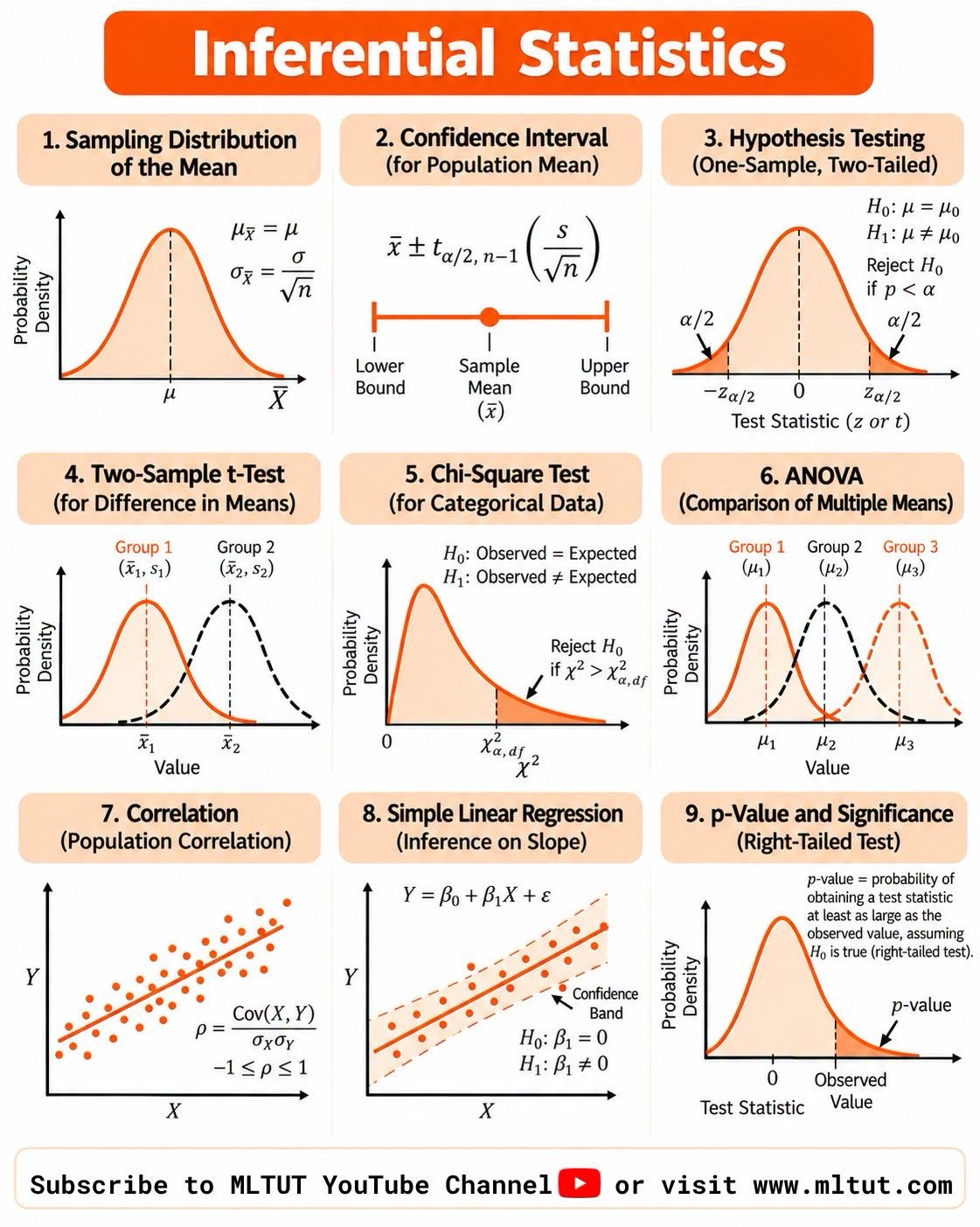
Some statistics, data analysis, and business analytics equations for your consideration.
Source: lnkd.in/p/e2ugMpxt


Enock retweeted

9 Essential ML Algorithms 🤖
① Naïve Bayes
② Perceptron
③ Linear Regression
④ K-Nearest Neighbors
⑤ Neural Networks
⑥ Principal Component Analysis
⑦ Support Vector Machine
⑧ Gradient Descent
⑨ Logistic Regression
Save this cheat sheet for your ML journey! 📌
#AI


Enock retweeted

A single artificial neuron does surprisingly little: a weighted sum, then one squashing function.
Three signals come in, each scaled by its own weight. The cell body adds them up with a bias, and the function decides what goes out the other side.
Watch the activation switch from sigmoid to tanh to ReLU. With ReLU, anything below zero simply doesn't fire.
Every number you see is worked out live as the weights drift.
Enock retweeted

Understanding probability is essential in data science.
In 4 minutes, I'll demolish your confusion.
Let's go!

Enock retweeted

Nine machine learning models, one formula each.
Linear regression fits a weighted sum by gradient descent. The perceptron wraps it in a sign function and nudges the weights toward each misclassified point. Logistic regression squashes it into a probability with the sigmoid.
KNN votes among the nearest points. PCA projects onto the top eigenvector of the covariance. An RBF SVM's boundary bends more as its kernel narrows.

Enock retweeted
Take a banked curve too fast and the car doesn't slide off the outside. It slides up the bank.
Friction is what holds it there. Go slow and friction points up the slope; go fast and it flips to point down. But it can only grip so hard.
On a 50 m bend banked at 20° with μ = 0.40, the limit is about 20.9 m/s. Watch the car pass it and drift up. Then the road goes flat (14.0 m/s), then loses its grip entirely (13.4 m/s).
Enock retweeted

NO FUNDING FOR PRIMARY RESEARCH? YOU CAN STILL START PUBLISHING
Original research is arguably very important. It generates new evidence and moves knowledge forward.
But you can start somewhere, especially if you currently lack research funding, laboratory facilities, access to participants, equipment or other research resources.
There are several legitimate papers you can publish without collecting new primary data.
Here are some of them 👇🏾
1. Letter to the Editor
This means different things across journals.
In some journals, it is a short reaction, critique, clarification or alternative interpretation of a recently published paper.
In others, it can be a short scholarly contribution on a timely or trending issue relevant to the journal.
Typical length: 300–1,000 words.
2. Commentary
A commentary discusses a recent paper, policy, event, controversy or development.
You may explain its significance, identify limitations, challenge an interpretation or discuss what researchers should consider next.
Typical length: 800–1,500 words.
3. Perspective or Opinion Piece
This allows you to present an evidence-supported position on an emerging issue, debate or future direction in your field.
It should still be grounded in credible literature. It is not simply your personal opinion.
Typical length: 1,000–2,500 words.
4. Editorial
An editorial is usually a short authoritative discussion of an important issue for a journal's audience.
However, many journals commission editorials from editors or invited experts, so always check whether unsolicited submissions are accepted.
Typical length: 800–1,500 words.
5. Narrative Review
You bring together existing studies to explain what is already known about a topic, where researchers disagree and what questions remain unanswered.
It is usually broader and less rigid than a systematic review.
Typical length: 3,000–6,000 words.
6. Scoping Review
A scoping review maps the available literature on a broad or emerging research question.
It can help identify major concepts, methods, types of evidence and important research gaps.
Typical length: 4,000–8,000 words.
7. Systematic Review
Here, you answer a specific research question using a predefined and transparent method for searching, selecting, assessing and synthesising existing studies.
You do not need to conduct a meta-analysis for every systematic review.
Typical length: 5,000–10,000 words.

Enock retweeted

Why does P(A|B) differ from P(B|A)?
Both are the same overlap, divided by different circles: P(A|B) = P(A∩B)/P(B) and P(B|A) = P(A∩B)/P(A). Bayes' rule P(B|A) = P(B)P(A|B)/P(A) just swaps the denominator.
Thomas Bayes never published it; Richard Price presented his essay to the Royal Society in 1763, after Bayes died.
Enock retweeted

I have created a useful template for your literature review matrix to make organising and synthesising research papers easier. It helps you compare studies, identify common themes, spot research gaps, and keep important information in one place.
Download the Excel file and edit it to suit your research topic and objectives. Feel free to share it with other researchers who may find it useful.👇🏽👇🏽
docs.google.com/spreadsheets…

Enock retweeted

A popular piece for everyone using QGIS and remote sensing data - 𝐂𝐨𝐩𝐞𝐫𝐧𝐢𝐜𝐮𝐬 𝐂𝐨𝐧𝐧𝐞𝐜𝐭 by @Copernicus EEA , a smart QGIS plugin allowing you easily to download, visualize, and explore Copernicus layers:
More: land.copernicus.eu/en/news/c…
𝐓𝐡𝐞 𝐍𝐞𝐰 𝐒𝐜𝐢𝐞𝐧𝐜𝐞 𝐨𝐟 𝐌𝐚𝐩𝐬 - thenewscienceofmaps.com/

Enock retweeted

Soil moisture more relevant than precipitation for shaping flood
If we want better flood forecasts, we must monitor soil moisture, from space and on the ground. 🛰️💧
Kimchi & Morin (2026) egusphere.copernicus.org/pre…

Enock retweeted
Data science is decided by its plots.
The KS statistic is the maximum vertical gap between two cumulative curves. SHAP assigns each feature an additive contribution to a prediction. The ROC traces true-positive against false-positive rate as the decision threshold sweeps from 0 to 1.
Elbow and silhouette mark the cluster count where within-cluster inertia flattens or average separation peaks. Bias squared declines while variance climbs with model complexity; total error reaches its minimum where the two curves balance.
Every curve is a compressed argument.
