

nyc
Joined November 2010
- Tweets3K
- Following754
- Followers4.7K
- Likes13.4K

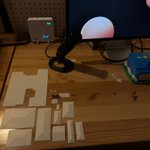




Workshopping a mini version of a house with the 3D printer.
Parts all made by my trusty @ChatGPT Dot.


I used Claude Opus 5.5 to design a little blueberry home for one of our Mac minis.
The phone is its face, so the enclosure needed a built-in stand. Getting there meant moving the phone so it didn’t block the Mac’s ports, changing the backrest to clear the camera bump, and figuring out how to print it with the filament I actually had.
I only had one 250g spool of blue left so I split the design into blue parts and separate green leaves and trim (leaf skirt), then I printed and assembled them on our Bambu H2S.
The tiny leaves went in with tweezers. They’re such a small detail, but they make the whole thing and it's so cute.

ALT A Bambu Lab 3D printer lays the first blue layers of the enclosure onto a textured build plate.

ALT The separately printed bright-green leaf-patterned trim rests on the printer bed before assembly. Raised veins decorate the tall leaves around its open center.

ALT Rear view of the assembled blue-purple Mac mini enclosure with green leaf trim. A round phone backrest and triangular brace support the landscape phone, leaving its camera cluster clear.
Emily Lambert retweeted

We used Opus 5.5 to design the "Bluey Box" and 3D print it on our @BambulabGlobal Printer. We used Opus 5.5 to build "Bluey" an iOS app + Desktop app that communicate with one another to give Bluey full control of my mac, powered by voice. Then we took some videos while we did all this... and we told Opus to make this cinematic video that you are watching now. @emilylambert (See more about the app below, it's open source)
Emily Lambert retweeted
Spent the entire weekend building.
Will be open sourcing all @agentnative_ projects.
5 videos next week as well.


Emily Lambert retweeted
Shout out to @zulali who built this AI powered TV from the 90s. He bought this old TV, gave it a raspberry pi, gave it a mic, a camera, and had it control codex through GPT Real Time. Probably the coolest gift anyone has given me.

In October I will begin making one video per week on hardware products. If you are building hardware that intersects with AI I want to hear from you.
I'll be getting into:
- 3D printing
- Smart Devices
- Mini Robots (Like the Microduck)
- The next Rabbit R1
- Running Local Models
- Smart Rings, Bracelets, Necklaces
- E Ink devices like the TRMNL
- And eventually humanoids
Huge bonus if they are open and fully customizable.
Astra was a huge eyeopener for me.
It made me want to use and build hardware.
Only the beginning for @agentnative_ and @agent_hardware...

Emily Lambert retweeted

How to build your own AI voice apps with GPT Live 1
In this video, @vishal_dubey built a Duolingo-style app that talks with you, saves vocabulary when you ask, and remembers words from an earlier session.
Overview:
> How GPT Live 1 and interaction models work
> Building the app in Vibecode without writing code
> Testing live conversation and memory
> How client delegation connects the voice model to the rest of the app
00:00 GPT Live 1 explained
01:00 Overview of interaction models
04:08 Inspiration for what we’re building
05:27 Building the app in Vibecode
07:11 Testing live conversation and memory
09:23 How client delegation helped us build this
Emily Lambert retweeted

Watch me build Grok bot using @vibecodeapp
Grok Bot is one of my favorite tools and I use it nearly every day for personal and work related tasks with over 8 bots.
I wanted to make this video to see if I could recreate it using @daytonaio @composio and @vibecodeapp , all powered by Claude Code as the agent runtime

Here's how you can build @bot From Scratch using Fable 5.1 in Vibecode
(Complete Guide)
In this video:
> Cloned Grokbot in 45 minutes w/ Claude Code as the agent
> Gave every agent its own computer + browser (Daytona)
> Added shared plugins: Gmail, Google Docs, 500+ tools (Composio)
> Built routines + triggers that fire when an email lands
> Deployed it live
Zero coding, built on the best vibecoding app: @vibecodeapp
00:00 Intro
00:11 The 4 Parts of Grokbot
01:28 The Stack (Vibecode, Daytona, Composio) + First Prompt
03:14 Building the UI + a Team of Bots
05:22 Agents That Create Other Agents
07:47 Every Bot Gets a Computer (Browser in the Container)
09:00 Check-in: 2 of 4 Parts Done
09:25 Shared Plugins: Connecting Composio
11:46 Plugins Working (Google Docs Test)
14:44 How Routines Work
16:26 Building Routines and Triggers
21:12 Recap: All 4 Parts Working
21:50 Deploying It Live on Vibecode
23:45 Final Thoughts
Emily Lambert retweeted

This post looks like the start of a VERY sophisticated and well-funded PR operation to get support for Democrats to regulate AI into oblivion. Let me show you how it works:
1.) This guy, with minimal followers and no previous account activity, goes to the Wall Street Journal which publishes an exclusive with quotes from him on his resignation 18 minutes BEFORE this post goes up. Planning was clearly done in advance.
2.) Within hours, it has tens of thousands of reposts and the account has 100k+ followers. The post is punchy, quotable, it almost seems professionally written. The first three accounts to quote tweet it all do so within 15 minutes of the initial posting. Remember, this account had basically zero engagement beforehand, so an organic reach explanation seems unlikely.
According to Grok those accounts are @_NathanCalvin (General Counsel at Encode AI), @peterwildeford (Head of Policy at the AI Policy Network), and @DKokotajlo (Head of the AI Futures Project), all of which are up-and-coming AI-Doomer policy advocacy nonprofits.
The AI Futures Project website says it is funded “primarily” by the Survival and Flourishing Fund, which says on its own website that it has advised Jaan Tallinn, Skype creator and one of the leading investors in Anthropic, to grant over $2.5 million to the AI Futures Project since 2024.
Encode AI says on its website that it is ALSO funded by the Survival and Flourishing Fund, which in turn says that it told Anthropic investor Jaan Tallinn to grant $516,000 to Encode AI in 2025.
And wouldn’t you know it, the Survival and Flourishing Fund ALSO says it told Jaan Tallinn to grant $2 million to the AI Policy Institute, the 501(c)(3) affiliate of the AI Policy Network, as well.
What are the odds that the first three quote tweets of Coxon’s post would all be major AI-restriction policy advocates funded generously by the same donor, who also happens to be one of the leading investors in, and a board member of, Anthropic, the company Coxon was resigning from? And all within 15 minutes of posting (two within ten)?
3.) Jacob Coxon doesn’t have much of a resume, but we do know that, in 2022, he got a $20,159 scholarship for the “long term future scholarship program” from the Good Ventures Foundation, one of the philanthropic vehicles of Dustin Moskovitz, a notorious AI-doomer who has spent tens if not hundreds of millions on policy advocacy to strictly regulate AI, while also being an Anthropic Investor himself.
It also just so happens that the 14th person to quote Coxon’s post was @MaxNadeau_ (27 minutes after posting) who is the program officer for the Technical AI Safety team at Coefficient Giving, another of Moskovitz’s philanthropic spending vehicles. Max is not a frequent poster, his last posts before quoting Coxon were before Labor Day, but he was remarkably quick off the mark for this one.
4.) Basically every major Democrat politician and candidate has suddenly glommed on to this post, and conveniently, as the people cry out foe answers, Bernie Sanders already has a bill written to “ban super intelligence” and regulate AI into oblivion, and will be releasing later this week. The bill, among many other things, will create “a new cabinet-level federal agency to safeguard the public from the dangers of artificial intelligence” that will be “advised by an Artificial Intelligence Advisory Board comprised of experts on artificial intelligence.” Do you think, perhaps, Anthropic and its many investors who fund AI policy advocacy might have interest in getting to place a pet “expert” on the board of an entity that dictates what AI is and isn’t allowed to do? And isn’t it fortuitous that this whistleblower came forward with his oh-so scary stories so close in proximity to the release of the most radical piece of AI legislation ever introduced?


