

computer programmer. https://xitter.cf/t.co/3XxStKIiMc https://xitter.cf/t.co/563Cj8CORd https://xitter.cf/t.co/sibsIaoNPV https://xitter.cf/t.co/NCaEROousK https://xitter.cf/t.co/0GELPOrG11
Vancouver, BC
Joined March 2007
- Tweets14.2K
- Following916
- Followers579
- Likes574





prompted a couple codex vibes too letter-lab-play.emh.chatgpt.… fractal-type.emh.chatgpt.sit…


Sol LeWitt, a pioneer of generative art before that was a thing created this library of instructions for drawing on walls. I had codex code up implementations of all of them here: lewitt-wall-drawing-studio.e…
but what if you wanted to write your own instructions? instruction-studio.emh.chatg…
had this idea - what if @p5xjs was ported to other languages like APL or Forth? p5-apl-field-studio.emh.chat… p5-forth-gesture-studio.emh.… - i think there is value in learning other programming paradigms and having a fun environment to explore them in would foster that...
thought logic programming would be another interesting paradigm to explore so here's p5.prolog: p5-prolog-constraint-studio.…
this is a great book nagamochishop.com/products/j… but screams for an interactive version - there are a few out there but none had the adjacent possible navigation i was looking for so i one-shotted this: iro-colour-discovery.emh.cha…
Reading “Information” by @JamesGleick and in chapter one he describes communication via drum and how with only two notes and a pause you lose fidelity - so to disambiguate you need to add context - could you make a game based on that idea? I tried: echo-drum-play.emh.chatgpt.s…
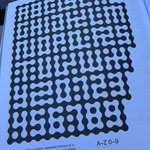
Saw an ad for this book on IG that let the reader play with moire patterns and I thought that would be a cool app - the clanker agreed:
moire-field-emh.emh.chatgpt.…
Do you think the clanker knows I’ve been drinking when the prompts get a little crazier and proper spelling/grammar is abandoned? Does it judge me?
codex vibe-coded me some demos utilizing various small specialized models that can run in a mobile web app local-tools.emh.chatgpt.site…
people are talking about how we're gonna get to mars but every conference call still starts with several rounds of "can you here me?"
playlin.io/game/anagramish/
My game got featured on playlin!

In 1945, Vannevar Bush described the future of photography as "The camera hound of the future wears on his forehead a lump a little larger than a walnut. It takes pictures 3 millimeters square, later to be projected or enlarged, which after all involves only a factor of 10 beyond present practice. The lens is of universal focus, down to any distance accommodated by the unaided eye, simply because it is of short focal length. There is a built-in photocell on the walnut such as we now have on at least one camera, which automatically adjusts exposure for a wide range of illumination. There is film in the walnut for a hundred exposure, and the spring for operating its shutter and shifting its film is wound once for all when the film clip is inserted. It produces its result in full color. It may well be stereoscopic, and record with spaced glass eyes, for striking improvements in stereoscopic technique are just around the corner. The cord which trips its shutter may reach down a man's sleeve within easy reach of his fingers. A quick squeeze, and the picture is taken. On a pair of ordinary glasses is a square of fine lines near the top of one lens, where it is out of the way of ordinary vision. When an object appears in that square, it is lined up for its picture. As the scientist of the future moves about the laboratory or the field, every time he looks at something worthy of the record, he trips the shutter and in it goes, without even an audible click"

source: web.mit.edu/sts.035/www/PDFs…
and all images produced by Gemini / NanoBanana2.

