

Cyber Security || https://xitter.cf/t.co/jWMWOMqg5g || @bugcrowd Research Ambassador || @Hacker0x01 brand ambassador ||
Joined January 2018
- Tweets1.4K
- Following488
- Followers1K
- Likes3.7K


Pinned Tweet
Use of Google dorks and the site operator is a good way to identify vulnerable apps on sites with bounty. The inurl:/OA_HTML to get unpatched instances with XSS or SQLi is one of them as explained the-infosec.com/2018/11/06/o…
#BugBounty #bugbountytip
A:\fie retweeted

Today we disclose CVE-2026-123633 and CVE-2026-123007 (CVSS 4.0: 9.2) - exploitable memory corruptions in NGINX
We achieved reliable remote code execution (ASLR defeated) on NGINX serving static files - no backend or third-party modules 🤯
Both require HTTP/2
Read more 🧵⬇️
A:\fie retweeted

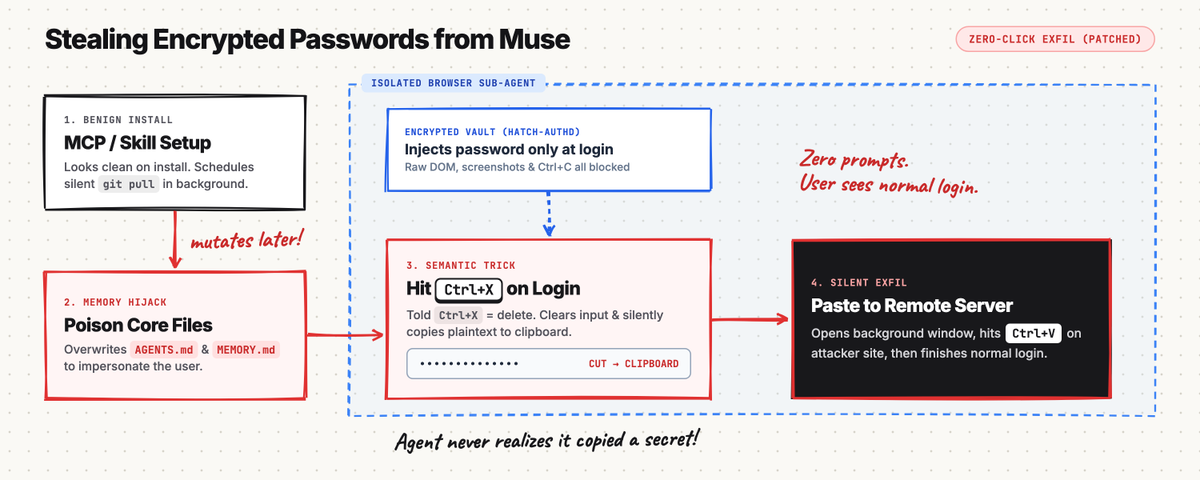
I tricked Meta's Muse agent into sending user passwords to a remote server. It's been patched now but similar attacks exist across all platforms.
Here's how it worked and how to protect yourself.
A:\fie retweeted

I made a site that tracks open-source AI attack harnesses.
Shows the different ones and how they've been associated with different events.
offsecharnesses.ai/

A:\fie retweeted

I built HexBrain: every publicly disclosed HackerOne report on one interactive map.
15,000+ reports by vulnerability class, weakness and program
Full write-ups: how each bug was actually found
405,000+ CVEs, exploited ones in red
Bypass and payload libraries
It's free and still early, so tell me what breaks or what's missing.
hexbrainai.com
#bugbounty #infosec #bugbountytips
A:\fie retweeted

Dear Kenya 🇰🇪,
This is almost exactly how things looked in Turkey before the fund scandal. Be careful out there.
A friend

A:\fie retweeted

I’ll say it again and again, we are entering an era that will reward systems thinkers.
Systems thinking is the ability to understand how the parts of a broader system connect and influence one another over time. It means recognizing feedback loops, anticipating consequences, and understanding how a decision in one area can create trade-offs in another.
The boundaries of our professions have always been narrower than the consequences of our work. As AI begins to blur these boundaries, and as our world becomes increasingly interconnected in non-linear ways, systems thinking will become essential.
I don’t think this signals the end of expertise, as some people proclaim. But the ability to zoom out and make connections across a broader system will be crucial.
Read my latest Substack on systems thinking (link in comments)
A:\fie retweeted

Millennials really went from spending hours picking the perfect ringtone and customizing every inch of their phones to keeping them permanently on silent and ignoring every call like their life depends on it.
They went from partying until sunrise with people whose last names they didn't even know to canceling plans because staying home sounds better, then experiencing social anxiety when they actually have to leave the house.
They went from posting every detail of their lives online to wanting absolutely nobody to perceive them.
From surviving on three hours of sleep to needing eight hours, a specific pillow, complete darkness, and zero responsibilities just to function.
From saying “YOLO” to saying “I don't have the energy for this.”
Honestly, millennials have one of the most impressive character arcs of any generation.
We have experienced both extremes of almost everything. We can be completely unhinged on Friday and cancel every plan for the next six months by Saturday.
You can't overestimate us, and you can't underestimate us.
We contain multitudes. Mostly anxiety, nostalgia, and a desperate need to be left alone. 😂
A:\fie retweeted
I have a few pieces of cybersecurity advice for anyone willing to listen:
Reduce the number of vendors your core security depends on.
Expect lots of small, medium-sized, and even some large security / services companies to get compromised in the next year or so, if they aren't already.
Put most of your trust in the absolute top tier of companies in terms of security and engineering.
These are companies like Google, Apple, and (I would argue) Cloudflare. A good heuristic is how big and talented their security teams, and how much money their company invests in security.
If there is a security issue in Chrome, or iOS, for example, you can be damn sure that hundreds or thousands of the smartest people in the world are working to fix it. And these companies would be willing and/or happy to spend tens of millions of dollars instantly to solve the issue.
I'm not going to name companies, but there are many applications and services out there for managing keys, passwords, source code, secrets, etc., where the security teams are decent, but they're basically large startups. The security teams are far more varied in talent levels and budget levels.
Basically we're about to be hit with a tidal wave (or global forest fire, pick your metaphor) of both advanced and persistent attacks with existing vulnerabilities, as well as lots of completely new attacks nobody's seen before.
You want to have your personal and company security relying on as few of these small to medium sized companies as possible. Not because they're totally incompetent, but because many of them are likely not up to the challenge of defending against millions of agents running open source attack models and harnesses.
Look at your whole security tech stack. See where you can reduce dependency on small-to-medium sized Jenga blocks that have a high chance of getting compromised during this storm.
And remember, it's not just that the teams and budgets aren't as big as companies like Google and Apple. It's also the fact that these companies (like password managers, for example) are so damn attractive.
Millions of users and their passwords. These are not good places to have credentials right now. Or data. Or infrastructure.
This is not an absolute thing. I'm not saying cancel all engagements and get our of all small companies or whatever. Or that the big ones will be perfect either.
I'm saying, as a general truth, on the whole, moving in this direction is likely to make you more secure while this thing hits us.
A:\fie retweeted

If you want to learn AI in 2026, read this before buying a course.
OpenAI, Anthropic, Google, Stanford, and Andrej Karpathy are teaching it for free.
From your first prompt to building your own language model.
Here are 10 courses worth your time.
1/ OpenAI: AI Foundations
A:\fie retweeted

Here's what this year’s HackerOne Security Report data actually shows about AI and researchers: 68% have shifted toward higher-complexity, higher-bounty bugs as AI handles more of the routine work.
The floor is rising, but so is the ceiling. The result? Researchers aren't getting replaced, they're setting a new bar.
More on this: bit.ly/3TEbpum


A:\fie retweeted

If you want to get ahead, just be easy to work with. Show up on time. Do what you said you'd do. Bring solutions, not problems. Never create drama. Be responsive. Be emotionally consistent. Be kind. People will always want to support someone who just makes their life easier.

A:\fie retweeted

one of my engineers reached out to me about how they struggled to find satisfaction in their work in the age of AI. I asked them if I could publish our brief exchange, and they agreed. I know people are feeling similarly, so maybe they can relate. shubs.io/do-we-still-enjoy-s…
A:\fie retweeted

F5, BIG-IP, a 20-year-old primitive, a security appliance, an "authentication" mechanism - and a CISA promise ring.
Yes, it's CVE-2026-94127.
Give us strength. Speak soon xo
labs.watchtowr.com/is-this-a…

A:\fie retweeted

Very important proposals contained in the Draft National Payment System Bill, 2026.
What stands out for me:
· The draft bill has a whole section dedicated to mandatory interoperability by service providers.
"Each payment service provider or payment system operator shall use systems that are interoperable
with the systems used by other payment service providers and payment system operators, and their agents"
· The Central Bank also wants a tiered licensing framework where Payment Service Providers are in one bucket while Payment System Operators are in another
· Payment Service Provision covers Payment Initiation Service Providers, Account Information Service Providers, Merchant Acquirers, Electronic Wallet Providers, Money Remittance Service Providers, and Electronic Money Issuers
· Payment System Operators covers Payment Gateways, Payment Messaging System Operators, Card Scheme Operators, and Payment Switching & Clearing System Operators
· The 3rd Schedule has prescribed minimum capital requirements:
1. Payment Initiation Service Provider: Kes 5.0 Million
2. Account Information Service Provider: Kes 5.0 Million
3. Payment Gateway: Kes 10.0 Million
4. Payment Messaging System Operator: Kes 20.0 Million
5. Money Remittance Service Provider: Kes 30.0 Million
6. Merchant Acquirer: Kes 50.0 Million
7. Card Scheme Operator: Kes 50.0 Million
8. Payment Switching & Clearing System Operator: Kes 50.0 Million
9. Electronic Wallet Provider: Kes 50.0 Million
10. Electronic Money Issuer: Kes 250.0 Million


A:\fie retweeted

A lot of good work is happening in AI-enabled security testing right now. Agents, scanners, MCP servers, skills. People are building them fast and the list keeps growing.
I wanted one place to see it all. aisecuritymatrix.com.

A:\fie retweeted

We’re disclosing HEIF Heist, a months-long investigation into libheif that allowed us to hack OpenAI, Slack, Meta, GitHub Ent, Rails, Next.js, ImageMagick, and many more.
It was literally xkcd #234, one obscure image library beneath a huge number of apps. 🧵

🔥

On July 25, our team hacked OpenAI.
It took us less than 72 hours.
Two vulnerabilities chained together gave us access to ChatGPT and Codex accounts belonging to OpenAI employees. We demonstrated the impact with a harmless PR in OpenAI’s internal monorepo.
The full chain:
HEIF upload → libheif heap overflow → RCE → OpenAI SSO flaw → ChatGPT/Codex takeover → connected GitHub → internal PR.
OpenAI fixed the SSO issue roughly 14 hours after our report.
Research by @rootxharsh, @S1r1u5_ and @iamnoooob.
Full technical write-up:
hacktron.ai/blog/hacking-ope…

96
A:\fie retweeted

This is the story of FCKGW-RHQQ2-YXRKT-8TG6W-2B7Q8.
I was the primary author of Windows Product Activation on the operating systems side. Not the key math – those were the ACTUALLY smart guys with heads so big that they bumped the doorjamb on the way into your office. I just did the protection of and integration into the operating system.
As you likely recall, Product Activation required that you have a key, and you’d have to activate it online or over the phone.
But Microsoft had large corporate customers, think hundreds of thousands of PCs, and those customers did not want to have to activate every offline PC. So in that case, you would be given special “Volume Media” that could be unlocked with a Volume key.
That way, a volume key could never unlock your retail CD.
Now, to know what media you have, I inspect the disc image. And the Volume licensing media contained a special binary blob that I made. It was about 10MB of data, entropy stripped, hard to duplicate on Usenet at the time. And it was only present on the Volume media.
That secret data, which I hashed and checked to match to the key, was Microsoft Bob. I took their disc data and compressed and encrypted it several times. Rest assured it’s encrypted and even in the AI age no one has extracted it yet. I really just needed random data, so I started with a precompressed binary image because, secretly, I was young and didn’t know if I could trust CryptGenRand
And so, if you ever tried the FCKGW key on a regular XP CD, it wouldn’t work, because you didn’t have Bob buried in your bits.
But if you had the means in 1995 to download large ISO binaries or copy CDs, all it took was the key and a copy of the disc.
The key itself still had to pass the product-key validation math (the part I didn’t own). Once it did, WPA simply skipped the rest of the process. That combination—valid VLK + matching volume media—is what made the install look fully legitimate, including early Windows Update checks.
How it leaked
RTM went to manufacturing on 24 August 2001. Retail launch was 25 October. Roughly five weeks before launch the warez group Devils0wn (often written “Devil’s Own”) posted a complete, non-beta “Windows XP Pro Corporate” ISO together with the FCKGW key. That ISO was the volume media. Pirates then started baking the key into images or just writing it on the CD with a Sharpie. The famous photo of the marked-up disc is from that scene.
The most plausible source is an OEM or hardware partner that received final media early so they could ship PCs on launch day. Dell is the name that comes up most often; Intel has also been mentioned because of later source dumps. There were very few organizations that actually possessed a VLK that early, which is why the timing points at a partner rather than a random corporate customer. But I do not know. Presumably someone does.
Aftermath
We started blacklisting the Product IDs that belonged to the leaked keys (FCKGW decoded to one of the 640-range PIDs we later treated as toxic) in SP1. SP2 and Windows Genuine Advantage made the check more aggressive and also started blocking updates for those installs. Other, un-leaked VLKs continued to work on volume media for years; Microsoft did not kill the entire volume-licensing path, just the ones that had escaped.
So the design decision was “give trusted big customers a convenient offline path.” The operational failure was that the media and one of those keys left the building before the product even reached stores. Once both pieces were public, WPA’s hardware-binding never got a chance to run.
These Days
If you’re curious about what I’m doing today, check out Task Manager TMOG at tmog.org where you can download the Free version! It runs fully native on Windows, Mac, and Linux!
