
Microbial Ecology and Genomics Alma maters: @AUC | @virginia_tech Postdocs: @UNCG | @NCState Also: @ITWorxHQ
Appalachia/Piedmont
Joined January 2010
- Tweets3.3K
- Following251
- Followers226
- Likes4.2K







Hazem Sharaf retweeted

Our latest set of phage-annotation tips are now published in a @PLOSCompBiol article: THIRTEEN QUICK TIPS!
journals.plos.org/ploscompbi…

Back in 2007 when I was working for @ITWorxHQ , a team was developing trading tools for @KnowledgeNet_KN They had a Reuters API live data access. This was my first exposure to the Saudi stock market. I always wanted to invest there compared to the smaller-sized Egyptian market.

ALT Saudi stock exchange 30 minutes before closing on 27th of October 2026.
Nearly all comments criticising this tweet by @robin_j_brooks are ignoring other directly related macro indicators like M2 and M3, foreign currency reserves, effect of regional events and the inherent structural issues of the Egyptian economy requiring perpetual EGP depreciation

The Egyptian Pound is falling. That's not a sign of weakness, but a sign of good policy. Oil prices are spiking as fears of another hot war build, so the weaker Pound is offsetting all of that. Egypt deserves huge kudos for letting the Pound float...
robinjbrooks.substack.com/p/…

Hazem Sharaf retweeted

The Egyptian Pound is falling. That's not a sign of weakness, but a sign of good policy. Oil prices are spiking as fears of another hot war build, so the weaker Pound is offsetting all of that. Egypt deserves huge kudos for letting the Pound float...
robinjbrooks.substack.com/p/…
I would love to see some nice Hollywood/Spielberg type production of that story even it is not true. I haven't seen good films in a while. The story in that tweet should be adapted for screenplay.

In 1941, a Spaniard walked into the British embassy in Madrid and offered to spy on the Nazis.
The British turned him down.
So he went to the Germans instead, pretended to be a loyal fascist, and got hired as a German spy. His plan was to lie to them for the rest of the war.
It worked better than anyone could have imagined.
His name was Juan Pujol García. Before the war he had tried his hand at running a chicken farm and a movie theater. He had no spy training. What he had was a deep hatred of both fascism and communism after the Spanish Civil War, and an incredible imagination.
The Germans gave him a codename, invisible ink, money, and orders to go to Britain and recruit spies.
He didn't go to Britain.
He went to Lisbon, Portugal, and made everything up.
Using a tourist guidebook, maps, magazines, newsreels, and a British railway timetable from the library, he wrote long, detailed reports about life in England. Military movements. Morale. Ports.
He'd never been there. He made mistakes. He didn't understand British money. He once reported that dockworkers in Glasgow would do anything for a liter of wine.
The Germans loved him anyway.
Then British codebreakers reading German messages noticed something strange. The Germans were hunting for a convoy that didn't exist, based on a report from some agent in Britain they'd never heard of.
The British went looking for this mystery spy. They found Pujol. In 1942 they finally took him on and brought him to London.
Now he had real help. MI5 gave him the codename Garbo, after the actress, because they thought he was the greatest actor in the world.
Together with his British handler, Pujol built a fake spy network for the Germans. It eventually had 27 imaginary agents. Each had a name, a personality, a job, and a backstory. A Welsh nationalist. A Venezuelan student. A Greek sailor. Some of them recruited their own imaginary sub-agents.
When they needed to explain why one agent had gone quiet, they killed him off. They even put a fake obituary in a Liverpool newspaper. The Germans reportedly paid a pension to his widow.
Who also didn't exist.
Then came D-Day.
Hours before the landings, the British let Pujol send a message warning the Germans that the invasion was coming in Normandy. It was timed so it would arrive too late to matter, but it made him look brilliant.
Three days later he sent the most important message of his career. Normandy was a trick, he said. The real invasion was still coming, at Calais, led by a huge army under General Patton.
That army was fake too. But the Germans believed him.
German forces that could have been rushed to Normandy were held back near Calais for weeks, waiting for an attack that never came.
The Germans were so grateful they awarded him the Iron Cross.
A few months later, King George VI made him a Member of the Order of the British Empire.
He's one of the only people known to have been decorated by both sides of the war.
After the war, afraid of revenge from surviving Nazis, he faked his own death from malaria in Africa and disappeared to Venezuela, where he lived quietly running a shop.
For decades the world thought he was dead.
In 1984, a British writer tracked him down. Pujol came back to Normandy for the 40th anniversary of D-Day and met veterans who had landed on the beaches.
Some of them thanked him.

Hazem Sharaf retweeted

Back in 1914, a family in Idaho stuck 53 cents worth of stamps on their 5-year-old daughter May's coat and mailed her to her grandparents' house 73 miles away. She rode in the mail car of the train, and the clerk on duty, who happened to be her mom's cousin, dropped her off at grandma's front door.
And it was completely legal, because nobody had thought to write a rule against mailing a kid.
Whatever the person ahead of you at the post office is trying to send, somebody tried something weirder a hundred years ago. That's pretty much how the whole rulebook got written.
May wasn't even the first. Parcel post launched in January 1913, and within weeks an Ohio couple handed their 8-month-old to a rural mail carrier, paid 15 cents in postage, and insured him for $50. He went to his grandmother's about a mile away. The Smithsonian's postal historian counted about seven kids mailed between 1913 and 1915. The Postmaster General banned it, and in 1920 the department had to put it in writing that a child doesn't count as a "harmless live animal."
The rules for what's actually allowed to be alive in the mail sit in a USPS document called Publication 52, and it reads like a list of things that went wrong at least once. You can mail live scorpions, but only if they're going to medical research or being used to make antivenin. Baby chicks are fine if they're less than 24 hours old and still in the hatchery's original box. Pheasants are allowed, but only April through August. Snakes and turtles are banned, period.
Somebody stood at a counter with every one of those before there was a rule.
There's also a reason it feels like you specifically always end up behind that person, and it's math. Say 9 out of 10 customers take two minutes, and the tenth takes 20 because the clerk has to go look something up. That one person is 10% of the customers, and she eats 53% of the clerk's time. So if you walk in at a random moment, the odds are better than a coin flip that she's the one at the window. Statisticians call this the inspection paradox. It's the same reason the bus always seems to take forever when you're the one waiting for it.
The internet made it worse. usps.com got 5.1 billion visits last fiscal year, and the online store sold about $419 million in stamps and supplies. Anybody with an easy errand prints a label at home now and just drops the box off. The people still waiting in line are mostly there for stuff a website can't handle, like customs forms, passports, certified mail, and boxes with air holes.
So next time the lady in front of you makes the clerk go look something up, cut her some slack. Her problem probably has a section number, and a hundred years ago somebody mailed a 5-year-old for 53 cents.

Hazem Sharaf retweeted

If you’ve visited Egypt, you know how annoying vendors and hustlers can be, especially in tourist areas. I consider it part of visiting a developing country, but I have to admit that Egypt takes it to another level.
Recently, though, my Instagram algorithm has been pushing videos of travel bloggers exploring parts of Cairo and Alexandria rarely visited by tourists. They go around offering huge sums of money for products worth mere pennies.
But the videos reveal a very different side of Egypt. Some vendors look startled and hesitate to accept the money. Others outright refuse it. With their almost nonexistent English, they keep repeating, “No, no.” And others even offered the product for free as a welcome gesture.
Honestly, it’s a side of Egypt I had forgotten still existed. Thanks to these travel bloggers, I’m reminded that it does.
Egypt appears 7 times in this map, 3x in Africa, 3x in Asia, and surprisingly, 1x in Europe. Egypt defeated Lithuania 10-0 in the 1924 Summer Olympics in Paris, France.
Personally, my worst defeat for Egypt was against Ghana in the 2014 World Cup qualifier, 6-1 in Accra!!

The Country Behind the Largest Ever Football (Soccer) Defeats for Each Country
brilliantmaps.com/football-d…

Updating R has always been a headache. Now I am forced to update from 4.2 to 4.6. I realised there was an incomplete attempt to update to 4.3 in August 2023! I usually update R when I started working on a new paper to lock in package versions. That dragged on for 3 manuscripts...

Hazem Sharaf retweeted

Here it is…my yearly picture of the same tree taken on October 20th 🍃🍁🍂 2020-2026
📸 Taken in Metuchen, New Jersey

Hazem Sharaf retweeted

Reflecting on my first year as an Assistant Professor of Economics at Seattle Pacific University, I am grateful for the growth, meaningful connections, and rewarding experiences this journey has brought.

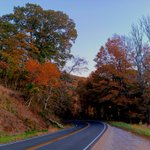
Just after leaving the lodge, many cars are stopping by the side of the road to take sunset pictures of the valleys below with the backdrop of beautiful fall foliage of the New River Valley and Blue Ridge mountains. The winding road (VA-700) down is also beautiful.

Just like most people, the first time I saw this pond was when I watched Dirty Dancing film back in the 1990s. First time in person was in May 2017 with the @VT_TPSC retreat at Mountain Lake Lodge. Yesterday was the first time I have seen it this full! Picture taken near sunset.

ALT Salt Pond Lake at Mountain lake lodge is filling up, with a backdrop of fall foliage. Picture taken on Saturday October 17th, 2026 at sunet (Pembroke, VA, about 4300 feet ASL).
I inadvertently did a radiational cooling experiment. I took this (indoor) thermometer with me to Bald Knob of Salt Pond Mountain (Mountain Lake Lodge). I forgot it above my car. Despite an air temperature of 0C, it got down to -5C. It was 1C by the time I took the picture!

So Blacksburg had its first freeze of the season this morning. Despite being in the USA for 10 years, I still use the metric system so my thermometer was saying 0C, but I like the Fahrenheit scale because of that, it was actually below freezing at 31F. @NWSBlacksburg official 30F

ALT Indoor/Outdoor thermometer (Acurite thermometer) showing the minimum stored temperature for the day of 31F (69F indoor). October 18th, 2026.
Had the pleasure of working with members of the Soybean Breeding Team and the Bo Zhang lab for my dissertation. I appreciate their help through out the years from the farm equipment and their lab at Latham Hall. Also sharing graduate student space at Smyth Hall basement.

The @virginia_tech Soybean Breeding and Genetics Team introduced children and their families to the amazing world of soybeans through an interactive presentation and hands-on activities at The Little Bookworm bookstore!

ALT Dr. Luciana Rosso speaking to families at the Little Bookworm Bookstore.

ALT The Virginia Tech Soybean Breeding and Genetics Team holding drawings at The Little Bookworm Bookstore.
Catching glimpses of my cousin's graduation from @YorkUniversity Liberal Arts & Professional Studies 2026 convocation. While I visited Canada several times, this is the first time I hear Anishinaabemowin, a native North American Algonquian language! youtu.be/oBv_TMFxvB4


Hazem Sharaf retweeted

Poor Mountain Natural Area Preserve is my favorite. Bottom Creek Gorge is good, any stretch of the AT. Mill Mountain trail system & Roanoke River Greenway if you're right in the city. McAfee Knob & Dragons Tooth are obvious choices, but each has less crowded adjacent options.
