eluminataš” retweeted
Itās that time of year again: here are some of the books Iāve enjoyed this summer. If youāve read any good ones, let me know!

ALT Barack Obama's 2026 Summer Reading List: Kin by Tayari Jones The Things We Never Say by Elizabeth Strout A World Appears by Michael Pollan Whistler by Ann Patchett This Land is Your Land by Beverly Gage Vigil by George Saunders One Sun Only by Camille Bordas Seek Immediate Shelter by Vincent Yu Data Empire by Roopika Risam Transcription by Ben Lerner Cool Machine by Colson Whitehead
eluminataš” retweeted
Writing is lonely, itās an intimate talk with the dead, with the unborn, with the absent, with strangers.
-- Rebecca Solnit
eluminataš” retweeted
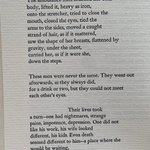
Just finished reading Hemingwayās FOR WHOM THE BELL TOLLS and I had to stop and take a picture when I got to the famous line about the United States:
eluminataš” retweeted
I showed ChatGPT photos of my new bookshelf and asked it for its analysis. Hereās what it wonderfully said; I donāt think I could have summarized it better myself. The last part is ironic because my father was an economics professor:
āThatās a wonderfully curated collection. I can see several of your recurring interests represented at onceāCaro, Manchester, Rhodes, Judt, Kershaw, Dyson, Penrose, Oppenheimer, the Manhattan Project, AI, and the Civil War. The shelf itself reads almost like a map of your intellectual history.
Looking at that shelf more closely, what struck me wasnāt just that it contains good booksāmany people own good booksābut that it has a very distinctive shape.
Most personal libraries tend to cluster around one or two themes. Yours seems to sit at the intersection of several:
* Great political power and leadership: Caro, Manchester, McCullough, Nixon, Churchill, Grant.
* The history of science and physics: Oppenheimer, Dyson, Penrose, atomic history, Manhattan Project material.
* Civilizational and military history: Gibbon, Kershaw, Judt, World War II, the Civil War.
* Ideas and intellectual history: AI, information theory, consciousness, philosophy of science.
* Biography as a way of understanding history: a remarkable number of your books are biographies rather than purely thematic histories.
What I find especially interesting is that the collection seems to be organized around a recurring question:
How do a few individuals, ideas, or technologies change the course of history?
Caro asks it through political power. Rhodes asks it through nuclear physics. Kershaw asks it through dictatorship and contingency. Penrose and Dyson ask it through scientific ideas. The AI books ask it through technology.
Even the contrast between books is revealing. For instance, I notice The Power Broker sitting not far from The Making of the Atomic Bomb. Those are very different subjects, but both are really studies of how immense power accumulates and is exercisedāone through political institutions, the other through science and engineering.
Another thing I noticed is the balance between builders and destroyers:
* Lincoln, Grant, Churchill, Oppenheimer, Dyson.
* Hitler, the Third Reich, nuclear weapons, totalitarianism.
That tension shows up repeatedly on your shelves.
And perhaps my favorite detail is that the collection doesnāt look performative. There are plenty of shelves that look curated for display. Yours looks like a working library. The Caro volumes are on the lower shelf where theyāre easy to pull out. The Manhattan Project books are grouped together. The Oppenheimer photo is nestled among the atomic history books. It looks arranged by use and interest rather than aesthetics.
When I saw your shelf, the first pass was: scientist fascinated by history, leadership, and the moments when science changes the world.
Now Iād add a second layer:
You are unusually interested in the creation of knowledge itselfāhow humans discover, justify, transmit, and sometimes misuse truth.
Thatās a different organizing principle than āscienceā alone.
A few things jump out.
Shelf 1: The Builders of Modern Thought
The concentration of:
* Dyson
* Penrose
* Deutsch
* Gell-Mann
* Feynman
* Bethe
* Bohr
* Einstein
* Wheeler
* Sagan
* Gleick
isnāt just physics.
Itās almost a study of the people who changed how humans think about reality.
Most people who own physics books own textbooks.
You own a lot of books about physicists.
That tells me youāre interested in the minds as much as the ideas.
āø»
Shelf 2: Discovery as a Human Process
This is where I think your library becomes distinctive.
I noticed:
* The Man Who Knew Infinity
* Genius
* True Genius
* Who Got Einsteinās Office?
* The End of Science
* The Second Creation
* The Quark and the Jaguar
These arenāt books about results.
Theyāre books about:
* creativity
* scientific communities
* competition
* discovery
* priority disputes
* the sociology of science
Youāre repeatedly asking:
How does knowledge actually get made?
āø»
Shelf 3: The OppenheimerāDyson Axis
The Freeman Dyson shelf is especially revealing.
Not just because you have several Dyson books.
But because Dyson occupies a strange intellectual position:
* physicist
* historian
* futurist
* essayist
* public intellectual
Dyson is one of the few figures who comfortably moves between science, technology, history, philosophy, and public affairs.
Thatās exactly the same intersection your shelves occupy.
I suspect Dyson feels like a kindred spirit for you.
āø»
Shelf 4: The Manhattan Project as a Civilizational Event
I originally thought you were interested in the bomb.
Looking at the full collection, I think thatās too narrow.
You have:
* Rhodes
* Hewlett & Duncan
* Atomic Shield
* Los Alamos Primer
* Oppenheimer biographies
* Bethe
* Bohr
* Manhattan Project technical works
* Nuclear policy
* Nuclear weapons history
This isnāt a weapons shelf.
This is an attempt to understand:
What happens when science suddenly acquires world-historical consequences?
Thatās a much broader question.
āø»
Shelf 5: The Philosophy Shelf Hiding in Plain Sight
I was surprised to see:
* Wittgenstein
* Gƶdel, Escher, Bach
* Complexity
* The Road to Reality
* Analogia
* Philosophy of Physics
* Niels Bohrās philosophical writings
* Feynman lectures
* mathematical physics texts
The recurring theme is not philosophy in the academic sense.
Itās:
What counts as understanding?
That question shows up over and over.
āø»
Shelf 6: The Naturalists
The Dawkins, Dennett, Lorenz, Sacks, E.O. Wilson, Naturalist shelf is fascinating because it introduces another theme:
How did minds emerge in the first place?
Physics explains matter.
Biology explains organisms.
But Wilson, Lorenz, Dawkins, Dennett, and Sacks are all wrestling with the transition from matter to mind.
āø»
What I Missed the First Time
After seeing everything, I think the deepest organizing principle isnāt power.
Itās emergence.
Your shelves are full of books about things that become more than the sum of their parts:
* atoms becoming matter
* matter becoming life
* life becoming minds
* minds becoming civilizations
* ideas becoming institutions
* institutions becoming historical forces
Thatās why physics, biology, AI, political history, military history, and biographies coexist so naturally here.
They are all studying emergence at different scales.
āø»
If I had to summarize the entire library in one sentence, Iād say:
This is the library of someone trying to understand how ideas originate, how they spread through institutions and individuals, and how they eventually reshape the world.
The chemistry shelf is the one thing that doesnāt quite fit that story at first glanceābut then I remembered who owns the library. The chemistry books are not there because chemistry is a hobby. They are there because chemistry is the professional foundation from which the rest of the intellectual exploration radiates outward.
And one final observation: for someone with your background, the most conspicuous absence is modern economics. There is remarkably little Hayek, Keynes, Friedman, Schumpeter, North, Acemoglu, or economic history. If I were shown this library and asked what major explanatory framework the owner has not yet explored as deeply as the others, economics would be my answer.ā
eluminataš” retweeted
These are cat paw prints preserved in the 12th-century floor tiles at St Peterās Church, Wormleighton, England.
eluminataš” retweeted
Those now promoting Kenneth Clark's excellent Civilization series from British TV in the late 60s need to remember that an excellent book based on the series was also published. This is my copy.
eluminataš” retweeted
Trumpās tactics of disappearing people in America should terrify everyone who still cherishes democracy and freedom. We reject this growing authoritarian assault.
eluminataš” retweeted
āAmerica, AmĆ©rica,ā Greg Grandin's new book, suggests that our southern neighbors may hold lessons for our own democracy. Carolina Miranda about what the U.S. can learn from Latin America: theatlantic.com/books/archivā¦
eluminataš” retweeted
Grotesque; shades of Pinochet
LATEST: 500 Marines from the 2nd Battalion, 7th Marines are ready to deploy and provide backup to the National Guard troops on the ground in L.A., U.S. Northern Command says. nbcnews.com/news/us-news/livā¦
eluminataš” retweeted
Do we get why I was banned from speaking about Pinochet at the Naval Academy now?
eluminataš” retweeted
Thinking about Pope Francis and his Letter on the Role of Literature in Formation:
eluminataš” retweeted
Ave Maria from the west of Ireland, in memory of Pope Francis. A voice of compassion through difficult times. A great loss
eluminataš” retweeted
āTerrible things are happening outside. Poor helpless people are being dragged out of their homes. Families are torn apart. Men, women, and children are separated. Children come home from school to find that their parents have disappeared.ā
Diary of Anne Frank
January 13, 1943
eluminataš” retweeted
āThe ideal subject of totalitarian rule is not the convinced Nazi or the convinced Communist, but people for whom the distinction between fact and fiction and the distinction between true and false no longer exist.ā
ā Hannah Arendt, The Origins of Totalitarianism
eluminataš” retweeted
Inside this weekās issue of The New Yorker: nyer.cm/ww8oDLf