

Ph.D. in Economics @PUCRioEconomia || monetary || so much to explore outside || views are only mine || RT is not endorsement || tweets in 🇧🇷🇬🇧
Rio de Janeiro, Brasil
Joined August 2009
- Tweets6.7K
- Following2.2K
- Followers3.3K
- Likes27.3K


Pinned Tweet
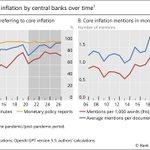
🧵 How do central banks actually communicate about core inflation?
In a new BIS Quarterly Review article, we use an LLM to read around 8,000 central bank publications from 24 economies since 2006.
Here are some of our findings 1/10

Eduardo Amaral retweeted

Formalized textbooks:
Dynamic Programming: Sargent & Stachurski (Vol 1 & 2); Stokey, Lucas & Prescott
Monetary: Gali (NK); Woodford (interest & prices); Cochrane (fiscal theory).
International: Obstfeld & Rogoff
500+ corrections (mostly tiny or typo)
github.com/LeanEconomics

Eduardo Amaral retweeted

How is AI improving time-series forecasting?
A brief presentation (in Spanish) on recent key developments (including work by @pablo_guerron and @ricco_giovanni)
Slides: galonuno.com/uploads/1/3/4/6…
Video: youtube.com/watch?v=dbD7h9mo…
RT @mileskimball: Today the paper I am most proud of in my whole career just came out as an NBER Working Paper. It took us a decade; all of…

Eduardo Amaral retweeted

Today's cool young researcher #econtwitter #econsky is @caterina_vieira @LSEEcon who works on topics related to development + urban economics

Eduardo Amaral retweeted

Food for thought!
"Inflation and Price Dispersion: New Cross-Sectoral and International Evidence" by Santiago Alvarez-Blaser.
"This paper investigates the relationship between price dispersion and inflation, shedding light on one major source of the cost of high inflation. By analyzing novel product-level web-scraped data from over 60,000 restaurants and supermarkets across 18 countries facing high and low inflation periods, I uncover new evidence of a significant positive correlation between inflation and price dispersion. My findings reveal that average annualized inflation, ranging between 0 and 20 percentage points across countries within a condensed time frame, is significantly associated with higher price dispersion in both the restaurant and the supermarket sectors. The estimates indicate that the marginal effect of suboptimal inflation on product-level distortions is positive, economically significant in all inflation environments and heterogeneous across sectors. Cross-sectionally, I find that as annualized inflation rises from 0% to 10% inefficient price dispersion is about 46% higher for supermarkets and 73% higher for restaurants. Lastly, the relationship between inflation and price dispersion does not flatten much at higher inflation, so that the marginal cost of additional inflation does not vanish as inflation rises – a pattern standard menu-cost models do not generate. This indicates a sustained impact of inflation on price dispersion, implying that accommodating higher inflation levels incurs substantial welfare costs."
bde.es/wbe/es/publicaciones/…

Eduardo Amaral retweeted

Yesterday, while celebrating the prize, I started thinking of the origins of the NK model again. One paper that came to mind was @mileskimball beautiful Neomonetarist model. What I did not know was that Mike wrote a comment on the paper, which is really amazing!

Eduardo Amaral retweeted

🚨 2026 Nobel Prize in Economics goes to Robert E. Hall and Michael Woodford 🚨
"for microfoundations of macroeconomic stabilisation"
Such a good macro prize. So happy to see Robert Hall, not mentioned as much as Woodford in this discourse

Eduardo Amaral retweeted

“They're probably hoping I'll cancel the exam.”
New laureate Michael Woodford was scheduled to be setting his economics students an exam today, when he was woken by a call from Stockholm at 4:30am. Woodford spoke to us about his feelings for his prize – and praised his co-laureate Robert E. Hall.
Listen to his first reactions.
Eduardo Amaral retweeted

Thrilled to see my PhD advisor Mike Woodford awarded the Nobel Prize (with Bob Hall). Mike's 2003 book, Interest and Prices, was a true paradigm shift in monetary economics. Bye-bye money supply, hello managing interest rate and inflation expectations.
share.google/YZtfsNlaWttP1eb…
A long-overdue Nobel for Hall and Woodford. But also for Wicksell, Calvo and Rotemberg. For inflation targeting, DSGEs, Dynare and cashless economies that anticipated a world of 🇧🇷Pix. A celebration of how economic theory has shaped our understanding and conduct of monetary policy.

BREAKING NEWS
The Royal Swedish Academy of Sciences has decided to award the 2026 Sveriges Riksbank Prize in Economic Sciences in Memory of Alfred Nobel to Robert E. Hall and Michael Woodford “for microeconomic foundations of macroeconomic stabilisation.”
#NobelPrize

Eduardo Amaral retweeted
BREAKING NEWS
The Royal Swedish Academy of Sciences has decided to award the 2026 Sveriges Riksbank Prize in Economic Sciences in Memory of Alfred Nobel to Robert E. Hall and Michael Woodford “for microeconomic foundations of macroeconomic stabilisation.”
#NobelPrize
Eduardo Amaral retweeted
Super interesting!
"Do Judges Move Markets? Ideological Shifts in the Supreme Court and Macroeconomic Expectations" by Thomas Drechsel and Naixin Zhang.
"This paper studies how judicial ideology shapes financial markets’ expectations about the macroeconomy. We use unexpected deaths of U.S. Supreme Court Justices as quasi-experimental shifts in the Court’s ideological balance. High-frequency asset price responses reveal how markets perceive the macroeconomic consequences of these ideological shifts. We find that a more conservative Court is associated with lower inflation expectations, lower real activity expectations, and lower bond yields. A shift towards a more liberal Court induces the opposite responses. The finding that inflation and activity expectations respond with the same sign suggests that markets revise their expectations about aggregate demand, rather than aggregate supply. Moreover, contrasting the yield responses with estimates from studies of fiscal policy news indicates that a more conservative (liberal) Court leads markets to expect tighter (looser) future fiscal policy. We validate our quasi-experimental setup with sectoral asset price dynamics, such as high-frequency responses of clean energy and health care stocks. Taken together, our findings are consistent with markets interpreting changes in the Supreme Court’s ideological composition as news about future fiscal expansions or contractions."
thomas-drechsel.com/papers/s…

Eduardo Amaral retweeted

We’re releasing a broad range of new mathematical results produced by an internal frontier model.
We’ve been consulting with the independent Advisory Group on Mathematics and Artificial Intelligence at the Institute for Advanced Study, and we have drawn on their advice and public recommendations to inform how we release these results.
github.com/openai/math

Eduardo Amaral retweeted
Super interesting!
"Chasing El Dorado: gold under shifting geopolitical and financial conditions" by Rafael Guerra and Gabriel Zelpo.
"This paper analyses the state-dependent effects of geopolitical risks on gold prices (i.e. the safe-haven role of gold), conditional on financial conditions. Geopolitical risks are often associated with tighter financial conditions. However, recent data reveal a decoupling be tween such shocks and more restrictive financial conditions, raising the question of how gold returns are affected by geopolitical shocks, conditional on the macro-financial environment. Using monthly data from 1990 to 2026, we find that increases in geopolitical risks– both geopolitical threats and realised events– increase gold returns, with stronger effects ob served during periods of loose financial conditions. We decompose this relationship into two mechanisms: (i) the credit and liquidity risk channel and (ii) the opportunity cost channel. Our findings indicate that the relationship operates most clearly through the first channel, suggesting that the key factor is investors’ capacity to rebalance, while the evidence for the second channel is less conclusive. Finally, we also find that the largest impact occurs when periods of loose financial conditions are compounded with periods of geopolitical escala tions, as seen in 2024–26. These insights highlight the relevance of understanding gold as a safe-haven asset amid complex macro-financial conditions."
bis.org/publications/working…

Eduardo Amaral retweeted
Super interesting!
"Debt Sustainability and the Range of Multiple Equilibria" by Olivier J. Blanchard, Pedro Martínez-Bruera, and Gonzalo Huertas.
"We characterize the size of the range of multiple equilibria in sovereign debt markets. We show that the nature of the equilibrium depends crucially on the degree of uncertainty, which we formalize first as uncertainty about primary balances and later as uncertainty about the fiscal feedback rule. For low uncertainty, the range can be large, but it becomes smaller as uncertainty becomes larger. If uncertainty is large enough, the multiplicity disappears: the interest rate is unique and becomes a continuous function of the debt level. The source of these results is that larger uncertainty decreases the effect of the perceived probability of default on the actual probability of default, thus reducing and eventually eliminating the scope for multiplicity. Interpreting the source of an increase in the interest rate in actual situations is difficult, and complicates the use of intervention by central banks."
nber.org/papers/w35850

Eduardo Amaral retweeted
Super interesting!
"Mind the Stance Gap: State-Dependent Filtering in the Federal Reserve Communications" by Alev Atak and Burçin Kısacıkoğlu.
"The Federal Reserve's public statements do not directly reflect the FOMC internal deliberations. The committee filters the message before releasing it, and the filter behaves differently when the policy rate is constrained. We formalize this two-stage filter and take it to data, comparing meeting-level monetary policy stance indices built from FOMC transcripts and post-meeting statements across 128 meetings from message leans somewhat more hawkish than the underlying deliberation, consistent with the Fed protecting its inflation-fighting credibility while conventional policy still has room to operate. At the effective lower bound, the sign flips, and statements turn substantially more dovish than the internal discussion. The reversal is not an artifact of forward guidance and quantitative easing language, and communication takes on a more direct role when the rate instrument is constrained. Using staff economic projections as an intermediate benchmark, we show that the regime-dependent shift stems from deliberation rather than public communication. We also show that the measured stance gap predicts later revisions in the Fed's statements because the FOMC initially communicates with a bias, and the statement gradually catches up to the internal view. Statement-based text measures are not transparent proxies for internal policy preferences, particularly across policy regimes, and Taylor rules estimated from public language overstate the Fed's sensititivity to inflation and unemployment."
drive.google.com/file/d/1YY9…
------------------------------------------
Central Bank Communication: Old and New Challenges
We are currently putting special emphasis on the topic of "Central Bank Communication: Old and New Challenges." High-quality research and policy papers, podcasts, and other relevant content will be featured across our channels. In addition to our own selections, we encourage you to submit your contributions via this form:
forms.cloud.microsoft/r/4pM5…

Eduardo Amaral retweeted

If AI raises the capital share of income, will workers ultimately benefit?
Recent analyses using a workhorse macro model concluded: YES.
I wrote a paper explaining why these conclusions are somewhat misleading. The future of wages might not be so rosy.
dropbox.com/scl/fi/28uq0gptp…


Eduardo Amaral retweeted

“Ekonomistlerin Bilmesi Gereken Makine Öğrenme Yöntemleri”
Susan Athey ve Guido W. Imbens
🔗annualreviews.org/content/jo…

Eduardo Amaral retweeted
Super interesting!
"Core inflation communication in practice" by Eduardo Amaral, Alejandrina Salcedo, Ilhyock Shim, and Mark A Wynne.
"Using a large language model to read central bank publications, we uncover patterns in how central banks communicate about core inflation. Two findings stand out. First, references to core inflation have become more frequent. This probably reflects its greater relevance when low and stable inflation means that headline movements are mostly driven by relative price changes, as in the pre-pandemic period. Second, the range of core inflation metrics cited has broadened. Central banks have avoided selecting a preferred gauge and instead relied on a suite of indicators to identify underlying price pressures. This expansion may introduce new communication challenges, as explaining additional measures can make messaging more complex."
bis.org/publications/qr-2026…
----------------------------
Central Bank Communication: Old and New Challenges
In the coming weeks, we will put a special focus on the topic of "Central Bank Communication: Old and New Challenges." High-quality research and policy papers, podcasts, and other relevant content will be featured across our channels. In addition to our own selections, we encourage you to submit your contributions via this form:
forms.cloud.microsoft/r/4pM5…

Eduardo Amaral retweeted

Over the past two decades, central banks have increased their mentions of core, or underlying, inflation and the suite of core inflation measures they communicate. Read the full article: bit.ly/4r4XTw7
#BISQuarterly