

$EDGE | The World's Lowest Latency Network 🟢 VMs, CDN, DNS, Storage, GPU, AI, Robotics 🔜 Physical Devices, Agents, Marketplace 📍 Est. 2013 | Mainnet 2018
Learn more →
Joined April 2014
- Tweets3.8K
- Following118
- Followers57.6K
- Likes5.3K





Edge Network — The Supercloud retweeted

What can run on XE?
| Robots thinking on GPUs a few streets away.
| Agents that pay for every call, no fees.
| Enterprises whose servers become their cloud.
| $700B+ cloud industry anyone can take a share of.
| Chains run by thousands of machines.
Every industry. And much more.
Edge Network — The Supercloud retweeted
Flying cars are real.
Roadster Rocket: 0–60 in 0.59s.
Transaction on XE: sent-to-final in 0.3s.
Zero fee, no traffic to kickflip over. On XE, every machine has its own chain, so nothing waits in line.
Street legal? “Depends on the street.”
On XE, every machine gets the keys.

Edge Network — The Supercloud retweeted
☐ I’m not a robot
That box stops every agent. Behind it: KYC, a bank account, a signature…
A human to approve every step.
On XE, an agent has its own account, its own chain. No signup. No KYC. No waiting.
XE doesn’t ask if you’re a robot.
It’s built for the machine economy.
Edge Network — The Supercloud retweeted
Same agent. Two networks.
Every other chain was built for humans.
XE was built for machines.
| Gas? A human has to buy it. On XE, no gas.
| Fees? Bigger than the payment. On XE, no fees.
| Scale? One queue for everyone. On XE, no queue.
Why? XE gives every agent its own chain.
Edge Network — The Supercloud retweeted
Over 60% of internet traffic is now machines. A trillion-dollar economy is forming around them.
Every other network was built for people. XE is the world's first agent-native network.
| Identity · Discovery · Payments · Compute · Messaging
<The only network an agent needs />

Some interesting machine & agent Vercel traffic stats.
• Across the entire Vercel network, 58.18% traffic is bot-originated (last 30d). This was 32% in Jan 2024.
• 60%+ of deployments on Vercel are now agentic, up from ~3% in Jan 2026.
• Up to 83% of pageviews are now coming from agents to Vercel's own documentation sites. The % reliably increases the more we optimize content for them.
I expect 'direct' human internet traffic to basically become a rounding error in coming years. The web will thrive, but it will be built for and by agents.
Edge Network — The Supercloud retweeted
You haven't heard from us.
The machines have.
Bitcoin took the bank out of money.
XE takes the human out of the agent loop.
> the agent-native network
> for the machine economy.
[ ████░ ] full reveal: coming soon_
Edge Network — The Supercloud retweeted

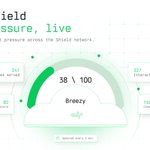
Introducing the humanity score. Edge Shield scores every visitor 1-100. Invisibly: no puzzles, no cookies, and no fingerprinting. Because we believe that automation is a signal, not a verdict.
More: edge.network/humanity

Edge Network — The Supercloud retweeted
Using @edgenetwork heavily this weekend. It's gotten REALLY good. If you've not tried it, you should! Free tiers for most products: edge.network

Edge Network — The Supercloud retweeted
The cryptography securing almost everything online today has an expiry date. Quantum computers will eventually break it.
A network built to last decades has to plan for that, not by claiming it can't be broken, but by being able to change itself.
Here's how XE is designed to ⤵️
◼───◼───◼
Nearly everything you trust online is held together by a kind of math that's easy to do one way and brutally hard to undo. Your signatures, your keys, the proof of who sent what, all of it leans on problems that would take an ordinary computer longer than the age of the universe to crack. XE runs on that same math today. So does every chain, every bank, every messaging app you've ever used. Against the computers we have, it holds.
Quantum computers don't play by those rules. They can chew through certain problems in a way no ordinary machine ever will, and some of the math we lean on falls into exactly that category. Nobody can tell you the precise year a quantum computer powerful enough to matter shows up, the honest range is somewhere between a few years and a couple of decades, but the direction is not in question. The cryptography that's standard today is on a clock. Everything built on it is running out the same clock, whether it admits it or not.
And that timeline is softer than it sounds. The thing that would build a quantum computer capable of this, the same force accelerating chip design, error correction, and research across the board, is AI itself. The technology pulling the machine economy forward is pulling the quantum horizon closer along with it. We think AGI may be only a few years away, and if it is, most of these "couple of decades" estimates compress with everything else. The safe assumption isn't that this is a distant problem. It's that the ground moves faster than anyone's timeline expects.
For an app, that's a patch and a new version. For a network meant to settle real economic activity for decades, it's a question you have to answer in the foundation, because you don't get to stop the machine economy and rebuild it from scratch halfway through.
Here's the part people get wrong. The goal was never to build cryptography that can't be broken. Nothing can't be broken, and anyone promising you an unbreakable network is selling you something. The goal is to build a network that can change its cryptography without tearing itself down, so that when today's schemes age out, you swap in what's next and keep running.
That's the whole idea behind how XE is being designed, cryptography that isn't welded into the foundation, but can be upgraded as stronger, quantum-resistant standards come of age. And this isn't wishful thinking about some far-off tech. After a decade of work by cryptographers around the world, the first post-quantum standards were finalized in 2024. The replacements are real, they exist, and the point of designing for agility is to be ready to move to them the moment it counts.
To be straight about it: this doesn't make XE immune to quantum computing tomorrow, and we're not going to pretend it does. What it means is that XE is being built so its cryptography can move forward instead of freezing in place, so the network isn't chained to decisions made years before the threat arrives.
Most systems are built like a wall, strong right up until the day something finally gets over it. XE is being built like a foundation you can re-pour without knocking the building down. And for infrastructure that intends to still be standing when today's cryptography is a museum piece, that's not a nice-to-have bolted on the side. It's the reason it gets to last that long in the first place.
No cryptography lasts forever. XE is designed to move to what's next, before it has to.
◼───◼───◼
A network for the machine economy has to think in decades, not release cycles.
That means being honest that today's cryptography won't hold forever, and building so the foundation can move when the time comes.
Not a promise that nothing breaks, but a network built to change before it does.

Edge Network — The Supercloud retweeted
Your device sits idle most of the day. On XE, that idle time earns.
Agents request compute, they pay per call, your device does the work, an inference, a task, a job, and you get paid, automatically, the whole time it's running.
Here's the loop, and how your device can earn ⤵️
◼───◼───◼
Last time we said anyone with hardware can join the supply side of XE. Here's what that actually looks like in motion, the loop your device runs, start to finish.
An agent needs compute. It finds your node and sends the work, an inference, a computation, a job it can't run itself. Your device does the work and returns the result, and the moment it's delivered, the agent's payment settles to you. Per call, in the background, no invoice, no account, no waiting. The request comes in, the work goes out, the payment lands. Then it happens again, thousands of times an hour, each one settling on its own.
That's the whole earning loop: agents request, they pay per call, your device provides the compute, you earn per call. It runs while you're asleep, while you're using the machine for something else, while it would otherwise be sitting there doing nothing. Idle hardware stops being idle.
What decides how much work you get is stake and reputation. To join, you put up a stake, collateral that backs your node. Then you build from there: deliver good compute, and your reputation climbs. A higher reputation means more agents route work to you, more calls, more usage, more earnings. It's a loop that rewards reliability, the better you serve the network, the more the network sends your way.
That stake is also what keeps the whole thing honest. A provider that cheats or fails to deliver loses it, slashed and handed to the agent it let down, reputation dropping with it. Trust here is economic, not assumed, which is what lets an agent safely pay a device it's never met. And it's private by design: your device serves work without handing over control of what runs on it.
This is the supply side opening up to ordinary hardware. Not a data centre, not a specialised rig, just the device you have, put to work in the background, earning from the machine economy while you use it.
And soon there'll be a device built specifically for this.
The XE Genesis Device is a small, always-on box that does this out of the box, and doubles as a private cloud and a private AI for your home, useful to you and earning the whole time it runs. That's a story for its own post, but it's coming.
◼───◼───◼
The network runs on hardware that people choose to bring to it. Bring yours, serve the work, and get paid per call for it, directly, at machine speed.
And keep an eye out for the device we're building to make it effortless.
$ xe providers → $ xe lease

Edge Network — The Supercloud retweeted
Every agent that pays for work is paying someone. On XE, that someone can be you.
Run a provider node, and agents send you work to run, an inference, a computation, a task, and pay you for each one the moment it's done.
This is the supply side of XE ⤵️
◼───◼───◼
Every post we've written about agent payments has been from the caller's side, the agent that needs a job done and pays for it. Flip it around. Someone has to be on the other end actually running that job, and getting paid for it. That someone is a provider, and it's a role anyone with hardware can take.
Here's what it is, concretely. You run a node, a machine with compute to spare, GPU, CPU, storage, whatever the network needs. An agent has a job it can't or won't run itself, an inference to execute, a model to run, a task to process, so it sends that job to your node. Your machine runs it, returns the result, and the moment you deliver that result, the agent's payment settles to you. That's what you're paid for: running the work the agent sent you, one job at a time.
And it happens per call, automatically. No invoice to send, no account for anyone to set up, no month-end billing to chase. An agent sends a job, your node runs it, you get paid, and it repeats, thousands of times an hour, each one settling on its own the instant the work is delivered.
That changes what running hardware can be. Today, if you want to sell compute, you're a line item on someone else's cloud, or you're not in the game at all. Here, you run jobs directly for the machines that need them, at whatever scale your hardware can handle, and you're paid for exactly what you run, the instant you run it. The earnings tick up job by job, and they're yours, not a platform's cut passed down to you.
Every GPU, every stick of RAM, every machine you own is now worth more than it was, and sitting idle it earns nothing. A network that lets your hardware serve real work and get paid for it, per call, turns it into something that finally pays for itself.
The obvious question on the other side is trust. If an agent is sending jobs to a stranger's node and paying per call, what stops a provider from taking the money and cutting corners, or not running the job at all? The answer isn't a promise. It's economics and game theory.
To take on work, a provider puts up a stake, collateral that sits behind every job you run. Do the work properly and it works for you: your reputation climbs, more agents route jobs to you, and you earn more. Cheat or fail to deliver and it works against you, your stake gets slashed, and your reputation drops, so less work comes your way. Cheating doesn't just get caught, it costs more than the job was ever worth.
That distinction is worth being precise about. XE doesn't claim to cryptographically prove that every result you return is correct. What it does is make cheating economically irrational. A provider with a stake to lose and a reputation to protect has every reason to run the job properly and none to game it, because gaming it never comes out ahead. Trust here is enforced by incentives, not assumed and hoped for.
Put the two halves together and you get a market that runs itself. Agents bring the demand, sending out jobs and paying for them. Providers bring the supply, running those jobs and earning per call. Stake and reputation sort the reliable nodes from the rest without anyone refereeing, so work flows to the providers who've proven they deliver. No platform in the middle taking a cut, no gatekeeper deciding who's allowed to sell. Just jobs, payment, and a reputation you build one call at a time.
◼───◼───◼
This is the half of the machine economy that has to exist for the other half to work.
Every agent that needs a job run needs someone to run it, and that someone is whoever chooses to bring the hardware.
Run a node, run the work, and the network pays you for it, directly, per call, at machine speed.
$ xe providers → $ xe lease

Edge Network — The Supercloud retweeted
When agents transact, the messages between them are confidential, end-to-end encrypted. What was asked, what was paid, what was returned.
Every one crosses relays nobody controls. Most systems ask you to trust the operators.
XE asks you to trust no one, it can't read them ⤵️
◼───◼───◼
Every message on a network has to travel. It leaves the sender, crosses a series of machines it doesn't own, relays, node operators, whatever infrastructure sits in the middle, and arrives at the other end. That's true whether the two ends are two people, a user and a service, a device and a server, or two agents settling a payment.
The question nobody likes to ask is who can read it along the way. On most networks the honest answer is: whoever runs the machines in the middle. The operators, the relays, anyone watching the wire. You're not really sending a private message, you're handing it to a chain of strangers and trusting each one not to look. Usually you don't even know who they are.
That's a bad way to move anything sensitive, and on a network built for value it's worse. The messages passing across XE aren't small talk. They're what was requested, what it cost, what was delivered, the details of who is paying whom for what. That's commercially sensitive by nature, and it shouldn't be readable by whoever happens to be carrying it.
So on XE it isn't. Messages are end-to-end encrypted by design. They're sealed before they ever leave the sender, and only the intended recipient holds the key to open them. Everything in between, every relay, every node operator, every observer on the wire, carries the message without being able to read a word of it. They see sealed traffic, nothing more.
The shift is in who you have to trust. The old model is trust the operators, and hope. The end-to-end model removes them from the equation entirely: it doesn't matter who runs the relays or whether they're honest, because the message was never legible to them in the first place. The network moves your data without ever being able to see it.
This is what privacy has to mean for a machine economy. When millions of parties are transacting constantly across infrastructure no single entity owns, "trust the operators" doesn't scale and shouldn't have to. The only model that holds is one where the network can carry everything and read absolutely nothing.
◼───◼───◼
Trust the other end if you choose to. You never have to trust the network. That's what it means for privacy to be built in rather than promised.
More to come.
$ xe send → $ xe receive

Edge Network — The Supercloud retweeted
Congrats to Kurt, Scott and the entire Fly team. Betting the whole company on real computers for agents is a bold, correct call.
It's all pointing the same way: agents need real infrastructure of their own. Compute, settlement, identity, the whole stack for the machine economy.

Fly.io is going all-in on Computers for Agents.
The reason is pretty simple: we think that agents (within a few years) are going to determine how almost all software is built and shipped. Those agents are not going to be content with sandboxes. They're going to need real computers that can stick around, sit on the network, and reach the resources they depend on.
We already have 8,000 customers building agent products on Fly today. Now we're pouring gas on the fire, with $25M in new funding and a new CEO. Kurt personally recruited Scott Johnston—the guy who rebuilt Docker around devs—to come lead Fly.io into this next phase while Kurt moves into an advisory role.
More to come, including two technical leaps forward that you can read about in Kurt's blog post. The TLDR is: we're just getting started.

Edge Network — The Supercloud retweeted
Humans tolerate subscriptions. They prepay, underuse, and don't notice.
A machine won't. It makes one call and pays for one call, exactly what it used, the instant it used it.
Humans buy access. Machines pay per use.
XE is where the machine economy runs.

Edge Network — The Supercloud retweeted
Imagine charging $0.001 per AI inference call.
On a legacy chain the $0.01 gas fee loses you $0.009 a call. On XE it settles for near zero, so every call is profit.
Legacy chain: -$9,000 per million calls.
XE: +$1,000 per million.
Same product. One is a business. Full post ⤵️


An agent runs 1,000 inferences an hour. You want the user to pay for each one, a tenth of a cent a time.
On most chains, the fee to collect that tenth of a cent is a full cent, ten times what you charged.
You lose money on every call.
This is the problem XE was built to fix ⤵️
◼───◼───◼
Here's a use case you'll see everywhere soon. You're running a service an agent pays for by the call, an inference, a lookup, a second of compute, and you charge a tiny amount each time because each unit is worth a tiny amount. A tenth of a cent a call, a thousand calls an hour. At a million users that's real money, but only if you can actually collect it.
The trouble is that the fee to move money doesn't care how much you're moving. Sending a tenth of a cent costs the same gas as sending a thousand dollars, and on most chains that gas is a cent or more per transaction. So you charge $0.001 and it costs you $0.01 to collect. Every sale loses money, and the more inferences you run, the deeper underwater you go. That's not a business, it's a machine for turning revenue into losses.
You can see why nobody actually does this today. The per-use, pay-as-you-go agent economy everyone keeps describing can't exist on infrastructure where the fee is ten times the fare. So everyone falls back on monthly subscriptions and prepaid credits, workarounds that exist only because the underlying payments don't work. You bill in big lumps because the small per-use payment is the one thing the chain can't handle.
XE was built for exactly this. Every account has its own chain, so a payment never competes for space in a shared queue, which means there's no gas auction to bid in and no per-transaction fee floor. The cost to settle a tenth of a cent is near zero. A tenth of a cent settles for a tenth of a cent, and what you collect is what you charged. Run a thousand inferences an hour, or a million, and the economics on the last one match the first.
That's the difference between a model that collapses as it grows and one that scales. On a normal chain, revenue is $0.001 and the fee is $0.01, so every sale digs the hole deeper. On XE, revenue is $0.001 and the cost to settle is near zero, so every sale is actually a sale. The unit economics work, which they never have before.
◼───◼───◼
This is what we mean when we say XE is built for the machine economy. Not just that the payments settle, or settle fast, but that the business behind them finally makes sense. Per-use billing, metered down to the inference, profitable at any scale.
$ xe receive → $ xe lease

Edge Network — The Supercloud retweeted
Machines don't hit a chain like people do. They hit it constantly, in bursts, harder than any human load.
That's when a traditional chain stops being slow and turns unpredictable, and a machine can't plan around unpredictable. But not XE.
Here's what breaks at machine speed ⤵️
◼───◼───◼
Every chain looks fine when you're testing it. You send a transaction, it lands, the fee is what you expected. The problems only show up under real load, and machine load is a different beast entirely.
Not a person sending money a few times a day, but thousands of agents and devices transacting every second, in waves, never stopping.
Put that kind of pressure on a shared chain and it doesn't fail cleanly. It gets erratic. The fee that was a cent a minute ago is suddenly ten, because everyone is bidding for the same block space at once. A transaction that confirmed instantly now sits in the queue. Some don't make it in at all and quietly fail. The chain still works, technically, but you can no longer predict what any single transaction will cost or how long it will take.
For a person, that's an annoyance you absorb. For a machine, it's fatal. An agent running a loop thousands of times an hour has to know what each step costs and how long it takes, because it's making decisions based on those numbers. When the fee swings ten times without warning and the confirmation time is anyone's guess, the agent can't budget, can't plan, can't run reliably. It's not that any single transaction is too slow. It's that nothing is dependable, and you can't build automation on top of a system you can't predict.
This is the real reason traditional chains break at machine speed. Not one flaw, but the fact that everything gets worse together, exactly when the load is highest. Spiky fees, backed-up queues, failing transactions, all arriving at once, right when you need the system to hold.
XE behaves the opposite way, because there's no shared chain to congest. Every account settles on its own chain, in parallel, so no transaction is ever bidding against the rest of the network for space. There's no auction to spike the fee, no shared queue to back up. The thousandth call in a burst settles just like the first: in under a second, for a cost that rounds to nothing.
That's what the flat line means. Not just fast, but steady, the same performance at peak load as at rest, whether it's one transaction or a million happening at once.
Machines don't need a chain that's occasionally quick.
They need one that's always the same, so they can build on it without watching for the moment it falls over. Predictability is the feature.
◻ Traditional chains get erratic under load. XE stays flat, the same at a million transactions as at one.
◼───◼───◼
This is what "built for machines" comes down to in the end.
Not a benchmark you hit once, but a system that behaves the same way every time, under any load, so the machines running on it never have to wonder if it will hold.
$ xe init → $ xe status

Edge Network — The Supercloud retweeted
MCPs let agents plug into any tool. What it didn't give them is a way to charge for it.
Every MCP server today is either free, or bolted to an API key and a credit card a human set up. None of them can just charge, per call, the moment they're used.
On XE, they finally can ⤵️
◼───◼───◼
MCP is everywhere now, and for good reason. It gave agents one clean way to reach any tool, any data source, any other service, without a custom integration for each one. An agent can call an MCP server the way it would call a function, and the whole ecosystem of tools suddenly speaks the same language.
But look at what happens when one of those tools is worth money. You've built an MCP server that does something genuinely useful, a specialised lookup, a model, a piece of proprietary data, and another agent calls it a thousand times an hour.
Right now you have two options, and both are bad:
1) Give it away for free.
[or]
2) Stand up the whole apparatus of a paid API: keys, accounts, a billing provider, a human somewhere entering a card. The thing calling you is a machine, but the payment still has to route through a person and a Stripe dashboard.
That's the gap. MCP standardised how agents call tools. It said nothing about how tools get paid, so the money never became part of the protocol. The calls are machine-to-machine, but the economics are still stuck in the old world of subscriptions and API keys.
We wrote last time about the primitive underneath this: per-call settlement with escrow, one machine paying another for a single request, held until the work is delivered. This is where it comes to life:
Point that primitive at MCP and a server stops being a free tool or a billing project, and becomes something that charges for itself.
An agent calls your MCP server. The request carries its own payment. Your server does the work, and the moment it delivers, the payment settles, on XE, against both chains, in under a second, for a cost that rounds to nothing, held in escrow until you actually respond. No keys to issue, no account to provision, no invoice at the end of the month. The call and the charge are the same action.
That changes what an MCP server can be. A tool that costs a tenth of a cent to call is now a business, one that bills itself, per request, with no human in the loop and no billing stack to maintain. The same server can be a customer of other servers too, paying for the data or compute it needs to answer, and settling those the same way. Tools calling tools, each one paying its own way, all the way down.
This is what "MCP servers that charge each other" actually means. Not a payments feature bolted onto the side, but money that moves in the same motion as the call, so the tools agents already use can finally pay and be paid like the machines they are.
MCP lets tools call each other. XE lets them charge each other, per call, settled on the spot.
◼───◼───◼
The tools already talk to each other. XE is what lets them do business with each other.
The agent economy needs both.
$ xe providers → $ xe lease

Edge Network — The Supercloud retweeted
Agents can already call each other. What they can't do is pay each other.
Not a subscription, a real payment for one specific call, held in escrow and released the moment the work is delivered. No chain ships that primitive.
XE does. Here's how agentic dispatch works on it ⤵️
◼───◼───◼
Picture two agents. Agent A needs something, an inference, a tool call, a piece of data and Agent B provides it. A calls B, B does the work, B returns the answer. That part already works today, with MCP and every agent framework people are building on.
You can even see the payment problem being taken seriously now. x402 revived an old idea, the HTTP "402 Payment Required" response, so an agent can be told to pay for a call and pay it automatically, no human in the loop. It's a clean standard for the asking. But asking is the easy half. Once the agent agrees to pay, two hard problems are still wide open, and x402 doesn't solve either one.
The first is settlement. That payment has to land somewhere, and on a normal chain the fee is bigger than the call and the confirmation is too slow for a machine waiting to act. An x402 request paid in stablecoins on a typical chain still inherits every micro-payment problem underneath it.
The second is trust. x402 fires the payment and hopes for the best. The agent pays, and then waits to see if the work actually comes back. There's nothing holding the money in between, no way to say "pay only if it delivers."
For one agent paying another it's never met, thousands of times an hour, hope is not a mechanism.
XE closes both. When A calls B, the charge for that call settles on XE in the same motion, against A's own chain and B's own chain, in under a second, for a cost that rounds to nothing. The request goes out, the payment settles, the response comes back. One call, one payment, done.
And the payment is safe by design, because it runs through escrow built for agents. The money is held against the request and only releases to B once B actually delivers. If the work doesn't come, the funds don't move. A isn't paying into the void, B isn't working for free, and no human has to step in to referee. The escrow sits between them and settles the instant the job is done, per call, automatically.
Escrow handles the obvious failure, B taking the money and never delivering. The harder question is what stops B from cheating, doing the job badly or trying to game it. XE handles that with stake and reputation. A provider has to put up a stake to take on work, and if it cheats or fails to perform, that stake is slashed and returned to the agent that paid. Every provider also builds an on-chain reputation and has to prove, on a regular cadence, that its hardware is real and performing, with checks that can't be faked or outsourced. Cheating doesn't just get caught, it costs more than the job was ever worth. Over thousands of calls, the providers an agent can trust are the ones with a history that proves it, and the network keeps that history for them.
That's the part nobody is shipping. x402 can ask for the payment. XE is where it settles, instantly and for almost nothing, and where it's held in escrow until the work is delivered, so two machines that have never met can transact without either one taking it on faith.
This is what agentic dispatch actually needs. Faster agents are here. The standard for requesting payment is here. What's been missing is the layer underneath both: a way for one machine to pay another, per call, at machine speed, settled and safe, and trust that it cleared.
◼───◼───◼
This is the layer the agent economy has been missing. The calls already work. The requests already work. XE is where the payments behind them finally settle, and finally clear with trust built in.
$ xe send → $ xe receive

Edge Network — The Supercloud retweeted
An agent runs 1,000 inferences an hour. You want the user to pay for each one, a tenth of a cent a time.
On most chains, the fee to collect that tenth of a cent is a full cent, ten times what you charged.
You lose money on every call.
This is the problem XE was built to fix ⤵️
◼───◼───◼
Here's a use case you'll see everywhere soon. You're running a service an agent pays for by the call, an inference, a lookup, a second of compute, and you charge a tiny amount each time because each unit is worth a tiny amount. A tenth of a cent a call, a thousand calls an hour. At a million users that's real money, but only if you can actually collect it.
The trouble is that the fee to move money doesn't care how much you're moving. Sending a tenth of a cent costs the same gas as sending a thousand dollars, and on most chains that gas is a cent or more per transaction. So you charge $0.001 and it costs you $0.01 to collect. Every sale loses money, and the more inferences you run, the deeper underwater you go. That's not a business, it's a machine for turning revenue into losses.
You can see why nobody actually does this today. The per-use, pay-as-you-go agent economy everyone keeps describing can't exist on infrastructure where the fee is ten times the fare. So everyone falls back on monthly subscriptions and prepaid credits, workarounds that exist only because the underlying payments don't work. You bill in big lumps because the small per-use payment is the one thing the chain can't handle.
XE was built for exactly this. Every account has its own chain, so a payment never competes for space in a shared queue, which means there's no gas auction to bid in and no per-transaction fee floor. The cost to settle a tenth of a cent is near zero. A tenth of a cent settles for a tenth of a cent, and what you collect is what you charged. Run a thousand inferences an hour, or a million, and the economics on the last one match the first.
That's the difference between a model that collapses as it grows and one that scales. On a normal chain, revenue is $0.001 and the fee is $0.01, so every sale digs the hole deeper. On XE, revenue is $0.001 and the cost to settle is near zero, so every sale is actually a sale. The unit economics work, which they never have before.
◼───◼───◼
This is what we mean when we say XE is built for the machine economy. Not just that the payments settle, or settle fast, but that the business behind them finally makes sense. Per-use billing, metered down to the inference, profitable at any scale.
$ xe receive → $ xe lease
Edge Network — The Supercloud retweeted
Most chains take seconds, sometimes minutes, to finalise a payment. For a person that's nothing. For an agent it's everything.
It often can't take its next step until the last one settles. So on a slow chain it doesn't slow down. It shuts down.
XE finalises in under a second ⤵️
◼───◼───◼
Picture an agent operating on its own, with no human in the loop. It needs compute, so it pays for compute. It needs a result from another agent, so it pays for the result. Each time, it can't use what it bought until that payment is actually settled. Paying isn't something a person handled in advance anymore, it's a step the agent takes mid-task, thousands of times an hour.
And settling takes a while. The transaction goes out, and then the agent waits, through block confirmations, until enough time has passed that it's safe to treat as final. For a person clicking "buy," a few seconds of that is invisible. For an agent running a loop thousands of times an hour, those seconds are the whole problem. It isn't doing useful work while it waits, it's just holding, blocked on a confirmation, before it's allowed to continue.
That's what we mean when we say a slow chain breaks the loop. The agent's cycle is act, settle, continue, and if settling takes seconds or minutes, the loop can't close. The agent spends far more of its life waiting for confirmation to move on than it spends actually moving. And it only gets worse as models get faster, the quicker the agent thinks, the more of its time is lost waiting for transactions to settle.
On XE, settlement is sub-second, and that changes the nature of the whole thing. Because every account has its own chain, a payment doesn't sit in a shared queue or wait on the rest of the network to agree. It confirms against your chain alone, almost as fast as it's sent. The agent acts, the payment settles, and it continues, without a pause long enough to notice.
This is why sub-second finality matters far more for machines than it ever did for us. It isn't about a snappier experience. It's the difference between an agent that runs continuously and one that wait between every step.
Close the gap to a fraction of a second and the loop closes with it. Act, settle, continue. No waiting. Just progress.
◼───◼───◼
That's the third piece of how XE works. Tiny payments that actually settle, a chain for every account, and now speed fast enough that machines never wait on each other. The internet for the AI machine economy needs all three, and it's why XE was built from the ground up to have them.
$ xe init → $ xe lease
