
Little known nature photographer
Rogers, AR
Joined January 2008
- Tweets3.5K
- Following4.9K
- Followers4.5K
- Likes9.7K






Ed Cooley retweeted

$668M in total financing for @gmi_cloud.
Founder & CEO @alex_yehya announced a $223M equity round led by ARCHIV with participation from $NVDA, plus a $445M credit facility led by CTBC.
GMI says it now has more than $600M in annualized revenue under contract and is processing 1T AI inference tokens per day, up 20x in six months.
🤝 Paid partnership

Announcing our $668M Series B!
Led by ARCHIV with participation from @nvidia.
This capital expands our GPU capacity across the U.S., Taiwan, and APAC, and scales our inference platform.
Our contracted ARR has reached more than 9x since the end of 2025.
Thanks to everyone who is building with us 🙏


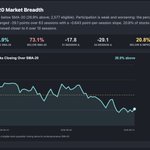
One day of market safety 😑 Pretty sure that is gone after today.
This one indicator has kept me safe through this chop. FOMO is a big problem for me so better safe than sorry.

104


Ed Cooley retweeted

A crash is significantly easier to trade than the chop we are seeing right now. In a crash, nothing sets up, so you simply step aside and sit in cash. This tape, however, is a psychological trap. It offers just enough random movement to tempt you in, only to sell breakouts on contact and squeeze shorts with violent, stop-hunting ramps. Our tradeable universe is shrinking as the market actively hunts liquidity in both directions. Trading serious size in this environment is a losing proposition. Don't take the bait.
Ed Cooley retweeted

Thomas Massie:
"You can tell that I'm ahead in the polls and they're desperate. That's why they're sending Hegseth to my district tomorrow. That's why the president's losing sleep and tweeting about this. That's why AIPAC has dumped another $3 million into my race."
Ed Cooley retweeted

A lot of buzz after the first chapter of Market Wizards about Qullamaggie.
I’m sharing a link with 1000+ qullamaggie style charts .
Look at:How the stock moves
Where it pauses ,Where it breaks out ,How trends repeat.Go chart by chart. That’s how you start seeing patterns.
If you find this valuable, please retweet so it reaches more people 🙌
Link - drive.google.com/file/d/1cym…
Ed Cooley retweeted

Food for thought.
Trump, Hormuz and the End of the Free Ride
For half a century, Western strategists have known that the Strait of Hormuz is the acute point where energy, sea power and political will intersect. That knowledge is not in dispute. What is new in this war with Iran is that the United States, under Donald Trump, has chosen not to rush to “solve” the problem. In Hegelian terms, he is refusing an easy synthesis in order to force the underlying contradiction to the surface.
The old thesis was simple: the US guarantees open sea lanes in the Gulf, and everyone else structures their economies and politics around that free insurance. Europe and the UK embraced ambitious green policies, ran down hard‑power capabilities and lectured Washington on multilateral virtue, secure in the assumption that American carriers would always appear off Hormuz. The political class behaved as if the American security guarantee were a law of nature, not a contingent choice. Their conduct today is closer to Chamberlain than Churchill: temporising, issuing statements, hoping the storm will pass without a fundamental reordering of their responsibilities.
Trump’s antithesis is to withhold the automatic guarantee at the moment of maximum stress. Militarily, the US can break Iran’s residual ability to contest the Strait; that is not the binding constraint. The point is to delay that act. By allowing a closure or semi‑closure to bite, Trump ensures that the immediate pain is concentrated in exactly the jurisdictions that have most conspicuously free‑ridden on US power: the EU and the UK. Their industries, consumers and energy‑transition assumptions are exposed.
In that context, his reported blunt message to European and British leaders, you need the oil out of the Strait more than we do; why don’t you go and take it? Is not a throwaway line. It is the verbalisation of the antithesis. It openly reverses the traditional presumption that America will carry the burden while its allies emote from the sidelines.
In this dialectic, the prize is not simply the reopening of a chokepoint. The prize is a reordered system in which the United States effectively arbitrages and controls the global flow of oil. A world in which US‑aligned production in the Americas plus a discretionary capability to secure,or not secure, Hormuz places Washington at the centre of the hydrocarbon chessboard. For that strategic end, a rapid restoration of the old status quo would be counterproductive.
A quick, surgical “fix” of Hormuz would short‑circuit the dialectic. If Trump rapidly crushed Iran’s remaining coastal capabilities, swept the mines and escorted tankers back through the Strait, Europe and the UK would heave a sigh of relief and return to business as usual: underfunded militaries, maximalist green posturing and performative disdain for US power, all underwritten by that same power. The contradiction between their dependence and their posture would remain latent.
By declining to supply the synthesis on demand, and by explicitly telling London and Brussels to “go and take it” themselves, Trump forces a reckoning. European and British leaders must confront the fact that their energy systems, their industrial bases and their geopolitical sermons all rest on an American hard‑power foundation they neither finance nor politically respect. The longer the contradiction is allowed to unfold, the stronger the eventual synthesis can be: a new order in which access to secure flows, Hormuz, Venezuela and beyond, is explicitly conditional on real contributions, not assumed as a right.
In that sense, the delay in “taking” the Strait, and the challenge issued to US allies to do it themselves, is not indecision. It is the negative moment Hegel insisted was necessary for history to move. Only by withholding the old guarantee, and by saying so out loud to those who depended on it, can Trump hope to end the free ride.

The past month has seen crazy chop. Not an environment for low risk trading. No Trend - No Trade!

68
Looks like another rejection of the 50 day and trendline on QQQ. This choppy market refuses to pick a trend.

1
72


