

Follow for commentary on Nigeria, politics, culture, development and diaspora life.
Nigeria
Joined January 2013
- Tweets1.4K
- Following42
- Followers279
- Likes124




Before propaganda gets your loyalty, let reality have the first word.
Two days ago, a colleague shared an article about how bad actors stay in power by recruiting professionals under pressure.
My first thought was that Nigerian politicians have perfected the entire process. They help create the pressure, then offer political loyalty as the escape route.
That is how propaganda finds staff.
So, before you borrow ethnic anger to defend a politician, check your bank balance first.
Some loud voices are working overtime to turn every criticism of this administration into an ethnic contest.
But hardship does not speak Yoruba, Igbo or Hausa.
Nigeria is politically diverse in every region. The South East once voted overwhelmingly for Obasanjo, while Tinubu lost Lagos and Osun. No politician owns the votes of an entire region, no matter how loudly a minority claims otherwise.
When someone defends every policy with unusual energy, ask:
Is food cheaper?
Is transport easier?
Is business better?
Do people feel safer?
Your rent has no tribe.
Your electricity bill has no party card.
And the market woman is not accepting “renewed hope” as payment.
Politicians may survive on propaganda. Nigeria will only survive on citizens who can recognise it.
I am Ben Uwazie.

North Coast lesson number one.
A town can be calm all afternoon and suddenly decide the whole evening belongs to fireworks.
And from Gortmore Viewpoint, on a clear day, you can look across the water and see Scotland from Northern Ireland.
That still feels slightly unreal.
#GortmoreViewpoint #CausewayCoast #CausewayCoastAndGlens #DiscoverNI #NorthernIreland #VisitNorthernIreland #LoveGreatBritain #UKTravel #ExploreMore #Scotland #WildAtlanticViews #RoadTripUK #HiddenGems #NatureLovers #LandscapePhotography #SunsetViews #TravelReels #IrishCoast #StayAndWander #NorthCoast
An unpopular opinion from a proud Nigerian: South Africa may be going through a phase, but it is not an unfamiliar one in African history.
I lived in Ghana from 2015 to 2021. In 2020, immigration officers, accompanied by military personnel, stormed my house without provocation. I had my documents and was a legal resident, so they left. But the question has always stayed with me: what justified that level of suspicion in the first place?
Between 2018 and 2020, it was not unusual to see Nigerians packed into immigration trucks during enforcement exercises. Flights left regularly with deported immigrants. Many Nigerians in Ghana also faced hostility around trade and retail activity, especially as Ghana enforced rules requiring foreign retail traders to meet significant capital requirements.
This is not to attack Ghana. It is to make a wider point: African countries have a long history of turning migrants into convenient symbols of national frustration.
In 1969, Ghana’s Aliens Compliance Order forced many West African migrants, including Nigerians, to leave the country. In 1983, under President Shehu Shagari, Nigeria expelled large numbers of undocumented migrants, many of them Ghanaians. That painful episode gave us the phrase “Ghana Must Go”, a reminder that no country in the region has clean hands when economic pressure turns into resentment against outsiders.
So when we look at South Africa today, we should be careful not to pretend it is uniquely hateful or uniquely broken. South Africa is facing deep economic pressure, high unemployment, weak public trust and growing social frustration. In that kind of environment, migrants, especially visible African migrants, can easily become scapegoats.
This does not excuse xenophobia. It does not excuse violence, harassment or dehumanisation. But it does help us understand the pattern.
When governments fail to create opportunity, people look for someone to blame. When institutions are weak, anger moves from policy failure to street-level hostility. When politicians find public frustration useful, migrants become easy targets.
The lesson is not that Nigerians, Ghanaians, South Africans or any other Africans are naturally hostile to one another. The lesson is that economic decline, poor governance and weak institutions can make any society turn inward.
As Africans, we must be honest enough to condemn xenophobia wherever it appears, including when our own country is the offender. We must also be wise enough to see the bigger pattern: today’s victim can become tomorrow’s aggressor when the political and economic conditions change.
South Africa may be going through a phase, but it is a dangerous phase. Africa has seen it before, and we should know better by now.

The guy said money would look good on me.
I agree. No need to overthink good advice. Lol.
But Wolfsburg made me think.
A city rose from war, built around cars, and became an industrial powerhouse.
Nigeria has Nnewi. Nigeria has Aba. Nigeria has talent.
What we need is structure.
Money may look good on me, but industrialisation would look better on Nigeria.
I am Ben Uwazie.
African hair is a whole conversation.
For my first two years in the UK, I paid about £25 every few days for grooming, plus the journey and waiting time, just to find the right barber. Not because I was being fancy, but because explaining African hair to the wrong barber can turn into a full TED Talk.
Eventually, I learned survival.
I bought a clipper and started cutting my own hair.
Then, for seven months straight, I left the hair alone.
No clipper. No shape-up. No negotiations with my hairline.
Recently, I visited Nigeria and my hair became a public concern. Everywhere I went, people looked at me like there had to be a deeper story. Even a banker was politely trying to understand whether it was African heritage, software developer behaviour, or a personal life update.
The one that got me was my sister telling me my young nephews had asked why “Brother’s hair” was so bushy.
That one touched me.
Because part of me wanted to say, “This is African hair. This is our texture. This is what many of us were taught to hide, cut down, or apologise for.”
But the honest answer was also funny.
In the UK, my hair had become an economic decision.
Sometimes it is heritage.
Sometimes it is £25, a long trip, one risky barber, and the fear of returning home with an apostle hairline.
But maybe that is the point: African hair should not always need an explanation.
I am Ben Uwazie

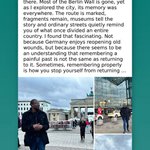
A visit to Germany taught me something strange about history.
You can tear down a wall without pretending it was never there.
Most of the Berlin Wall is gone, yet as I explored the city, its memory was everywhere. The route is marked, fragments remain, museums tell the story and ordinary streets quietly remind you of what once divided an entire country.
I found that fascinating.
Not because Germany enjoys reopening old wounds, but because there seems to be an understanding that remembering a painful past is not the same as returning to it.
Sometimes, remembering properly is how you stop yourself from returning to it.
That experience came back to me during a visit to the National Assembly Library. As I looked through the collection, I noticed something missing.
Not a book.
Almost an entire chapter of Nigeria.
I had been looking through the collection when I noticed something strange. For all the history sitting on those shelves, I could barely find anything about one of the most consequential periods in our national story.
So I asked the attendant.
She was very polite.
She listened carefully and assured me that my observation would be taken into consideration.
I thanked her and quietly wished my observation a successful journey through the Nigerian administrative system.
May it find favour.
But the contrast with Berlin stayed with me.
Nigeria ended the war, declared “No victor, no vanquished”, and then seemed to gather many of the uncomfortable conversations into one large Ghana-Must-Go bag and push it somewhere nobody would accidentally open it.
Unfortunately, history is terrible at staying inside bags.
It returns through family stories, political grievances, ethnic suspicion, separatist movements and election-season arguments. And naturally, it returns on social media, where people born decades after the war sometimes appear ready to personally continue it in the comments section.
Living in Northern Ireland has made this even more striking to me. The Troubles remain sensitive and politically charged, but the history is visible in museums, murals, tours and public conversations. Nobody is pretending that remembering everything has magically solved everything, but at least the past has somewhere to sit.
Perhaps Nigeria needs to make room for its own history too.
Not to reopen old wounds or distribute ancestral guilt, but to document what happened, preserve important sites, record the stories of survivors and allow future generations to understand what their country survived.
We may never agree on every interpretation of 1967 to 1970. Getting Nigerians to agree on anything might require its own constitutional conference.
But Berlin left me with one thought.
You can remove the wall.
You can rebuild the country.
You can even move forward.
But if you erase the memory too, do not be surprised when another generation starts rebuilding the wall in their minds.
I am Ben Uwazie.

Turns out the Greyjoys had good taste in real estate.
A trip to Dunluce Castle got me thinking about what Northern Ireland managed to do with Game of Thrones.
The castles were already here. The coastline was already spectacular. The stories simply gave the world another reason to come looking.
And somehow, while everyone else was searching for Westeros, they ended up discovering the Causeway Coast.
That is the clever bit.
Nigeria has plenty of stories and places capable of doing the same.
Not every Nollywood sitting room needs a tour bus outside it.
But some stories can leave behind more than credits.
I am Ben Uwazie
The road to King’s Landing, according to Game of Thrones.
The road to confusion, according to me trying to identify trees.
#DarkHedges #NorthernIreland #GameOfThrones #CausewayCoast #VisitNorthernIreland #KingdomOfTheNorth #TravelReels #NigerianInUK #DiasporaLife #BenUwazie
#TaxReform is welcome. #Nigeria needs it.
But reform should not just mean finding new people to bill. It should turn informal workers into visible citizens with records, credit access, business support and public services.
Anything less is cash collection with better grammar.
A sorry, made in Nigeria 😂
#NigeriansInUK #CultureShock #NigerianEnglish #BritishEnglish #DiasporaStories

Funny how distance can teach you pride.
In the UK, I let my hair grow. Back in Nigeria, it became a full public discussion. But maybe that is the point. African hair should not always need defending, shrinking or hiding. Sometimes it should just be allowed to exist.
#BlackHair
British politics may be heading into another major plot twist. Keir Starmer could be resigning on Monday. What do you think?
facebook.com/share/p/1LQCA8i…
#UKPolitics #KeirStarmer #AndyBurnham

I've worked on more WordPress projects this year than ever, and it reminded me how powerful the platform still is. Trick is knowing when to trust plugins and when to write custom code.
Read my full post:
linkedin.com/pulse/balancing…
#WordPress #WebDevelopment #PHP #Laravel #UKTech

Ben Uwazie retweeted
After spending a lot of time using #jQuery I just wanted to be sure I still remember how to make use of #HTML DOM with pure #javaScript. #jsTracer is the outcome, not sure what it does in particular but you can check it out on my #github page or visit eobasi.com/js-tracer

We talk about sustainable farming and energy — but what about sustainable code?
Every inefficient loop and unneeded query consumes energy. Here’s my take on #GreenCoding and long-term software design: linkedin.com/pulse/sustainab…
#Sustainability #SoftwareEngineering #TechForGood
🤖 Made with AI
...If the youth perceive him as weak, Sowore will be charging the cart of #RevolutionNow.

Starting a #catfish processing business is perfect for #SmallBusiness #entrepreneurs looking to break into the #agribusiness scene. #Businesses in #Mbaise can rely on @jmeggro for quality live catfish at affordable prices.
webcilo.com/g/Business/how-t…
#catfishFarming #ruraleconomy
Ben Uwazie retweeted

Exciting news! #Webcilo Inc just launched #Vibebo, a new anonymous #messaging platform for connecting & communicating freely․ #anonymouscommunication s.einnews.com/k9CwNxvS42