

Interested in how things work and making them work better 💫 | Tech policy at PF Global; Adviser @TenThinkTank.
Joined January 2011
- Tweets5.1K
- Following808
- Followers2.1K
- Likes29.7K


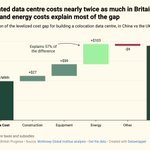




Unless Britain sorts out its sky-high energy costs, it will abdicate whatever little remaining relevance it has to influence the future of AI.
(H/t @jujulemons)

I find recycling very degrading so don't generally bother with it, but knowing how much energy it takes to produce metal cans always makes me feel guilty when I chuck one into the general waste.
So I was pleased to learn that in North London, where I live, household rubbish gets incinerated. The metal doesn't burn, so it can be pulled out of the ash afterwards using magnets and sent off for recycling, all without me lifting a finger.
It's a win-win!
Eamonn Ives retweeted

For six months, Google Maps sent a slice of drivers in ten American cities down deliberately slower routes.
About 30 seconds slower on average, and under 2% of trips were touched. The experiment ran on roughly 100 of the most congested road segments in each city, switching on and off day by day so each city acted as its own control. The results are out now in Nature Cities, from Google Research with collaborators at Berkeley and Stanford.
The reasoning behind it is old and slightly counterintuitive. Every navigation app does the same thing: it finds you the fastest route right now, for you alone. When millions of phones do that at once they all pour onto the same handful of arteries, and those arteries stop being fast. Transport economists have been writing about the gap between what's good for one driver and what's good for the network since the 1950s. Nobody had tested a fix at city scale with real drivers, because you'd need to steer routing for a large share of a city's traffic, and about three companies on Earth are in that position.
So Google put a penalty on the worst segments during their worst hours, which nudged the routing engine towards alternatives of similar road class and comparable travel time, then measured what happened across the whole network on weekdays between 7am and 8pm.
On the targeted segments, traffic moved roughly 2% faster in the median city. Los Angeles got 4.56%, Atlanta 3.30%. Fuel burn on those stretches dropped between 0.5% and 1%. Across every road that saw a change in traffic, which covers around 80% of each city's driving, speeds rose 0.35%, reaching 0.5% during the morning and evening peaks. Total travel time on affected trips fell 0.69%. Their Bayesian model put the probability that the speed effect was genuinely positive at 99.8%.
That adds up to more than 1,000 tonnes of CO2-equivalent saved per year, per city, in most of the places studied. Cars and vans account for around 10% of global carbon emissions, and the average driver spends about 2.6 years of their life behind the wheel, so a fraction of a percent across an entire road network is a serious amount of fuel.
Per driver, the saving comes to about 0.25% of an average journey, roughly one fortieth of the normal day-to-day wobble in how long the same commute takes. Nobody in those ten cities noticed anything, in either direction, including the people sent the long way round.
The authors are careful about what they haven't shown. They measured the immediate effect, not what happens once drivers work out the freed-up route is quicker and pile back onto it, which is the standard way road improvements get eaten. Their penalty scheme was deliberately crude, so the ceiling on the approach is unknown. And the underlying Google Maps data is commercially confidential, so nobody outside can check the numbers.
The finding sitting underneath all this is that a private company's routing algorithm has become a piece of transport infrastructure, tunable in the way a traffic light or a congestion charge is tunable. The obvious follow-up experiments are the ones a city government would want to run, not the ones a mapping company would.
link to full article: nature.com/articles/s44284-0…

Eamonn Ives retweeted

📩 New Digest!
In this week’s edition: Starmer bowing out, Chancellor chancers, social media scapegoating, and more.
Incl:
@BDSixsmith
@DanNeidle
@jackmrankin
@KelseyTuoc
@Matthew__Bowles
@Sam_Dumitriu
@lindsey_brink
@adwooldridge
@chalmermagne

Eamonn Ives retweeted
📩 New Digest!
In this week’s edition: A rubbish by-election, wealth tax woes, a framework for free speech, and Burnham keeps barrelling on.
Incl:
@annaroseridgway
@jcdinnage
@AndyMasley
@K_Niemietz
@Noahpinion
@JonHolb
@ukdynamism
@tylercowen


Eamonn Ives retweeted
📩 New Digest!
In this week’s edition: Brexit birthdays, Burnham's back, and all mod air-cons.
Incl:
@JournoStephen
@defossardf
@Simmons__
@ManiBasharzad
@cjsnowdon
@mrianleslie
@JerusalemDemsas
@dc_lawrence
@pdmsero
@MLiebreich

Eamonn Ives retweeted
📩 New Digest!
In this week’s edition: Tech troubles, Burnham rumbles, Brexit debates bubble, and more
Incl:
@K_Niemietz
@ArchieHall
@tejparikh90
@emily4MK
@jeegarkakkad
@Noahpinion
@Psythor
@BritainRemade
@BritishProgress
@paulpowlesland
@lfg_uk

Eamonn Ives retweeted
📩 New Digest!
In this week’s edition: World Cup bonanza, febrile rhetoric, censors’ charters and more
Incl:
@matthewlesh
@PhilAldrick
@eamonnives
@jujulemons
@jamesbreckwoldt
@chalmermagne
@AnyaM8_
@BritainRemade
@resfoundation
@marcsidwell
@louismosley

📊 Interesting results from Public First's polling on prediction markets!
More than half of Reform voters think it's acceptable to bet on election outcomes, and they're the most relaxed about betting on celebrity deaths.
Greens are surprisingly chill, while the Lib Dems are the biggest pearl-clutchers.
publicfirsttech.substack.com…

Eamonn Ives retweeted
📩 New Digest!
In this week’s edition: markets maligned, growth confined, tongues tied, and more
Incl:
@ArchieHall
@Simmons__
@jcdinnage
@TimHarford
@BrianCAlbrecht
@timleunig
@K_Niemietz
@WeAreBrightBlue
@watt_direction

So cool to see this finally out in the wild! It was a real privilege to play a small part in its development.
If you're interested in learning more about how to make R&D budgets as effective as possible, do take a look. 👇

At @IFP, we’ve spent the past 3 years thinking about all the different ways the US government & philanthropy fund R&D.
Until now, R&D funders haven’t had a systematic way to match the innovation problem to the right funding tool.
We built THE ATLAS OF INNOVATION to fill that gap.
atlasofinnovation.org
Alongside @UChi_MSA, we’ve boiled down thousands of hours of research into a handful of questions covering how much the R&D funder knows about:
- the problem they want to solve
- the solution it should have
- the team that should build the solution
Why the Atlas matters:
The US government spends close to $200 billion every year on R&D. And after the Anthropic and OpenAI IPOs, there will be hundreds of billions of dollars in new philanthropic giving.
Choosing the correct funding approach to the social problems they’re trying to solve will mean the difference between success and failure.
For example, NSF research grants have helped seed breakthroughs from MRI machines to search engines, but grants aren’t built to deliver the kind of industrial speed and scale that a project like Operation Warp Speed required.
Picking the wrong funding approach can leave programs behind schedule, over budget, or without anything to show for all the money they spent.
How we built the Atlas:
1. We began by creating a matrix of dozens of considerations that a thoughtful policymaker or funder would ideally weigh before deciding how to fund a project.
2. We looked at every major funding approach, from grants to R&D tax credits to advance market commitments, analyzing when they work well and when they fail to meet the mission.
3. We spent months deep in the weeds of contract theory and incentive design, looking at historical examples and the state-of-the-art research in innovation economics.
4. We then worked to turn that research into a tool that time-strapped policymakers and philanthropic funders could rely on at the start of an innovation funding cycle.
5. Three years later, we are launching just that: a new (and visually stunning) website to help funders decide how to best incentivize innovation. And all they have to know… is what they currently know about their innovation goal! The Atlas takes care of the rest.
How to navigate the Atlas:
Answer questions about your goal to find the funding approach aligned with the information you have.
Each funding mechanism has its purpose for particular technologies and specific moments in development.
There shouldn’t be an ARPA for every field, just like we don’t need a prize or AMC for every innovation. The Atlas helps you navigate those tradeoffs.

Eamonn Ives retweeted
📩 New Digest!
In this week’s edition: battle of the old Blairites, energy price escalation, and not-so-NEETs.
Incl:
@tomhfh
@InstituteGC
@jdportes
@NilsPratley
@pdmsero
@DanNeidle
@Philip_Salter
@7Kiwi
@BenZaranko

Eamonn Ives retweeted
📩 New Digest!
In this week’s edition: Rough ideas, making sense of Mancunian miracles, power struggles, building bridges, and more.
Incl:
@J_D_89
@Simmons__
@martha_dacombe
@NilsPratley
@jamesbreckwoldt
@PMarlowe1939
@nanransohoff
@StefanFSchubert

Eamonn Ives retweeted
📩 New Digest!
In this week’s edition: the capitalist command economy, wishful thinking, and making tax simple again.
Incl:
@cjsnowdon
@PJTheEconomist
@ChrisGiles_
@georgeeaton
@bswud
@pietergaricano
@LabourGrowth
@AndyMasley
@Louise_Rowntree

Eamonn Ives retweeted
📩 New Digest!
In this week’s edition: Results day, technology truths, policing properly, and the case for a thicker political layer
Incl:
@matthewlesh
@TomJackSpencer
@defossardf
@jo3hill
@jujulemons
@HelenaRosenblat

Eamonn Ives retweeted

✨Personal post warning ✨
6 months ago we lost our baby boy, Leo, at 33 weeks.
It is, unsurprisingly, the hardest and worst thing we have ever been through. My wife has been utterly amazing, and we have had loads of support from friends and family, but nothing could have ever prepared us for the pain. It is harrowing and isolating, and we miss him every day.
I'm saying this here for two reasons.
First, because I want friends/colleagues/acquaintances to know that if, god forbid, they come up against anything similar, that they can reach out to me. I have found a lot of support in people that can at least half understand what we're going through, and I want to be able to offer that to others if they need it.
Second, because I have reached the sixth stage of grief: 'run a half marathon'. I will be running the Royal Parks Half in Leo's memory to raise money for @SandsUK who continue to support my wife and I, and do so much more for bereaved families across the UK, including funding research to help prevent baby loss.
If you fancy chucking a quid in the hat to support my attempt to exercise, the link is below. And if anyone does want to talk or share pain, I'm always around for a pint.
Eamonn Ives retweeted
📩 New Digest!
In this week’s edition: Britain ungoverned, nuclear squandering, AI vs the job market, and more...
Incl:
@pdmsero
@ChristianJMay
@worstall
@georgeeaton
@RuxandraTeslo
@louismosley
@deanwball
@HumanProgress
@whazell
