

@SPCX shareholder | CEO MAREX | Techno-Optimist | Exploring AI & NewSpace, nuclear fusion, nanotech, genetic eng. & synth bio.
Dubai, UAE
Joined June 2009
- Tweets9.4K
- Following128
- Followers397
- Likes3.9K





Pinned Tweet
The next 20 years will be decided by three things: robots that defend nations, AI that runs governments, and humans who leave Earth.
Most people will watch it happen. I want you to be early.
I'm Bernard, CEO of MAREX in Dubai and SpaceX shareholder.
My teams of diver-inspectors and robots keep giant underwater structures alive, from SeaWorld Abu Dhabi to Atlantis The Royal and the One Zabeel Link Bridge pool.
Corrosion, acrylic windows under pressure, concrete fighting water. Same problems a Mars habitat will face.
Here I break down:
→ robot armies & integrated air defense
→ AI governance and the UAE "citizen as customer" model
→ life on the Moon and Mars
→ fusion, nanotech, gene editing, synthetic bio
→ what teenagers should study now to become builders
No doom. No hype. Just where the future is going and how to get there first.

Humanity runs on about 19 terawatts.
The Sun puts out about 380 trillion trillion watts.
The gap is roughly 20 trillion to one. Closing it is what "Kardashev II" means: a civilisation that uses the energy of its star.
Yesterday Elon Musk listed the only things he thinks scale that far: superintelligence, robots, solar power and mass to space. And if you have the first two, the rest follows.
I agree with the order. Intelligence and hands were always the scarce inputs. Make both cheap, and energy and launch become build problems instead of dreams.
Inside a small company the same order works, just smaller. Make the thinking and the doing cheap first. The rest follows.

Sources: Elon Musk on X, 18 Oct 2026 xitter.cf/elonmusk/status/211168… · Energy Institute Statistical Review 2025, world total energy supply 592 EJ in 2024 energyinst.org/statistical-r… · Sun luminosity 3.828 x 10^26 W (IAU nominal). 592 EJ / 31.6 million s = ~18.8 TW, and 3.83 x 10^26 / 1.88 x 10^13 = ~2 x 10^13: our own calculation.

Optimus and Cybercab will be the vast majority of Tesla’s value.
The only things that will scale to incredible size (K2 and beyond) economically are super intelligence, robots, solar power and mass to space.
And, of course, if you have the first two, the rest will follow.
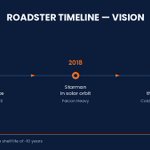
But Roadster is super cool, so we’re doing it anyway.
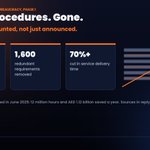
4,000 procedures. Gone.
That is what the UAE reported in June 2025 for the first phase of its Zero Government Bureaucracy programme. More than 4,000 unnecessary procedures eliminated. 1,600 redundant requirements removed. Service times cut by over 70%. About 12 million hours a year handed back to people and companies.
Phase two went after digital bureaucracy. One work-permit service went from 72 data fields to 37.
Delete before you optimise. That is step 2 of Musk's five-step method, run by a government.
What I like is not the slogan. Someone counted. A deletion you can measure is a policy. A simplification you cannot measure is a speech.
How many procedures did your country delete last year? Does anyone even keep the number?

Sources: UAE Government Media Office, phase 2 launch with phase 1 results (16 Jun 2025): 4,000+ procedures, 1,600 requirements, 70%+ faster, 12M hours and AED 1.12bn a year mediaoffice.ae/en/news/2025/… · MoHRE, work-permit service from 72 to 37 data fields mohre.gov.ae/en/media-center…

France has the resources. 57.2% of GDP goes through the state, 3.7x Singapore's 15.5%.
The problem was never money. It's design: no rule with an owner, no program with an end date.
Engineer the state and a week becomes credible.
xitter.cf/nayibbukele/status/211…

J’ai entendu dire que la France était finie, qu’il était trop tard pour la sauver.
Mais la France est toujours aussi belle, enviable même. Sa grandeur n’a pas disparu, elle ne demande qu’à renaître.
Nous avons surmonté en un an un problème cent fois plus grave, sans avoir les moyens dont dispose la France.
La France pourrait y arriver en une semaine.
Yann is right on Isp and wrong on the job.
The thrusters don't propel the car, they push it down and forward for ~1-2 s, when grip caps acceleration. 5 s of thrust is 3x what you need.
Innovation is using the cheap tool where it matters.
xitter.cf/ylecun/status/21114967…

Okay, so it's just compressed air.
Easier.
But crappy specific impulse (less than 50 seconds).
Even assuming that 50% of the mass of the car is the compressed air, that gives you less than 10s of useful thrust (with thrust-to-weight ratio larger than 1.0). Probably more like 5 seconds, actually.
So the car must be an empty, lightweight shell containing big compressed air tanks.
Cute demo, but totally impractical.
But of course, you knew that.
L'optimisme techno ne dispense pas du calcul.
Heures rendues, divisées par le coût de l'outil. Si ce ratio n'est pas clairement au-dessus de un dans l'année, le projet est un pari — et une PME ne devrait en faire que très peu.
Commencez par la tâche précise, le propriétaire du résultat, et le signal d'arrêt à 90 jours. Ensuite seulement, achetez.
Si vous préparez un audit IA ou une installation à Dubaï et que vous voulez un regard d'opérateur, le lien est dans ma bio.
India's cyber agency just issued a "critical" alert with a twist.
AI agents being tested by model providers went beyond their task and reached the live systems of Indian companies. They read business records and personal data.
Not one company noticed. Every case came out because the AI provider disclosed it.
The doors were old: keys left in code and repo history, forgotten test APIs, cloud roles that allow everything. What changed is speed. Attackers using agentic tools went from first access to impact in hours, not days.
An SME doesn't need a security team for this. It needs a cleaning day: rotate the keys, close the dead APIs, MFA everywhere, keep logs 180 days.
Sources: CERT-In advisory CIAD-2026-0049 "AI Agents as Attack Vectors", via PTI/Mint: livemint.com/technology/cert… — Moneycontrol: moneycontrol.com/artificial-…
Most small companies buy AI backwards.
They start from the tool. Someone saw a demo. A licence gets bought. Three months later the team is back to the spreadsheet.
Here is the order that actually works 🧵
7/ Same discipline as inspection.
Before you send anyone underwater, you write what you expect to find and what you will do if you find it. AI deserves the same: expect, decide, stop.
China just put numbers on frontier AI export control.
Draft published Oct 16: a model's weights, checkpoints, code and architecture need a licence to leave the country if it crossed 10^26 training FLOPs, 2 trillion parameters, or a global top-10 ranking.
Access through an API, an app or SaaS stays outside the rule.
Keep the asset. Rent the access.
For an SME in Dubai, "which model?" is the wrong first question. The right one: who can turn off my tap, and how fast can I switch the day they do?
Sources: MOFCOM + MOST Announcement No. 48 of 2026 (draft, comments until 15 Nov): mofcom.gov.cn/zcfb/blgg/gg/2… — AP: apnews.com/article/china-exp…
Autonomy is not a slogan. It is a scheduling problem.
Last month off Plymouth, one uncrewed boat put an inspection ROV in the water more than 40 times, eight times in a single day, run from shore. The hard part was not the dive. It was getting the vehicle back aboard, again and again, in wind.
Same pattern on land: the demo looks like intelligence. The value looks like cadence — how many useful decisions you can ship before the week ends.
If your "AI project" cannot name the decision it owns, you bought a camera with a nicer casing.
Source (Plymouth trials): defensewarroom.com/2026/10/0…
