
AP/CP Pathologist @KingsCollegeLon Trained @MayoClinicPath @Yalepathology @NU_pathology | Digital Pathology | AI in Medicine | Sharing real diagnostic cases
Joined October 2025
- Tweets432
- Following5.5K
- Followers723
- Likes5.3K
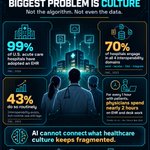





Healthcare AI’s biggest problem isn’t the algorithm. It’s the CULTURE.
In other industries, users adapt to technology.
In healthcare, technology must adapt to every physician, specialty, and hospital.
One extra click? Resistance.
One standardized pathway? Objections.
Every department wants customization. Every institution protects its data.
Fragmentation isn’t always a technical failure. Sometimes, we DESIGN it into healthcare.
Then we expect AI to connect what we spent decades separating!
The solution? Physicians must become architects of digital healthcare, not just users of IT.
Before smarter AI, we need smarter collaboration.
The biggest interoperability problem may not be between systems. It may be between the people behind them.


A positive TB screening test today. Negative on repeat. Which one do you trust?
This is a real problem in healthcare-worker #TB screening.
IGRA improved greatly on PPD/TST—but it is still an ex-vivo immune experiment, not direct detection of the bacterium.
Near the cutoff, results can shift with:
blood volume, mixing, incubation delay, temperature, immune variability and analytical noise.
In published HCW studies, reversions are common—especially with borderline results.
In our own repeat-testing experience at King’s College Hospital:
10 initially positive/borderline HCWs → 6 negative on repeat, 4 remained positive.
So maybe we should stop asking only:
Positive or negative?
And start asking:
How strong was the signal? How reproducible was it? How far was it from the cutoff?
This is why #IP10 / #CXCL10 is so interesting—a stronger downstream immune signal may help identify weak responses that IFN-γ misses.
The future of TB screening may be less binary, more biological.
#IGRA #QuantiFERON #HealthcareWorkers #Microbiology #LaboratoryMedicine #OccupationalHealth


A triglyceride of 4,300 mg/dL is not just one abnormal result.
Someone asked online what a number that high means. The top reply, from a hospital clinician: patients at that level are usually being admitted for pancreatitis.
There is a lab side too. A sample that fatty is visibly milky.
The analyzer measures it as a lipemia index, and the lab's rules hold any test the fat can interfere with.
The triglyceride is real. Some of the other numbers in that tube may not be.
A 99% accurate AI, screening for a 1-in-100 condition: about half its alarms are false.
Take 10,000 people. 100 have the condition.
A model that is 99% sensitive and 99% specific catches 99 of them.
It also flags 1% of the 9,900 healthy people: 99 false alarms.
That is 198 alarms, and half of them are wrong.
Accuracy depends on who you test.
What prevalence was your tool validated on?
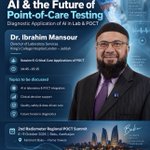
An ABG is a snapshot. A series of ABGs tells a story. AI could predict the next chapter!
Blood gases contain more than numbers. Trends in pH, PaCO₂, PaO₂ and bicarbonate reveal evolving physiology.
Now imagine AI connecting these trends with vital signs, oxygen therapy, ventilator settings and clinical context.
Detecting subtle deterioration, recognizing hidden patterns and predicting risk before conventional thresholds are crossed.
The future of laboratory medicine: From reporting results to predicting outcomes.
#AIinHealthcare #BloodGasAnalysis #POCT #PredictiveAI #LaboratoryMedicine


If professionalism is not on the sign-off sheet, it will not get taught.
In a long thread about a difficult student, the top reply was simple: professional standards were part of the competencies that had to be signed off.
The evidence backs that up.
Physicians later disciplined by medical boards had three times the odds of documented unprofessional behavior in medical school.
The authors estimated that 26% of the risk of later discipline was attributable to it.
Ibrahim Mansoor FCAP, FIAC, FACHDM retweeted

🔬 Leeds Lymphoma Course @Dr_HebahAli & @pgopinathpg Practical • Interactive • International
A comprehensive online course in lymphoma diagnostics for residents & pathologists
🎓 3 days | Expert faculty
💬 Live cases + Q&A | Recordings
🔗 Book now ow.ly/m4Qp50Zyt39

Ibrahim Mansoor FCAP, FIAC, FACHDM retweeted

Sex-dimorphic roles of Histone Variant H2A.Z in #AlzheimersDisease
🗒️In Human👤 hippocampus
H2AZ1 & H2AZ2⬆️, but overall H2A.Z chromatin occupancy⬇️in ♀️not ♂️AD patients
"more than half of the genes that gained H2A.Z in male patients lost H2A.Z in female patients"
"unique sites in each sex were primarily intergenic"
🗒️In 5xFAD Mice🐭
H2AZ1 knockdown (AAVDJ-U6-shH2AZ1, Stereotaxic injection into CA1 at 2.5 mo) has Opposite function in ♂️vs♀️
👉Memory (object location memory, only observable at 3 mo)
👉Insoluble Aβ42 (8 mo)
👉Soluble pTau217 (8 mo)
+H2A.Z ChIP in 4- & 8-mo 5xFAD ♀️♂️🐭
"many genes that were modified in human female patients were also modified in female 5xFAD mice (3,127 of 7,012)"
GSK3B/MAPT/PTPRS
@IvaZovkic @NeuroCellPress 2026
sciencedirect.com/science/ar…

Ibrahim Mansoor FCAP, FIAC, FACHDM retweeted

Flat Epithelial Atypia (FEA), left pic
Focal Atypical Ductal Hyperplasia (ADH), right pic
Dr. Allison. 2026 Diagnostic Pathology Update #USCAP #pathology #PathX

Ibrahim Mansoor FCAP, FIAC, FACHDM retweeted

Understanding and clinical approach to early T-cell precursor acute lymphoblastic leukemia pubmed.ncbi.nlm.nih.gov/4286… #leusm

Ibrahim Mansoor FCAP, FIAC, FACHDM retweeted

Histologic features favoring CMV hepatitis in liver allograft biopsies with overlapping rejection-type injury
➡️Microgranulomas
➡️Neutrophilic microabscesses
Difficult topic, covered by IJSP. Read more here 👉🏼 tinyurl.com/5enfmwv3
#PathTwitter #GIPath #MedicalLiverPath

Ibrahim Mansoor FCAP, FIAC, FACHDM retweeted

Adamantinoma-like Ewing Sarcoma: An Underrecognized Mimicker in the He...
sciencedirect.com/science/ar…
Our case series on a rare diagnosis on the head neck!


Is the platelet count low, or are the platelets just stuck together?
In some people, platelets clump in the EDTA tube.
The analyzer cannot count a clump as platelets, so the count drops while the patient's platelets are fine.
The blood film shows the clumps.
Someone asked online why labs in their area will no longer draw the citrate tube that gets around this.
Lab staff answered: many popular analyzers are not validated for citrate samples, so each lab must validate that use before it reports one.
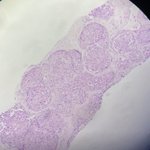
Not every clear-cell nest is clear cell carcinoma.
A routine fallopian tube.
One small, well-circumscribed nest of cells with clear, vacuolated cytoplasm.
Alarming enough to be sent for a second opinion.
What settled it:
• bland cytology
• no mitoses
• no infiltrative growth
• no hobnail cells
A Walthard cell nest.
Benign, incidental, and briefly frightening.

Low platelets can be a bleeding risk, or clots forming in small vessels everywhere at once.
Doctors discussing a fatal TTP case online kept coming back to one detail: there had been a head CT, but no basic blood count.
In TTP, tiny clots use up platelets and slice red cells into fragments called schistocytes.
The count falls because platelets are being consumed.
A count cannot tell you which story you are in. The blood film can.
people think an IGRA is simply a “TB blood test.”
It isn’t.
It is a live ex-vivo immune experiment performed outside the body.
Fresh blood is exposed to TB-specific antigens, T cells are stimulated, and IFN-γ is measured after incubation.
That means the result can be influenced by far more than TB biology:
blood volume, tube mixing, transport, delay to incubation, temperature, incubation time, immune status, analytical variation — and especially how close the result is to the cutoff.
That is why a low-positive IGRA can sometimes become negative on repeat testing.
So the real question is not always:
“Positive or negative?”
It may be:
How strong was the signal? How reproducible was it? And what did the experiment actually measure?
This is also why biomarkers like IP-10/CXCL10 are so interesting: a much stronger downstream immune signal may help us detect weak responses that IFN-γ alone can miss.
#Tuberculosis #IGRA #QuantiFERON #IP10 #CXCL10 #Microbiology


Many lab results reach you without a human ever looking at them.
That is by design, and the design is a set of rules someone wrote.
Before release, each result is checked against:
• instrument flags
• hemolysis, icterus and lipemia indices
• the measuring range
• the patient's last result
• critical and physiologically absurd values
Pass every rule, it releases.
Fail one, a person looks.
One academic lab spent 13 years building its rules, from 40% of results released this way to 99.5%.