

PhD & Lecturer in Archaeology! 20+ years of fieldwork experience. Specialise in new tech in archaeology and Neolithic-Iron Age tombs in Arabia!
Sydney
Joined July 2009
- Tweets3.2K
- Following748
- Followers15.8K
- Likes2.3K






After a difficult year, finally hitting the gym again! 🏋️♀️
I need good podcast recommendations to take my mind away from the agony of step machines, squats, and free weights!

The Seven Sisters.
Featuring six, seven,and eight stars, apparently.

THE SEVEN SISTERS
7 divine beings. 7 stars. A sacred connection between Earth and the heavens.
In ancient Mesopotamia, the Sibitti, also called the Sebettu, were “the Seven”: powerful divine beings associated with warfare, destruction, and protection. In astronomical tradition, they were identified with the Pleiades, the star cluster recorded in cuneiform as MUL.MUL, “the stars.”
Their celestial symbol appears as seven dots or seven stars on cylinder seals, royal monuments, and some boundary stones known as kudurrus. These marks frequently appear alongside other heavenly emblems, connecting the divine world with the sky above. Scholar E. Douglas Van Buren proposed that some early 7 dot motifs represented pebbles used in divination, although that explanation remains an interpretation of their origins.
The Pleiades also had a practical place in Babylonian astronomy. The astronomical compendium MUL.APIN includes rules using the Moon’s relationship to the Pleiades to determine when an additional month should be inserted into the calendar. Watching the heavens helped organize life on Earth.
In the poem Erra and Ishum, Anu places the Seven at Erra’s side as fierce divine weapons. Yet their formidable power could also serve protection. Ritual instructions prescribe armed figurines of the Sibitti made from tamarisk wood, equipped with weapons including axes, daggers, bows, and quivers. Such figures were incorporated into protective burial rituals intended to defend households against threatening forces.
The Pleiades also hold profound significance in Indigenous star traditions from Australia to the Americas.
In the Wongutha tradition of Western Australia, as retold by Aboriginal author May O’Brien, the Seven Sisters are women who visited Earth and travelled across the land. Other Aboriginal accounts preserve their journeys through Country and their relationship with the night sky.
In North America, Cree knowledge keeper Wilfred Buck identifies the Pleiades as Pakone Kisik, the “Hole in the Sky.” He recounts a tradition in which Star Woman passes through that opening and becomes the first human on Earth. As Buck explains: “the hole in the sky is where we come from.”
The Pleiadian-seeding hypothesis interprets such star-origin accounts as possible memories of humanity being seeded on this planet by beings from the Pleiades, commonly called Pleiadians. That interpretation remains speculative. Each Indigenous nation has its own teachings, and these distinct traditions deserve to be understood in their own cultural context.
Still, the comparison invites a compelling question: What did our ancestors understand about their relationship with the stars, and what can we learn by listening closely to the stories they preserved?
Research: "E. Douglas Van Buren, The Seven Dots in Mesopotamian Art and Their Meaning" (knowledgebasedsociety.com/wp…)
#WELOVEMESOPOTAMIA #Sibitti #Pleiades #StarLore

Paper was accepted into the International Congress on the Archaeology of the Ancient Near East (ICAANE) in Tbilisi!
Super excited as I will present a lot of new data related to these beautiful structures…
Anyone else going?

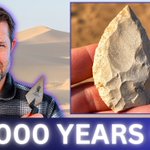
A recent paper from Saudi Arabia has uncovered evidence of an ancient lake, hippo bones, and amazing stone tools preserved in the desert.
All dating back to 125,000 years ago!
Find out more 👇
Archaeologists Found 125,000-Year-Old Weapons in the Desert
youtu.be/vm4ySlSfPMY

The time period they are reporting happens to overlap with the peak of monumental tomb building in Saudi Arabia, which started a few centuries earlier and continued a few centuries afterwards. 🤷♂️


BREAKING: The Results Are IN!
This morning on Fox News, Noah’s Ark Scans Founder Andrew Jones announced the results from the charred wood samples recovered by Dr. Cenker Atila from the Durupinar Noah’s Ark site.
The lab results are in: Both of the wood samples date back to the exact same time period of Noah’s Flood.
We are still waiting for the lab results from 2 other countries, but we couldn’t wait to share the first round of American lab results with the world.
We’re just getting started, but we need your support as we plan to continue the research until ALL of the evidence is irrefutable and the scientific world must finally admit, The Durupinar Formation is truly the resting place of Noah’s Ark. DONATE: NoahsArkScans.com/donate

There are 2 Hughs(Huw) who work in Saudi. Me and @huw_groucutt. We agree on a lot academically, but not on name spelling.
But he is one of the authors of the paper presented in my new video 👇
Archaeologists Found 125,000-Year-Old Weapons in the Desert
youtu.be/vm4ySlSfPMY

125,000 years ago, the Saudi desert was home to a lush palaeolake full of hippos, buffalo, and human hunters using advanced technology.
In my latest video, I break down the incredible new evidence of prehistoric 'hippo' hunters!
Full breakdown 👇👇
youtu.be/vm4ySlSfPMY

Did early humans use poison-tipped weapons 125,000 years ago?
A new study out of Saudi Arabia reveals microscopic residue on Paleolithic stone tools, and it might completely rewrite what we know about prehistoric hunting tech.
New Video. Click here 👇👇
youtu.be/vm4ySlSfPMY

Uploading and releasing in a little under 3 hours! It’s a good one!
Some amazing discoveries and I have some photos provided by the team.

Hugh Thomas retweeted

Wadi el-Mahdath Desert Kites: A chain of Neolithic hunting traps and some 400 rock carvings around a seasonal wadi in the basalt desert of north-eastern Jordan. The Kites in Context Project began work here in June 2022. More 1/

ALT Wadi el-Mahdath Desert Kites
This one. I excavated this mustatil a few years ago. Not only was it in a beautiful part of AlUla, we found some cool stuff. Including the partially preserved skeleton of a child, and a fragmentary Neolithic pot(likely earliest locally made pot in region). c.5000-4700 BCE. 1/


You may have seen recent news reports about archaeologists discovering 125,000-year-old stone tools coated in poison in KSA.
It’s a fascinating bit of archaeology & the focus of my upcoming video.
🇦🇺 Sydney: 1AM 22 Nov
🇸🇦 KSA: 5PM 21 Nov
🇬🇧 UK: 2PM 21 Nov
🇺🇸 New York: 9AM 21 Nov

I did!!
This is the al-Diwan chamber at Hegra (Mada'in Salih), in AlUla, Saudi Arabia. Hegra was the second capital of the Nabataean Kingdom!
If you take the standard bus tour of the site, you'll get to see this.
Fun fact: my dig house was located just a few kilometres away!


100% agree!! These structures are definitely NOT designed to trap animals!!!
Mainly because the images shared by the OP don't actually show desert kites. They're Bronze Age tombs dating to the 3rd millennium BCE.
A rather important distinction. 1/


This is a Desert Kite! They have a very distinctive shape, they have been studied and dated across West Asia.
This is located about 20km away from the tombs in the OP and is one of several hundred in the area!
You can read more about kites here: link.springer.com/article/10… 2/2

“it turned out that what he was actually looking for was a sample that couldn't be distinguished from natural limestone.”
I’m not sure how this wasn’t clear 🤷♂️
Here is the challenge @FoMaHun mentions AND his response, saying that his ‘stone’ was comparable to natural stone


A person can remain in a state of utterly profound ignorance for an incredibly long time, even when the evidence of their own stupidity is staring them right in the face.
That's exactly what happened to me.
Here's what happened. @drhught posted a challenge, I think here on Twitter, asking anyone who could send him artificial limestone to do so, because he wanted to take it to an expert for examination.
Obviously, he probably expected nobody to volunteer, but I did. I'd already got everything ready for shipping to him when it turned out that what he was actually looking for was a sample that couldn't be distinguished from natural limestone.
I don't quite understand the premise, either, because the stone of the Great Pyramid of Giza is clearly distinguishable from natural limestone, given that it's salty.
Anyway.
So we had quite an argument about whether I should send my samples or not. The stuff I made using ash lye is indeed 96% limestone, remarkably pure, but it's damn lightweight. Because it's porous. Because the water has left it, and what else could have taken its place but air? A geologist picks it up, feels the weight, and immediately says: this isn't natural stone.
In the end, I didn't send Hugh the samples. What's the point? I know perfectly well that they meet the requirement in terms of composition, but not in terms of physical properties. Not yet.
So, where does that leave us? Hugh is both right and wrong, but a lightweight limestone cube clearly isn't going to be the final solution.
And that's when the Universe spoke to me! It does that from time to time, you know!
Get this: I grew up in a traditional rammed-earth farmhouse. The walls were at least a metre thick.
One summer, when I was already in high school, my parents decided to open up two rooms by cutting through the one-metre-thick wall between them. After all, what could be so difficult? It's just dirt.
Well, holy shit, that stuff was as hard as rock! You couldn't break it with a pickaxe, or even a chisel. It was so ridiculously hard that after a few days of struggling, during which we had barely removed any material at all, we were close to giving up.
I'll cut the story short: the solution was to drill a hole through it and then saw our way through. We went through something like 20–30 enormous timber saws in the process.
But here's what's important: ordinary soil, when properly rammed, can become almost as hard and dense as any rock. True, it's not waterproof, but as long as it has a roof over it, there's no problem.
There's a reason people were still happily building earthwork fortifications well into the Middle Ages. In Hungary, quite a few place names end in Földvár, meaning earth fort, such as Balatonföldvár, Dunaföldvár, Tiszaföldvár etc.
The fort itself is long gone, because once the roof structure rots away, the whole thing quickly falls apart. But its memory lives on.
NOW THEN!
What happens if, instead of rammed earth, we try making walls out of rammed limestone powder? Why?
Well, just because. Because that's what we have nearby. Rammed limestone also compacts like crazy, which is precisely why it's used as a road base. But it doesn't set.
Unless, instead of sprinkling it with water, we use ash lye!
The evidence is Davidovits's pyramid stone recipe, and that video from over 20 years ago showing how they make a limestone block.
I was a complete idiot for never taking this into account before. They RAMMED it. Davidovits and his team rammed the limestone powder. (And they added natron and various other ingredients, but that's beside the point for now (I'm not going to use those; I'll be using ash lye enhanced with slaked lime)).
But if they were ramming it almost dry, why the hell did ancient people need a nub? Were there any excess water at all?
Hehe!
I once had the opportunity to talk to Ralph Davidovits, and I asked him whether they had encountered any problems with excess water when making that multi-tonne block by ramming.
AND HE SAID THEY HAD!
Yes! They actually had a water blowout while working on it!
Because excess water is just as unwanted in rammed limestone powder. It helps with the initial compaction and gets the chemical reaction started, but after that it HAS TO leave. And it WILL leave. Condensation forces the water out of the mixture, no matter what.
Inspired by this, I made four different artificial limestone samples using four different types of limestone, all rammed almost dry. That's what you see in the video. The four samples are shown in yoghurt cups after ramming. When I finished, I cut the bottoms off the cups, hoping that water would escape through the openings.
And TADAAAAAA! It did!
When you ram a wall out of soil, you don't need a nub to drain water, because the soil doesn't expel it.
But when you ram a wall out of limestone, you need drainage, because the limestone pushes the water out.
Phew. What a journey! I wasted at least two years on fully wet casting simply because the image of wet concrete had become hardwired into my brain. WHAT A LOAD OF NONSENSE!
What's more, this ramming technique could be done without mixing anything together beforehand. Yes, ZERO MIXING! Suddenly, it's much easier to imagine a Baalbek-sized artificial stone when making one is as simple as falling off a log!
You simply spread a layer of dry limestone powder, splash some ash lye onto it, creating a little localised puddle, then spread and work it into the powder with a tamper. Add the next layer of limestone powder, splash on some more lye, and so on.
I actually think this could also represent the real historical development of the technique. First came rammed earth, which remained in use for thousands of years, until someone tried limestone powder instead and discovered that it was even better than soil, because when sprinkled with the right liquid, it turns into actual stone.
What if the ancient earthworks recently discovered beneath the Amazon aren't earthworks at all, but simply the remains of walls that have disintegrated?
I don't think anyone set out to build mounds there. What would be the point? For religious reasons? Nonsense. They could have been walls. Rammed-earth walls.
God, I'd love to try this on a much larger scale with limestone rubble, in practice, right now! But winter has just arrived. Never mind, though. If I've already spent years waiting to find the right solution, a few more months won't make any difference.

