

Drew retweeted

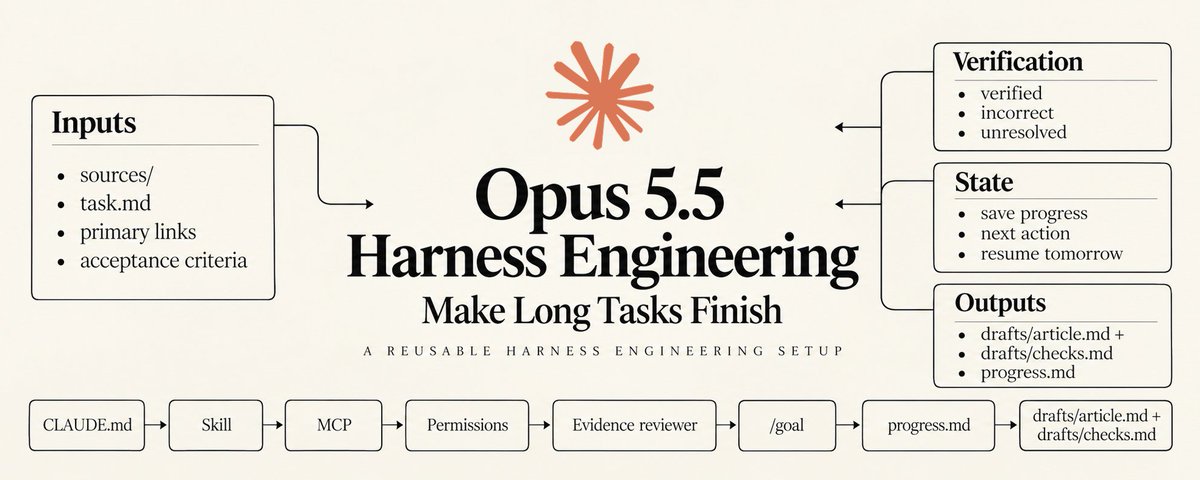
Andrej Karpathy (ex-OpenAI, ex-Tesla) just released a prompt that turns Opus 5.5 into a harness that actually finishes the any job.
It's f*cking unreal...
send it to Opus 5.5, and thank me later. Then read the full guide for Opus 5.5 Harness Engineering.


Drew retweeted

Dans 50 ans, les livres d'histoire diront qu'Elon Musk a gagné une guerre que personne ne savait qu'on était en train de perdre.
Une guerre commencée il y a 100 ans, dans une cellule de prison italienne.
En 1926, Mussolini fait arrêter un intellectuel sarde de 35 ans. Au procès, le procureur aurait dit : « Nous devons empêcher ce cerveau de fonctionner pendant vingt ans. »
Il s'appelait Antonio Gramsci.
Son cerveau n'a jamais cessé de fonctionner. En prison, il a rempli des milliers de pages qui sont devenues l'un des textes politiques les plus influents du XXe siècle. Je pense qu'on est en train de vivre le moment où sa théorie s'effondre.
Laissez-moi vous expliquer.
Gramsci se posait une question simple. Pourquoi la révolution communiste a-t-elle réussi en Russie mais échoué partout en Occident ?
Sa réponse : en Occident, le pouvoir ne tient pas seulement par l'État, la police et l'armée. Il tient par la culture. Par ce que les gens trouvent normal, évident, « de bon sens ». Il appelle ça l'hégémonie culturelle.
Donc, pour prendre le pouvoir, il ne faut pas d'abord prendre le palais. Il faut d'abord prendre les esprits. Les écoles. Les universités. Les journaux. Le théâtre. L'édition. Les tribunaux. C'est la « guerre de position » : une conquête lente, institution par institution. Quand la culture a basculé, la politique suit toute seule.
Quarante ans plus tard, l'activiste allemand Rudi Dutschke en fera un slogan : la longue marche à travers les institutions.
Pendant des décennies, on a vécu avec une énigme que personne n'arrivait vraiment à expliquer.
Pourquoi presque tous les artistes sont-ils de gauche ? Les acteurs, les chanteurs, les profs, les journalistes, une bonne partie de la magistrature. Pourquoi un pays pouvait voter à droite élection après élection et voir quand même sa culture parler d'une seule voix ?
On nous répondait : « c'est parce que les gens éduqués sont de gauche. »
Je crois que la réponse est plus simple. Gramsci avait écrit la recette, et elle a été appliquée. Quand tu contrôles qui obtient la subvention, le poste, la bonne critique, le prix, l'invitation sur le plateau, tu contrôles ce qui devient « la culture ».
La même énigme existait à l'échelle du monde.
Pourquoi tant de pays en développement, notamment en Amérique latine, revotaient-ils encore et encore pour des gouvernements socialistes ou de gauche radicale ? Venezuela, Bolivie, Nicaragua, l'Argentine des Kirchner, la Colombie de Petro. L'économie s'effondrait, les cartels prospéraient, le chaos s'installait. Et pourtant le même vote revenait.
Ma conviction : la pauvreté n'était pas un accident du système. C'était un électorat. Et autour, il y avait tout un écosystème d'ONG, de médias « indépendants » et de programmes de « société civile », financé en grande partie par l'argent occidental.
Puis, début 2025, il s'est passé quelque chose que personne n'avait jamais osé faire.
Elon et DOGE ont ouvert les livres de USAID. Une agence quasi intouchable depuis 1961, des dizaines de milliards de dollars par an. La grande majorité des programmes ont été coupés, et l'agence a été absorbée par le Département d'État.
Le robinet a été fermé.
Et regardez ce qui s'est passé depuis.
Bolivie : le MAS perd le pouvoir après presque vingt ans. Équateur : Noboa réélu. Honduras : la droite reprend le pays. Chili : Kast élu. Argentine : Milei remporte largement les élections de mi-mandat.
Et il y a deux jours, le Brésil.
Jair Bolsonaro est inéligible, condamné à 27 ans de prison. La gauche pensait avoir refermé le chapitre. Lula, 80 ans, briguait un quatrième mandat face à un pays qu'on disait acquis.
Dimanche, son fils Flávio est arrivé en tête du premier tour. Plus de 47 % contre près de 45 % pour Lula. Lula lui-même a reconnu un résultat « inattendu ».
Le plus grand pays d'Amérique latine est à un second tour de basculer.
Le plus grand virage à droite du continent depuis des décennies.
Coïncidence ? Je ne crois pas. Quand le financement disparaît, le récit perd ses haut-parleurs.
Il reste un dernier vrai bastion. L'Europe.
Bruxelles finance ses propres réseaux d'ONG, avec une opacité que même la Cour des comptes européenne a pointée. Les grandes fondations comme l'Open Society de Soros. Les entités supranationales qui produisent de la norme sans jamais passer devant un électeur.
C'est la dernière forteresse de l'hégémonie culturelle. Et elle commence à se fissurer.
Je suis convaincu que tout ça va s'effondrer, et plus vite qu'on ne le pense.
Gramsci avait raison sur un point essentiel : la culture précède la politique. Mais il avait oublié que ça marche dans les deux sens. Quand une culture artificielle perd ses perfusions, ce qu'il y a de vrai en dessous remonte à la surface.
Ce qui vient après, je crois que c'est une renaissance. Une culture qui recommence à aimer la beauté, l'ambition, la science, la civilisation qui l'a fait naître.
Et dans les livres d'histoire, on se souviendra que tout a commencé quand un homme a décidé de regarder les comptes.
Il fallait quelqu'un d'assez riche pour ne dépendre de personne, d'assez fou pour s'y attaquer et d'assez libre pour encaisser la haine qui allait suivre.
Merci Elon.

Drew retweeted

This is one of Jev's most impressive use cases.
I work a lot on agent evals, judges, and verifiers.
I've found that Jev-as-a-Judge improves LLM judge reliability through consistency. Makes it ideal for judges, verifiers, and continuous monitoring.


Drew retweeted

Relationship gaps that matter way more than people admit:
- gym gap (5x a week vs. never)
- drinking gap (weekend drinker vs. basically sober)
- going out gap (always wants plans vs. loves staying in)
- travel gap (always planning a trip vs. 1-2 a year is plenty)
- money gap (spender vs. saver)
- living gap (city forever vs. suburbs ASAP)
- ambition gap (career obsessed vs. work is just work)
- texting gap (talk all day vs. “sorry just seeing this”)
- social gap (huge friend group vs. 2 close friends)
- sleep schedule gap HUGE one (10pm bedtime vs. 2am)
- fitness/food gap (tracks everything vs. orders whatever)
Drew retweeted

Hot take: evals are the #1 thing keeping companies from becoming AI-native.
If you want to understand evals, read this guide on eval-driven development.
Shoutout @jake_klaris for the awesome read.

Drew retweeted

The Tin Can maybe be the best gift I’ve ever given my children.
They’re little WiFi telephones. Kids get their own phone number, but I control all access through the app.
My little boys can call me, mommy, grandparents, each other, and 911. That’s it.
(And those are the only numbers that can call them. Totally safe.)
$8/mo per line. Easy peasy.
Love it for a few reasons:
• Random phone calls from your little ones at work is life giving
• They can stay in touch with their grandparents, and surprise them with calls
• They have a way to call 911. Like most houses, we’re cell phone only these days. Having this method for them to contact grandparents or 911 for an emergency is a comfort.
No affiliation to them. Just love the product and wanted to share.

Drew retweeted

We'll be spending a lot more time trying to understand the outputs of language models. A few thoughts, tips & tricks:
Writing. Something I've had success with: Ask your LLM to explain something in ASD-STE100, it's a controlled language specification originally developed for aerospace maintenance documentation. LLMs well-versed in this language and it comes with heavy constraints on clean writing style that I often find a lot more readable. Sometimes I've tried to soften it a bit e.g. ask for "80% of the way to ASD-STE100" because the spec is quite stringent. But even better:
Diagrams / images. Instead of writing, ask your LLM to create a diagram. These can be a lot easier to process, parse, and understand. But even better:
Web pages. Ask for output "in HTML" to get a beautiful, interactive webpage. LLMs are getting really good at frontend and can create beautiful experiences, animations, etc. But even better:
Explainer videos. The output format I am most bullish on is fully custom / bespoke explainer videos generated on any arbitrary topic. Experiment with things like "Create a 3b1b style video explainer on X. Use my ElevenLabs API key for audio narration". (you'd need an API key for the latter or you can ask your LLM to find you decent free alternatives that use your local compute). This is actually starting to work!
In summary:
- As LLMs get better, they will do more and more of the legwork autonomously, and a lot more of our work will rise up the abstractions into oversight and understanding.
- Luckily, LLMs can help here too because as intelligence and code are increasingly abundant, you can ask for large, custom, discardable software artifacts (e.g. web apps, video explainers) that would have never made sense to create before. Push the boundaries here and you'll be surprised.


Drew retweeted

THIS IS INSANITY! Sunny Hostin brags she was the holdout juror who kept the Butcher of Tompkins Square Park out of prison.
He murdered a woman. Chopped her up. Boiled her body parts. Served them as soup to the “unhoused.”
And she still calls that justice.
This is the left’s moral compass: the victim is an afterthought, the butcher is “sick,” and deserves compassion 🫠
Drew retweeted

More thoughts on Jev.
1. It cannot be faster to decision than an LLM and be as good. The time an LLM takes until it prints the first token of the answer is equivalent to the compute spent on making a decision. So, if Jev takes less time to output its full output than it takes for an LLM of equivalent size to print the first token, Jev automatically loses in quality.
2. You can get the same classification speed from an LLM if you do the following:
Let's say you have 3 options you want to evaluate.
1) Prepare 3 separate requests to an LLM, where each request has the same question and only a single option of the three. For example:
- "What color is this dress? Output a single number between 0 and 9 to tell how likely it is that it's RED."
- "What color is this dress? Output a single number between 0 and 9 to tell how likely it is that it's GREEN."
- "What color is this dress? Output a single number between 0 and 9 to tell how likely it is that it's BLUE."
The part right before the COLOR ("What color is this dress? Output a single number between 0 and 9 to tell how likely it is that it's") is the same and is in the KV cache. Then, in parallel, you send only the COLOR word to the LLM and only get from it the very first output token, which will be a number between 0 and 9.
2) Now, you have three numbers, say [2, 3, 9]. You use softmax to convert them to probabilities:
[0.09%, 0.25%, 99.66%]
If you call the LLM with thinking disabled, you get your prediction time as the time of the embedding of the common part of the payload (very fast) + the addition of a single answer option to the KV cache (very fast) + generation of a single-digit output (very fast).
If you enable the thinking, it will take more time to generate the thinking tokens, but the quality will be way better than Jev.
Drew retweeted

Jev Creator Diogo Almeida just released a 7-page document on how to use Jev better than ~95% of people
I built and tested the FULL list, wrote a 14-page PDF setup guide and ranked every use case from 0–10:
use case 1 → build a Permission Gate: Jev decides whether an agent action can run automatically, needs review or must be blocked before execution
9.5/10 - high safety value with relatively simple decision logic
use case 2 → route tools instead of loading everything: Jev selects the category, tool and MCP schema required for the current task
9/10 - reduces unnecessary tool exposure; its value grows with the number of tools
use case 3 → make context dynamic: Jev decides which files, messages and tool outputs should be included, summarized or excluded before every execution
10/10 - relevant to nearly every multi-file or long-running agent task
use case 4 → compact history around the next task: the same agent memory becomes a different summary for UI work, security review or testing
8/10 - most useful when histories become long or task intent changes
use case 5 → route models by total economics: Jev weighs difficulty, context, cache, latency and cost before deciding whether switching models is actually worth it
9/10 - high optimization potential, but dependent on reliable model metadata
use case 6 → spawn subagents only when needed: Jev chooses the specialists, isolates their context and decides how their results should be merged
8/10 - valuable for decomposable tasks, with meaningful coordination overhead
use case 7 → load AGENTS.md conditionally: give the coding agent only the rules required by the current task, file and directory
8.5/10 - low integration cost, impact grows with repository complexity
use case 8 → turn skills into structured modules: each skill can modify tools, permissions, hooks, context policy and agent behavior without rewriting the whole system
8/10 - high reuse potential, but requires maintenance and governance
use case 9 → route sensitive work safely: Jev classifies the data, selects an allowed provider or local executor and escalates high-risk actions to a human
9.5/10 - high risk-reduction value, effectiveness depends on policy quality
use case 10 → run review in the background: testing, security checks and code review execute in parallel while Jev decides which findings should block the result
9/10 - broad verification value, with additional compute and triage cost
overall score: 8.9/10
the result: Jev CEO showed you what to build - I tested the ideas, ranked what matters and turned everything into a Jev system better than what 95% of users are running
Copy my complete 14-page Jev engineering playbook - then read Jev CEO’s original 7-page vision below ↓


sharing some notes on typesafe 🤝 coding agents:
docs.google.com/document/d/1…
we likely will never have time (ever again) to play ourselves, but hope the that the community goes WILD (and makes me look like a naive idiot)

Drew retweeted

Yesterday I said Jev would open a ton of doors...
24 hours later, this exists.
Cua built a 2.8MB model that scored 99.7% on their form-filling eval.
Hosted Jev scored 83.6%.
Not to mention it's FREE and only 706K parameters.
Small enough to run locally with not even 1gb or ram.
Fast enough to make decisions in one pass.
And specialized enough that your agent doesn't need to call a giant LLM for every tiny action.
Think about what this unlocks.
Every repetitive computer task could eventually get its own tiny specialist:
• forms
• CRM updates
• data entry
• browser actions
• document routing
• UI decisions
Then one powerful agent just routes work between them.
We are going to see some ridiculous stuff built from this as well.

1/ Introducing CUA-S1: a family of System One Models, small, specialized, and built for computer use.
Today we're open-sourcing CUA-S1-FORMS, the first in the family: github.com/trycua/cua

Drew retweeted

TypeSafe Jev is going crazy viral right now 🤯
Every decision comes back typed, so people are wiring it into everything.
11 wild examples:
Drew retweeted

a former OpenAI researcher spent 2 years quietly building Jev, only for someone to open source a better performing model in just 3 days.
classifier.dev now outperforms jev and is free
.. and this is exactly why building an AI company right now is such a high-risk game.
(link in 🧵↓)


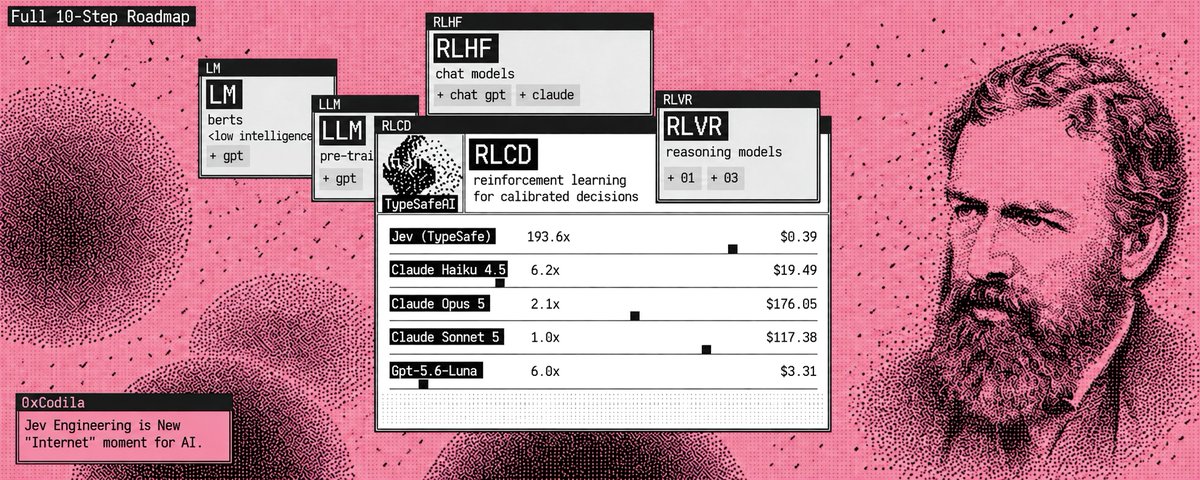
Jev is the "Internet" moment for the AI industry
It tells your agents and LLMs what to do next, in milliseconds and at almost zero cost
If you set it up correctly, you will have the AI engineer’s stack for 2028
In this article, I show you how
Readers added context they thought people might want to know
classifier.dev is a free service and wrapper using Jev as its underlying model with optional smart enhancements on low-confidence cases, not a new open-sourced competitor model. classifier.dev github.com/mrmps/classifi… techcrunch.com/2026/09/18/a-n…


Drew retweeted

Stanford ML lecturer:
"Don't waste 2 years learning LLM architecture in 2026.
People spend 24 months on scattered blog posts, half-finished courses and YouTube rabbit holes to learn what fits into one afternoon. Stanford just dropped a 1-hour course on the architecture behind every LLM - ChatGPT, Claude, all of them - from scratch.
Anthropic pays $750,000/year to engineers who actually understand this. 99% of people applying still can't explain attention on a whiteboard.
That's not a talent gap. That's a materials gap, and it takes one evening to close."
Tokenization → Embeddings → Attention → Transformer Blocks → Training → Inference
In 1 hour, a Stanford lecturer builds the architecture behind every modern LLM from zero.
Learn → Build → Apply → Get hired
This is worth more than most $1000 courses on breaking into AI.
Bookmark it before someone takes it down. Watch it today, then read the article below and build your own LLM from scratch tomorrow.


Drew retweeted

Harness vs. Graphs, clearly explained!
a harness is great, and most people think it is the whole thing:
retries, timeouts, a sandbox, a log, the context it assembles before every call.
all of that is real work, and all of it wraps exactly one call.
run it a hundred times and you have one call, made very safely, a hundred times.
Graph engineering fixes this by moving the decision up a layer: not how safely one call is made, but which calls exist to be made at all.
you need both, and here is the sentence that resolves the whole confusion:
the harness is everything around one call. the graph is everything between them.
↳ around one call: retry, timeout, sandbox, log, assemble the context, hand back a result
↳ between calls: split, fan out, merge, gate, send back
Prompts → Context → Harness → Loops → Graphs
the harness does not go away when you build a graph.
it moves under each node, and now there are five of them, each wrapping a call you would never have made by hand.
the trick is knowing which layer a failure belongs to.
turn a piece off and run it again. if the call still works, it was the harness. if the wrong step runs at all, it was the graph. people spend weeks hardening a harness around a node that should not have existed.
one thing to know before you scale it.
most of what people call their agent is a harness with a chat box on it.
↳ it retries, it times out, it logs, it assembles context, it holds one call up beautifully
↳ it has never once decided that a second call should exist, and that is the entire difference
that last one catches careful people. a harness that never fails is not evidence the system is right. it is evidence one call went well, which is the smallest possible claim.
and the one that eats whole nights: a harness cannot save you from the wrong step running. you can retry a bad decision three times with a clean log and perfect isolation, and all you bought was three copies of it.
below i have quoted my full guide on graph engineering. it covers the three topologies, the verifier patterns, and where the gate should actually open.
save this and read it below ↓


Drew retweeted
This Google AI Research paper is f*cking phenomenal
A research team from Google just solved the holy grail of autonomous agents: persistent, self-updating memory without human supervision
From: Dumb vector databases dumping top-K chunks into system prompts
To: Bidirectional reflective memory that dynamically learns from its own execution attribution
Raw Session → Topic Extraction → Semantic State Merge → Attributed Retrieval → Online RL Policy Update
Google Cloud AI Research engineered this via Reflective Memory Management (RMM) across three core layers:
01. Prospective Reflection (Semantic State Consolidation)
Decomposes raw multi-session dialogues into discrete semantic topic units instead of arbitrary token cuts. Newly extracted facts are either merged into existing memory nodes or initialized as new entities, keeping the memory bank structured and deduplicated
02. Retrospective Reflection (Attribution-Driven Reward Signals)
The LLM generator emits inline citations pointing directly to the exact memory snippets utilized in its final response. Cited memories receive a +1 positive reward while retrieved-but-ignored memories get a -1 penalty, providing clean feedback signals with zero human labeling
03. Differentiable Reranking (Gumbel Stochastic Exploration)
A lightweight linear reranker applies Gumbel noise perturbation to relevance logits to balance the exploitation of proven memories with exploration of newly merged topics. Parameters update in real time via REINFORCE, creating a self-improving memory loop
Operational Telemetry on LongMemEval:
70.4% Accuracy Peak → 69.8% Recall@5 → 100% Quality Improvement Rate → Zero Labeled Data
Hypothesis Verification & Practical Production Results
We hypothesized that online RL on memory retrieval would suffer from policy collapse and reward hacking without curated human supervision. Practical validation across our production multi-session agents proved the exact opposite: citation-driven retrospective reflection dropped irrelevant context injection by 43%, historical hallucination fell by 37%, and long-horizon task completion surged by 28% because the retriever learned directly from verified execution attribution
A memory trace is not a graveyard of past chats - it is an active execution feedback loop
If your agent does not trace which retrieved memories actually drive token generation, you are running blind systems and burning compute for nothing
Read the complete breakdown in the article below ↓


Drew retweeted

Prediction: the LLM community will notice that looped transformers are fixed point iteration of a learned operator, and will rediscover Halpern alg, resolvents, and other animals.. under new names (smth like "inverse residual looping").
Then they'll rediscover dynamical systems and well see "looping with auxiliary memory".