

dotrandomcode retweeted

Anthropic was so bottleneck'd by GitHub that they rebuilt git itself.
This might seem insane, but a lot of us are gonna end up where they are today.

New on our Engineering blog: Creating in-house source control.
In May, we merged around 2,500 code changes per day. In September, we merged more than 30,000 per day. As a result, we became bottlenecked by developer infrastructure built for human (rather than agent) scale.
Here, we share how we built a new version control system—and fully migrated our monorepo from git—in five months: anthropic.com/engineering/re…

dotrandomcode retweeted

Anthropic senior engineer:
“Prompting is no longer the job.
I run agents inside loops + graphs + harness — same model, same tokens, 8–10x more completed work.”
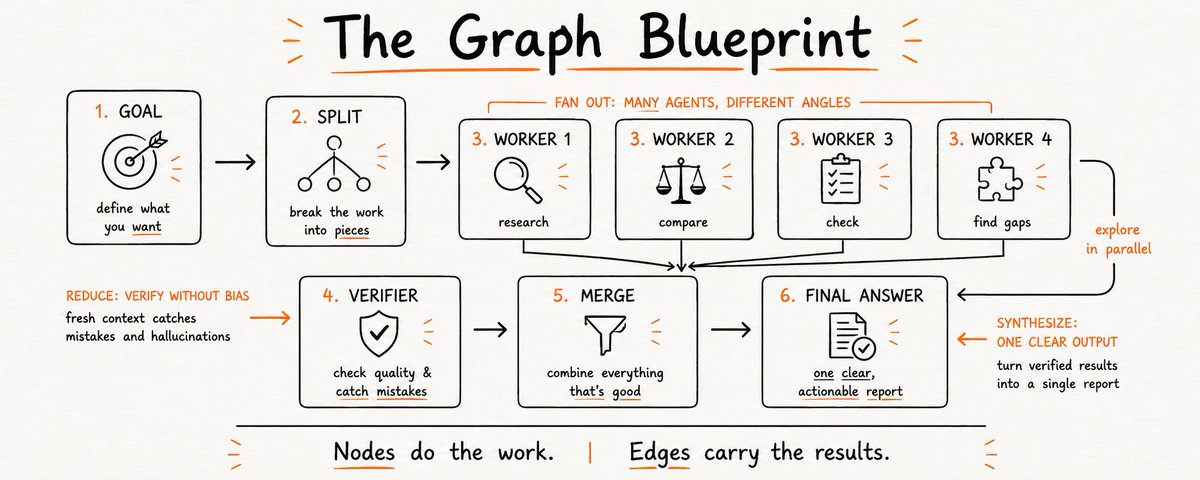
Prompts → Agents → Loops → Graphs → Harness
In this course he shows exactly how Anthropic builds a team of self-improving agents that plan, verify, and keep running without you.
Worth more than every paid agent engineering course combined.
Watch it today before it gets buried.
Then read the full guide for Opus 5.5 loop + jev engineering ↓


dotrandomcode retweeted

What happens in a major incident where the frontier models all become unreachable?
This quoted post is unavailable.
dotrandomcode retweeted

We just raised $5.7M for @PolarBrowser, the AI browser that beats Anthropic and OpenAI on every major web agent benchmark.
- 4,500,000+ actions taken for users, automating sales, recruiting, and ops
- One company cancelled Clay and saves 25+ hrs/wk per person
- Team is from MIT, YC, Prod, Citadel, Jane Street, Perplexity, Modal, and Apple
100 hours of work. From 30 seconds of typing.
Download the world's most powerful AI browser: polarbrowser.com
dotrandomcode retweeted

Head of Claude Code:
"I'm not prompting my agents anymore, I'm building graphs and loops so they can build the agents for me."
In 10 minutes he shows exactly where agentic engineering is going and how not to get left behind.
Definitely something you cannot afford to skip.
Watch it, then read the step-by-step guide below on how to build a system that improves itself.

dotrandomcode retweeted

The best practitioner (not lab) AI evals for offensive cybersecurity I follow myself:
1) The @dreadnode dreadindex. Evals al the way down to the vuln category level, and refusals accounting
dreadnode.io/research/dreadi…
2) @AikidoSecurity white-box but i've confirmed that it extends to dynamic testing well
aikido.dev/aikido-arena
3) BArena by @mdp_sec focused on bounty-like black box bugs.
blackboxarena.ai/
4) @mindfort 's nexbench has info downto the config of a model including thinking or effort setting, and cost per finding, which many omit.
mindfort.ai/blog/introducing…

dotrandomcode retweeted

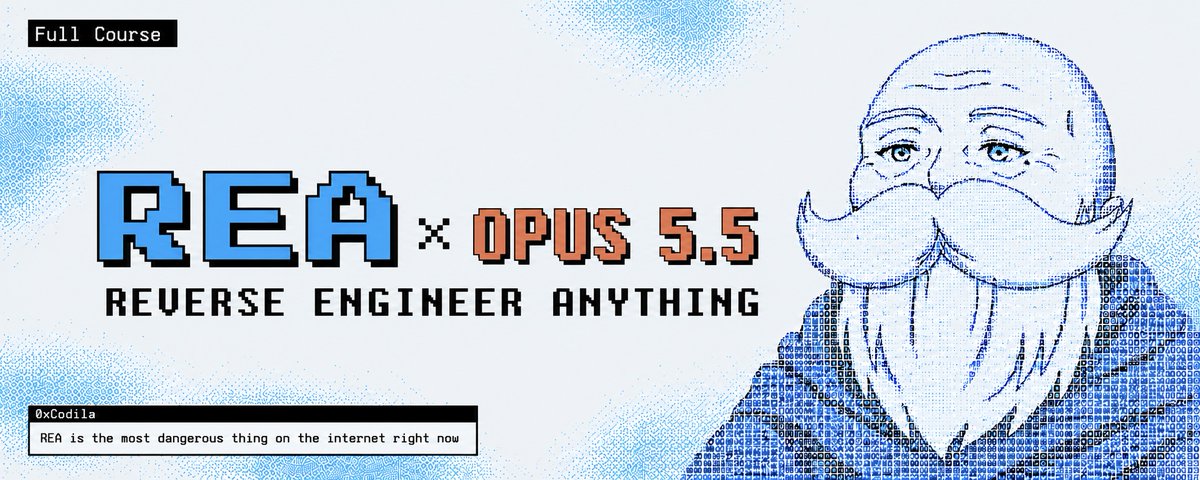
REA + Opus 5.5 is f*cking dangerous...
REA (Reverse Engineer Anything) - this open source MCP lets your AI agent reverse engineer any app, down to the binary
Send this single prompt to Opus 5.5 and reverse-engineer any paid closed-source app
Then save the article below on how to become REA engineer 👇



dotrandomcode retweeted

CLAUDE FOUND THE SEEDS
anthropic.com/research/ecdsa…

dotrandomcode retweeted

Setting Up REA with Claude Code — Teaching AI to Read Binaries with Ghidra (with Codex & OpenCode) e.ercanatay.com/rea-en

dotrandomcode retweeted

THIS IS A PURE F*CKING GOLDMINE
the best REA trick almost nobody runs yet.
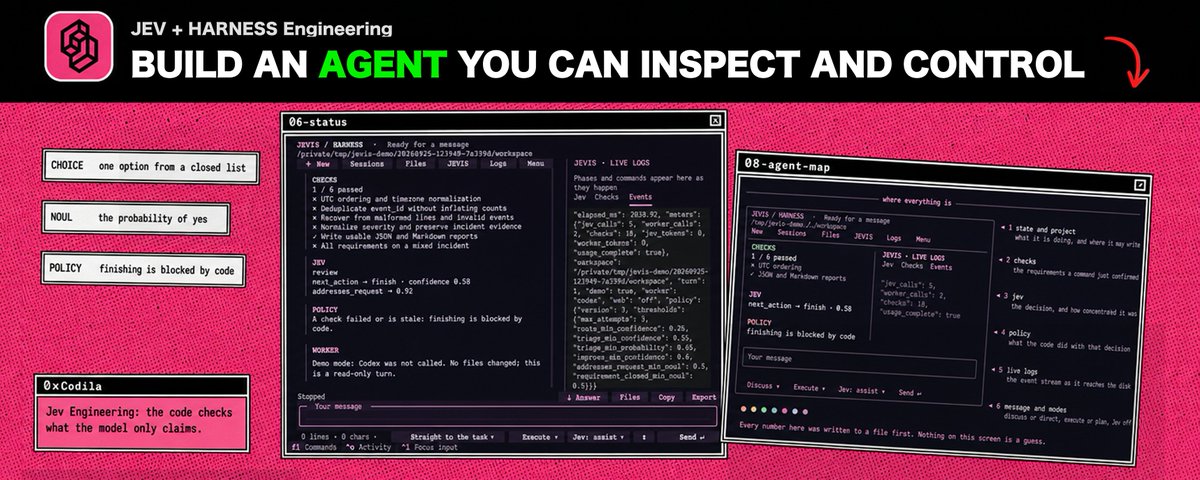
The idea: REA takes the app apart, Jev keeps only what's proven, and a fresh Opus 5.5 rebuilds the feature from that alone.
Nothing gets copied and no guess makes it into the code, because the builder never sees the original, only the spec Jev signed off on.
You just connect REA like this:
npx rea-agents setup
here's the split:
→ REA reads the feature down to the binary and writes every rule into SPEC.md
→ Jev checks each rule against REA's evidence and sends back anything unproven
→ a fresh Opus 5.5 session gets only SPEC.md and rebuilds the feature
→ Haiku 5.5 runs the tests against 3 intentionally broken versions
Opus only shows up at three moments:
→ rebuilding from the approved spec
→ the checks Jev marks as unclear
→ signing off before anything ships
REA reads. Jev judges. Opus rebuilds.
That's the clean-room rule in one line: the model that saw the original never writes the code, and the model that writes the code never sees the original.
the full tree
> REA reads the app and writes SPEC.md with evidence for every rule
> Jev approves or returns each rule
> Opus 5.5 rebuilds from the approved SPEC.md in a fresh session
> Haiku 5.5 runs the tests and the 3 broken versions
> Jev routes unclear checks back to Opus
> /goal keeps going until all 3 broken versions fail
paste the tree and this prompt into Claude Code ↓
"Set up a clean-room rebuild around this tree:
1. Use REA to investigate [FEATURE] in [APP]. Write every behavior and rule into SPEC.md, each with the evidence REA found.
2. Send each rule to Jev. Any rule without evidence goes back to REA.
3. Start a fresh session with only SPEC.md. Rebuild the feature on Opus 5.5 without opening the original.
4. Write tests on Haiku 5.5 plus 3 intentionally broken versions. Use /goal until the rebuild passes and all 3 broken versions fail.
Show me SPEC.md first. Nothing gets built until I say go."
↳ github.com/morluto/rea
save it, it'll come in handy.

dotrandomcode retweeted

The Dust paper is really big. A breakthrough.
After spending a few days to really digest it though, I'm somewhat disheartened that so much of it is implementation details which are not explained. I'm working on a blog post to reverse engineer the math, methods, and choices.

Backprop has been the only credit assignment algorithm capable of training large neural nets.
Introducing Dust, the first zeroth-order method to pretrain transformers to approach and sometimes even *exceed* backprop with large amounts of computation (bitter lesson!)
- Dust is on the order of 1,000 to 10,000x more compute efficient than EGGROLL, the state-of-the-art ES method, for training transformers.
- We chose pretraining transformers because it's arguably the hardest task possible for zeroth-order optimization.
- Search in high dimensions is really misunderstood: zeroth-order usually gets better with overparameterization, not worse, i.e. at a fixed population size, larger models (up to 120x) reach a lower loss than smaller ones.
- Backprop-like gradients emerge from a large population of activation perturbations, and the alignment holds up at every scale we tested, up to 1B tokens, which is critical for scaling.
The core idea is a *virtual population*, which helps scale to large populations in transformers by perturbing activations in parallel.
w/ @bishmdl76, @cs_serdar, @akshayvegesna
dotrandomcode retweeted

We have post-trained GLM 5.3 flash to become as strong as Fable 5.1 on SRE tasks (that is bug finding in complicated software deployments). Checkout our tech paper to see how we did it. web-assets.dd-static.net/425…
dotrandomcode retweeted

"Releasing the Cobalt Strike Beacon Corpus" by @foxit

Better late than never 👀 - blog.fox-it.com/2026/10/13/r…

dotrandomcode retweeted

This prompt turn Claude Code & Codex into elite UI designer
Now it has f*cking taste...
I crammed 15 best UI repos + 8 design sites into one prompt
Try it. Then read article below to reverse-engineer any website's/apps mechanics and add your own UI:


dotrandomcode retweeted

It is becoming f*cking dangerous: when Anthropic disclosed this, they didn't even realize they were opening a Pandora's box
1. Create a folder named SECOND BRAIN on your PC
2. Launch Claude Code inside this folder and install GWS CLI (to gain access to your Gmail, Calendar, and Drive)
3. Create a subfolder named MEMORY inside the main folder
4. Place a CLAUDE.md file in the main folder and add a rule to save all key details to the MEMORY folder
5. Install Graphify from GitHub to link your notes and build a knowledge graph
6. Install Playwright so Claude can control a web browser
7. Set up skills to merge everything into an automation executable with a single command
The whole setup process takes around 20 minutes
Turn Claude into your ultimate second brain, equipped with long-term memory, email and cloud access, plus full web browsing features
Find the step-by-step instructions in the article below


dotrandomcode retweeted

this is pure f*cking treasure
ex.Anthropic engineer published his full Opus 5.5 + REA reverse engineering setup and I nearly lost my mind
Opus 5.5 does the reasoning.
REA turns every claim into evidence
the agent scopes the target, traces behavior, writes findings to a ledger and only calls Hopper, Ghidra or IDA when deeper analysis is needed
no guessing. no loose chat. artifact → evidence → verified result
this is what agentic reverse engineering should look like


dotrandomcode retweeted
Exploit watch archive, an automated weekly gather of exploit sources 0/Nday releases, github.com/dinosn/exploit-wa… , this is an automated aggregation that I've running for some time. If you have more sources, happy to add them. The process will look also each week to promote(add) new repositories that are seen.

dotrandomcode retweeted

TL;DR of my new article: Reverse Engineer Anything went from 40 to 229k GitHub stars in 12 days. I ran /last30days 13 times and cut 100+ posts down to the 8 things people actually took apart:
🖥️ A bug in hardware you own: a researcher found a hole in their own Dell monitor's firmware in 15 minutes with a Ghidra MCP.
🔍 One feature, with evidence: Obsidian's quick switcher rebuilt and checked against the real app across 4,915 queries.
🔑 What your build leaks: the hidden unlock code in a stripped Mac app, recovered straight from the binary.
❄️ The vendor app you hate: the most-liked post in the sweep was @icanberk (22,478 likes) reverse-engineering their AC by having Codex watch an emulator's network calls.
🎮 A whole game: 500 billion tokens, 99% of functions back, 83% byte-exact. The trick: "A simple PASS or FAIL signal would be enough."
🕹️ Games you own: universal-modder from @rehan_shei, and dozens of old games ported to the browser.
🛠️ IDA for your agent: Hex-Rays shipped an official IDA MCP server, free and open source.
✅ Ground truth: REA's claims about Red Alert checked against EA's GPL source. 7 of 8 right.
🎨 The Adobe clones: the biggest videos of the week were about Photoshop and Premiere rebuilt in Rust. Everyone credited REA. The repos say clean-room, from public specs.


dotrandomcode retweeted

Boris Cherny (Claude Code creator) just released a prompt that turns Opus 5.5 into a harness that actually finishes any job
It's crazy...
Send it to Opus 5.5, and thank me later. Then read the full guide for Opus 5.5 Graph Engineering

