
Creator of Levanter and @MarinCommunity. MTS @ Open Athena. Previously Research Engineering @StanfordCRFM, co-founder at Semantic Machines ⟶ MSFT.
Berkeley, CA
Joined September 2007
- Tweets2K
- Following1.3K
- Followers4K
- Likes2.5K



This feels like a general problem with AI (and really most of our institutions): we optimize the legible version of what we want.
Then we're surprised when they're not the same thing.
That model is legitimate mathematics. But the original motivation was faster computation on actual machines.
Somewhere along the way, the formalization became a research objective in its own right, totally divorced from the computation we originally wanted to make faster
I've been thinking more about Ben's post. His most interesting point got lost in the AI kerfuffle. We asked for a faster FFT, but formalized "faster" in a model with O(1) exact complex arithmetic.
The result answers the question we wrote down, but that's not the one we meant.

OpenAI’s faster Fourier transform is less a mathematical breakthrough and more a malicious exploit of mathematical traditions.
argmin.net/p/faster-fourier-…

I've been thinking about where the data for the next generation of open models will come from.
The internet gave us a remarkable commons for pretraining. Posttraining is different: it consumes tasks, not documents. And that commons doesn't exist. Not yet. openathena.ai/blog/there-is-…

David Hall retweeted

Deep learning is often taught as a sanitized collection of facts and math. But work at the frontier of AI is messy and empirical.
Our new class, Deep Learning Alchemy, aims to teach the art and science of deep learning in the hands-on spirit of Language Modeling From Scratch.
Students build intuition by running experiments on small LMs, then test it through prediction quizzes: given an unseen code diff, can you predict what happens?
deep-learning-alchemy.github…
My co-instructor @kothasuhas and I think there's significant demand for classes that treat students as serious learners who want to be assessed for what they’ve learned, and so we're trying a new exam-heavy approach to the class (7 exams, 85% of the grade, with the remaining 15% in-person discussion assessments).
We’ve designed the class so students can use AI agents to run their experiments and do their assignment, but they then have to demonstrate that mastery on exams without access to the assignment, and any partial credit on the exam has to come through citations to the assignment, incentivizing them to know what’s in their write-up.
The same assignments and quizzes are public for anyone to try (lecture recordings will be released through @StanfordOnline with some delay). We have some very fun assignments and quizzes covering both classic topics (like NQM, run-to-run stochasticity, and scaling laws) and new and timely topics like muP or hyperball. Made by some real experts like @TristanThrush and @wen_kaiyue
Try some quizzes below!

Ben’s out here spreading the good word of ultrafinitism.
(But seriously, the cost model here is pretty broken.)
OpenAI’s faster Fourier transform is less a mathematical breakthrough and more a malicious exploit of mathematical traditions.
argmin.net/p/faster-fourier-…
We’re Marin, the details are pretty much always available!
github.com/marin-community/m…
This time we’re deploying Triton router top-k and short conv, leaner ragged a2a transport, fused expert backward, and XLA scheduling fixes


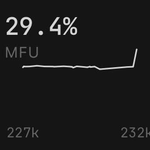
More perf tweaks landed thanks to @mcmcescher! We're now up to ~40% more tokens-per-second than when we launched.

ALT graph showing MFU jumping from ~26 to ~29.4

David Hall retweeted

Takeaways from my fireside chat with the lead of the Marin project, David Hall @dlwh, at the Frontier Data Summit yesterday:
Topic: "How benchmarks are (and aren't) used in model development today"
Takeaways:
- Benchmarks typically occupy one square of a 2x2 grid: pretraining vs posttraining, and internal development vs external communication; posttraining x external ("model card evals") are the household names, but not the only benchmarks that matter
- The best evals for internal development work at multiple scales, so they can guide scaling laws and give signal weeks or months before the model scores something non-zero on traditional model card benchmarks
- Pretraining tends to mostly rely on metrics derived from the pretraining corpus like loss/perplexity, since most benchmarks being built today are built for post-trained models where models may score 0 for months during training; some older evals with short answer types (e.g. multiple choice) also work (e.g. MMLU)
- Evals that isolate a particular property are particularly helpful for guiding decisions during development -- e.g. GraphWalks, MRCR, etc. Doing well on them is necessary but not sufficient to develop a great model. Note that both of these are synthetic; there's a place for those
- Evals we wish existed: more like Terminal Bench Lite (h/t OpenThoughts, @terminalbench, @SnorkelAI, @bespokelabsai) -- intentionally simpler variants of frontier tasks that correlate well with the model card versions but provide signal for smaller models and in earlier stages of development
If you've got an idea for a killer benchmark, get it funded and supported with an Open Benchmarks Grant: benchmarks.snorkel.ai/
xitter.cf/i/broadcasts/1jxXgBoAo…

David Hall retweeted

Going live shortly with a bonus session added! 👀
🆕 How benchmarks are and aren’t used in model development today, with @bradenjhancock (@LaudeInstitute) and @dlwh (Marin/Open Athena)
Behind the benchmarks: Terminal-Bench Science, JudgmentBench, and SlopCodeBench, with @StevenDillmann, @RussellYang16, @GOrlanski, and @vincentsunnchen
xitter.cf/i/broadcasts/1jxXgBoAo…

David Hall retweeted
🚢Marin 535B-A23B training has crossed the halfway mark! Some observations and learnings so far:


David Hall retweeted

github.com/marin-community/m… 31% MFU?! This man doesn’t know limits. @mcmcescher 🙇♂️🙇♂️🙇♂️

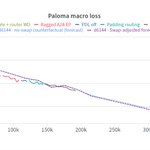
Gotta say the imminent-looking crossing in Larry's plot is making me nervous but my friend "zoom in" is still here to help.

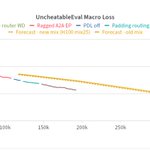
ALT zoomed in plot showing run still slightly beating forecasts

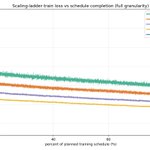
43 days ago Marin kicked off the largest live-streamed pretraining run in history: a 535B MoE trained on 18T tokens. A scaling ladder was used to forecast eval loss along the entire trajectory, and the forecast was publicly pre-registered. Its halfway along, and despite being a 300x extrapolation, the run is within 0.3% of the forecast.
The run was originally planned to be 360B parameters. Until @ravwojdyla found a hardware implementation with custom kernels to grow to 535B parameters while also speeding up tokens per second. Learn about how he did it on the Open Athena blog: openathena.ai/blog/expert-pa….


David Hall retweeted
If you're keeping tally of our blogs @ravwojdyla enabled:
- ~All the infra that enabled our data scale
- A kernel that let us ~2x our parameter count while maintaining higher MFU
🐐
43 days ago Marin kicked off the largest live-streamed pretraining run in history: a 535B MoE trained on 18T tokens. A scaling ladder was used to forecast eval loss along the entire trajectory, and the forecast was publicly pre-registered. Its halfway along, and despite being a 300x extrapolation, the run is within 0.3% of the forecast.
The run was originally planned to be 360B parameters. Until @ravwojdyla found a hardware implementation with custom kernels to grow to 535B parameters while also speeding up tokens per second. Learn about how he did it on the Open Athena blog: openathena.ai/blog/expert-pa….
This is the first in a series on how we got our 535B MoE hero run to ~27% MFU on 11 NVL72 racks.
@ravwojdyla tackles expert parallelism: what we tried, what didn't work, the (somewhat) ugly solution we launched with, and the better solution we swapped in mid-run.

Marin’s 535B-parameter hero run was originally planned as a 360B model. In openathena.ai/blog/expert-pa… we explain how expert parallelism made room for a roughly 50% larger model, with approximately 23B active parameters per token - and the tradeoffs involved.
David Hall retweeted

New historic NanoGPT record at 39.9s (-27.7s) from @DevenPzak , obliterating the prior record of 67.6s!
This record introduces a new paradigm of thinking to NanoGPT: instead of optimizing matmuls or adding more expressive operations, optimize at the individual flop level with incredibly clever engineering and ML judgement. If a flop is low value on a particular step, skip it.
Specifically:
-(~8s) Sampled softmax. If a token doesn’t appear in a batch, skip its lm_head fwd/bwd some fraction of the time.
-Sparse values. Only run an optimizer step for ngram embeddings that occurred in the batch. Set beta1 to zero to enable this. Beta2 is applied retroactively when the row is later used.
-Sparse updates. Only update ngram and value embeddings once every 4 steps instead of once every 2.
-Sparse communication. Shard the n-gram table across GPUs, and only pass the rows receiving updates on each step.
-Sparse optimizer states. For the n-gram table, reduce from 2 floats in Adam optimizer per param, to 1 float per 768 params.
-Hand-rolled flash attention for 64 dim heads.
There are several additions that add accuracy too:
-(~4s) EMA during last 300 steps, combined with lifting final_lr to 0.3 instead of 0.15.
-(~1s) A new optimizer, Anvil2, which expands muon via a second tracked momentum buffer, improves the ortho coefficients, and modifies the cautious weight decay application.
-A couple additional dynamic skip connections in the network.
The most striking consequence of the ‘flop aware paradigm’ is you can grow parameters arbitrarily large,
only limited by the available memory, since you can selectively choose how to expend flops on those parameters on each step. NanoGPT has kept active parameters below 124M, but total is unbounded, and has grown to 640M through embedding sparsity over the last year. This PR takes that to its logical conclusion on the 8xH100, scaling up to 65B sparse embedding parameters, which accounts for 25% of the PR’s gains. At frontier scale, where one is not bounded by an 8xH100, one could imagine where this paradigm could lead.
github.com/KellerJordan/modd…
As this was a very notable PR, I spoke with Deven for an hour to learn how he did it. Here’s his story on the changes: hyperstition.cc/training-nan…

David Hall retweeted
Data work seems to me to be relatively under-discussed as part of modern discussions about progress towards RSI.
Example: Ant. talked a lot about architecture and kernels in their RSI post, but not much about constitutional RL and synthetic data: anthropic.com/institute/recu…
