
Postdoc @Berkeley_EECS | Prev. PhD @UTCompSci, CSE @iitdelhi
Berkeley, CA
Joined June 2017
- Tweets333
- Following416
- Followers262
- Likes3.4K






Pinned Tweet
Some overdue career updates 🎓
This summer, I defended my Ph.D. after six golden years at UT Austin, working with exemplary supervisors and peers at the @utnslab and @ldosexpedition labs. My thesis builds abstractions and interfaces to make systems programmable, flexible, and robust.
Next, I have started in the NetSys lab at @UCBerkeley as a postdoctoral scholar. At Berkeley, I’ll expand my research at the intersection of systems and agents: how do we design systems that remain performant, trustworthy, and maintainable as autonomous agents are increasingly used to build and deploy them?
Excited for what lies ahead! Stay tuned!! 🚀
🤖 Made with AI


**Performance robustness** matters for business-critical applications as much as safety and correctness -- yet, even learned controllers miss latency targets under changing environments.
Next week, I will be at NSDI to present my work that addresses this challenge!

This is joint work w/ Gaurav, Jiaxin, @bobowang2014, @IsilDillig, Sanjay, and @adityaakella
Catch this work at NSDI first day, first session, first talk (track II)!

Learned congestion controllers may not always result in good performance - even SOTA learned controllers can result in bandwidth starvation, and other types of poor behavior!
Our work on making learned controllers meet desired properties will appear at EuroSys this week!

Key idea in Canopy: we construct a quantitative feedback from formal verifiers and integrate this feedback *into the training loop* of learned controllers.
Thus, the neural network learns to not just optimize for empirical performance but also: how to meet desired properties!
This is joint work with @chenxiyang_ut, Rohit, @kshiteejmahajan, @swarat, and @adityaakella
If you are at EuroSys, please check out the talk during Day 2 afternoon session (track B) and reach out if there are any thoughts/questions!
Divyanshu Saxena retweeted

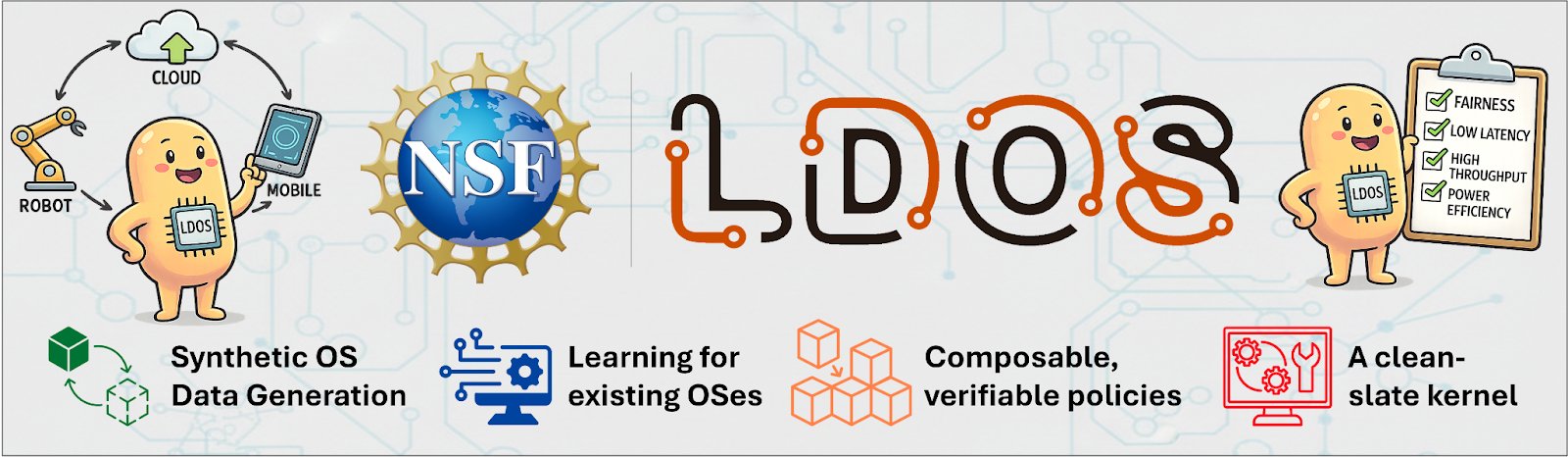
Our @ACMSIGOPS blog post lays out the LDOS roadmap for learned OS policies. Would love to hear thoughts from the systems + ML community!
Co-written with @divytweet
Aneesh Durg, Sujay Yadalam, Jiayi (Jane) Chen, Rohit Dwivedula, and Chris Rossbach. Many thanks to the @NSF CISE Expeditions program for supporting this work.

LDOS aims to build an intelligent, self-adaptive OS that uses learned policies to share resources efficiently and effectively. It presents a concrete path of using AI to rethink and redesign OS.
Divyanshu @divytweet and the @UTCompSci team, led by Prof. Akella @adityaakella, wrote a great article to share their vision, roadmap, and many exciting research directions they've made great progress on.
You can find more information at ldos.utexas.edu and @ldosexpedition.
Thanks for featuring our article!
This blog post highlights the motivation behind and the vision for LDOS @ldosexpedition. We are actively working towards the next horizon of intelligent Operating Systems!
LDOS aims to build an intelligent, self-adaptive OS that uses learned policies to share resources efficiently and effectively. It presents a concrete path of using AI to rethink and redesign OS.
Divyanshu @divytweet and the @UTCompSci team, led by Prof. Akella @adityaakella, wrote a great article to share their vision, roadmap, and many exciting research directions they've made great progress on.
You can find more information at ldos.utexas.edu and @ldosexpedition.
Divyanshu Saxena retweeted

New SIGOPS Blog -- "LDOS: Toward A Learning-Directed Operating System" by by Divyanshu Saxena, Aneesh Durg, Sujay Yadalam, Jane Chen, Rohit Dwivedula, Chris Rossbach, and Aditya Akella.
sigops.org/2026/ldos-toward-…
If you are attending @NeurIPSConf, do check out our poster at the ML for Systems workshop on a novel approach for improving interdependent systems policies by developing shared representations!

Divyanshu Saxena retweeted

For decades, OSes have relied on hand-tuned heuristics. What if they could write their own?
🔥 Meet PolicySmith, our LLM-driven framework that generates high-performing, interpretable system code.
📄arxiv.org/abs/2510.08803 at #HotNets25
#LDOS #MLforSystems #CodeGeneration

Our vision for using LLM-driven search for discovering better systems heuristics is set to appear at HotNets'25!
Our thesis is that we can achieve **instance-optimality** using advanced code-generation and reasoning capabilities of LLMs!

For decades, OSes have relied on hand-tuned heuristics. What if they could write their own?
🔥 Meet PolicySmith, our LLM-driven framework that generates high-performing, interpretable system code.
📄arxiv.org/abs/2510.08803 at #HotNets25
#LDOS #MLforSystems #CodeGeneration
Crucially, we identify what this high-level specification should contain - abstracting the overall search into a small number of components.
We apply this to Web Caching and Congestion Control; and discover heuristics that outperform established baselines in our prototype!
