
I like building and I cannot lie.
UC Berkeley, Savage Lab
Joined October 2011
- Tweets114
- Following1K
- Followers387
- Likes623




Pinned Tweet
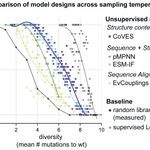
Do you need a billion parameters and millions of sequences for #proteindesign? Maybe not! See our paper: shorturl.at/novMO
We show that interpretable, non-autoregressive structure-based protein design can work!
Original thread: shorturl.at/cdgCP
David Ding retweeted

Check out our last pub. from @mfgrp lab! We discovered that skin commensal microbes induce systemic and local B cell responses upon colonization and took advantage of this knowledge to create topical vaccines using engineered skin microbes. Please read the thread for details.

Today we report that an engineered skin bacterium, swabbed gently on the head of a mouse, can unleash a potent antibody response against a pathogen. Could lead to topical vaccines that are applied in a cream. @DjenetBousbaine led the charge... @Nature 1/55

David Ding retweeted

Excited to share our new preprint on the Taxol pathway!
We developed a strategy to systematically activate and identify gene sets in non-model organisms and used it to find 8 new genes in the Taxol pathway, allowing us to biosynthesize Taxol precursors de novo.
Surprisingly, this required a new protein (FoTO1) that helps the first Taxol P450 oxidase produce the correct product. more here: biorxiv.org/content/10.1101/… congrats to coauthors
@Sattely_lab
@ctliu629 @fordycelab
David Ding retweeted

What limits rubisco function? Is it the chemical mechanism? Evolution? In an updated pre-print @prywes et. al explore this question by assaying >99% of single amino acid mutants in Form II rubisco (1/7)

So we are blowing past 1.5C, and expecting hundreds of millions of global south folks with forced migration and newly poverty in the coming years. #ipcc

Really enjoyed this summary of recent AI progress and possible implications: youtu.be/xoVJKj8lcNQ?si=8oI0… thanks Carlo amadei
Thanks to the team @ecolienthusiast, @samsinai, @_nathanrollins, @NoamPrywes, @dfsavage, @michael_laub8, @deboramarks. Thanks also to @chloehsu0 + @SteffanPaul3, and 2 anonymous reviewers for great suggestions.
The 5050 program is giving me the tools to turn my research into a startup, everything from how to move fast to the secrets of fundraising to how to build a team around you. If you want to learn about deep tech startups, and build one, go apply!
xitter.cf/sethbannon/status/1757…

The SaaS startup playbook doesn’t work in deep tech. “Move fast and break things” doesn’t apply when building nuclear reactors or bioengineering cell therapies.
That’s why we built 5050, “a cheat code for starting a deep tech startup.” (quote from an alumni)
Applications open!
fiftyyears.com/5050
5050 is a program to help scientists and engineers start indispensable companies. We’ve distilled everything we know about deep tech startups into a two phase program.
Phase I: Explore
We’ll help you answer: How do I turn my breakthrough science into a business? What do I need to make a startup idea work? How do I recruit a world-class team Am I ready to be a founder?
We'll help you diagnose and mitigate risks and pivot quickly if necessary.
At the end of Explore, those ready to build a startup will be invited to the next phase, Build
Phase II: Build
You’ll join a select cohort of the most high-speed founders solving massive world problems. Build will help you de-risk their technology, hit milestones, raise a first round, and reach takeoff speed faster than you think is possible. You’ll learn everything you need to know about starting a deep tech company and what it takes to become a world class entrepreneur.
At @fiftyyears, we’ve backed over 100 deep tech startups, helped them raise over 5.5 billion dollars, and supported our founders in achieving many firsts:
➜ the first carbon-negative molecule factory
➜ the first cultivated meat approved in the U.S.
➜ the first microgeo satellite for internet connectivity
➜ the first in-orbit space pharma drug factory
➜ the first de novo synthesis of a 1000+ base DNA molecule
➜ and many more
Whether you’re validating an idea or ready to build — 5050 is for you.
Apply! ➜ fiftyyears.com/5050
David Ding retweeted

@MafaldaFigDias & @Jonnygfrazer lab is looking for someone who loves model building and is keen on studying disease from an evolutionary perspective.
Experience in statistics, deep learning, or transcriptomics is desirable but not essential.

David Ding retweeted

New preprint out!
Babies are born to breastfeed.
While 50% of lactating persons struggle to make enough milk, there are no FDA-approved drugs to enhance lactation.
We engineered a long-acting prolactin, Prolactin-XL,
to enhance milk production.
bit.ly/prolactin-XL
1/14

David Ding retweeted

Excited to share our preprint on cyanobacterial communities and their core microbiome, with @Dr__Diamond as corresponding author and incredible help from @jkzorz, @K_BoumaGregson, @catacruanas, @BanfieldLab. #microbiome #Genomics #WomenInSTEM
biorxiv.org/content/10.1101/…

Do you need a billion parameter protein language model to make the right mutations?
Turns out: Learning residue mutation preferences from structure enables designing protein variants better than autoregressive methods.
biorxiv.org/content/10.1101/…
1/7

So maybe most that expensive & uninterpretable sequence models are learning is just the local structural context. Building models directly on structure can be more powerful.
6/7
More info here: youtube.com/watch?v=OaOj3znH…
This was great teamwork with @ecolienthusiast, @samsinai, @_nathanrollins, @NoamPrywes, @dfsavage, @michael_laub8, @deboramarks. Thanks also to @chloehsu0 + @SteffanPaul3.
7/7
David Ding retweeted

Watch this mother react the moment she sees her baby move
This newborn baby boy was born at Sedgwick County Zoo via c section on November 15 and was put on oxygen,
here is mum and baby reunited
David Ding retweeted

Here at @SavageCatsOnly we are thrilled to present a review on rubisco. We focused on structure, mechanism, evolution and engineering attempts. We try, and fail, to conclusively answer the question "What exactly is holding this enzyme back?" 1/10
arxiv.org/abs/2207.10773
