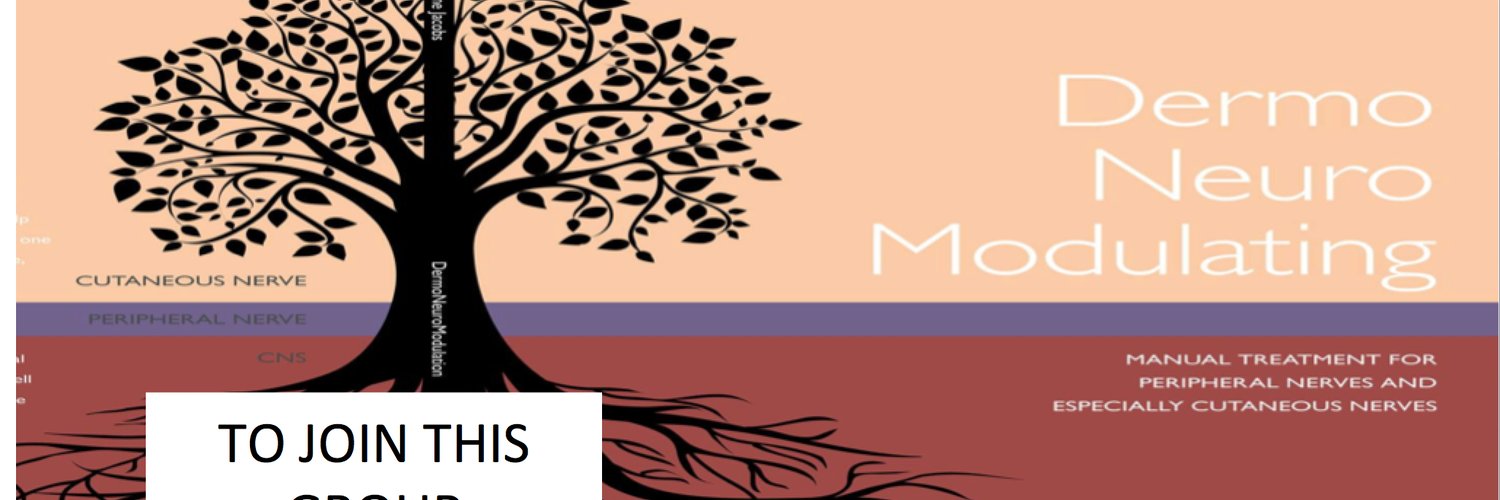

retired physiotherapist~writer~workshop instructor https://xitter.cf/t.co/dLluHN8Toy ~ https://xitter.cf/t.co/rqv0ZKJq6E ~ The book: DermoNeuroModulating
Weyburn, Sask, Canada
Joined August 2009
- Tweets31.9K
- Following1.2K
- Followers4.4K
- Likes11.2K





Pinned Tweet
Brand new Dermoneuromodulating (DNM) on-demand course, recorded in studio, replaces the one that had significant audio issues. Free access to anyone who purchased the old course @JoinEmbodia. embodiaapp.com/courses/1181-…

Ectodermalism, a principled approach. The nervous system spans the entire distance between skin cell and sense of self. Be kind. Don't be narrow in your framing of manual care for people.

In pain care, we have a habit of swinging the pendulum too far.
Some clinicians lean heavily on bottom up strategies: local tissue treatments and biomedical interventions while overlooking the top down drivers that can amplify and sustain pain experiences.
Others leap straight into psychologically informed approaches, missing the fact that an unresolved nociceptive process is still fueling the system.
Both extremes can fail our patients.
The best clinicians hold space for both:
•Bottom up skills: recognizing and treating tissue driven nociceptive contributors.
•Top down skills: addressing the psychological, behavioral, and contextual factors that shape pain.
Neither alone is enough. The art of pain care lies in knowing when each matters most and how they interact.
This is not about bottom up or top down. It is about bottom up and top down, brought together in a way that truly meets the person in front of you.
I see the fort is still standing against reason.

IFOMPT Issues!!!
A brand new blog that’s gonna ruffle a few @IFOMPT feathers adammeakins.com/blog/ifompt-…

Diane Jacobs retweeted

I don't understand publishing papers in journals that aren't open access. Who do you want reading the paper? Just other academics?
As a consumer, most of us have already funded this research through taxation which goes to the University.
It feels like a broken system
Diane Jacobs retweeted

HOT OFF THE PRESS:
OPEN ACCESS 50 DAYS
CFT is the first treatment for chronic disabling low back pain with good evidence of large, long-term (>12 months) effects on disability.
@MarkHancockPT Peter Kent Anne Smith @jpcaneiro @RobSchutze @kieranosull @janhartvigsen and team

Diane Jacobs retweeted

DNM practitioners in Uganda looking for dycem reels @RolianPhysio has got you covered @mutiibwallan @dfjpt @Ugphysiotherapy
Diane Jacobs retweeted

Whenever you're solving a problem—you have to solve these two meta problems in order to be adaptive:
• Anticipation: You need to anticipate the world. The farther out you can anticipate the world the more intelligence people will attribute to you. It's way better to avoid the tiger than to fight it
• Relevance Realization: There's way too much information to pay attention to—and you're intelligent by ignoring most of the information (and zero in on the relevant information)
But it’s not a cold calculation—you care about this information rather than that information
Machines don't care about the information they're processing—you do


Diane Jacobs retweeted

Everyone on social media is self promoting, me and you included… but some are worse than others!

Diane Jacobs retweeted
Surprise! The Russians, after repeatedly saying they don't want a ceasefire, have once again said they don't want a ceasefire.
Diane Jacobs retweeted
Just my hands causing a change in the life of my Clients. Thanks to Dermoneuromodulation @RolianPhysio

Diane Jacobs retweeted
Off to bed after unraveling pain with Dermoneuromodulation magic and some slick DNA skills. If your body’s a puzzle and your nerves are screaming, DM me—I’m the physio you need. Night, X! @dfjpt @dr_katumwa @EnockArts @rkalyes1 @RolianPhysio @Ugphysiotherapy @agosflowerPT
Diane Jacobs retweeted

Discomfort and mistakes are part of our development. Don’t go backward, go forward. #Leadership #hcldr #silvernail_lining
Diane Jacobs retweeted
She tried everything—chronic headaches, endless physio visits, no relief. Then she found Dermoneuromodulation (DNM). No cracking, no forcing—just the nervous system doing its thing. One session, and she was amazed.
As Diane Jacobs says: 'No need for expensive, high-velocity manipulations. Let nature do the work. Let the nervous system handle its own heavy lifting, self-correction, and feedback loop dismantling.'
Pain doesn't have to control you. Maybe it's time to try something different.@RolianPhysio @dr_katumwa @EnockArts @rkalyes1 @Ugphysiotherapy @dfjpt @mutiibwallan @adfurlan @adamdobson123 @agosflowerPT #DNM #PainRelief #Neurocentric – at Kampala, Uganda
Diane Jacobs retweeted

Ever wonder why a ‘new’ treatment suddenly works when nothing else did? 🤔 It might not be the treatment itself—but something much deeper at play.
Clinicians often claim, "My patient didn't respond to anything until I tried this new treatment." It’s a compelling statement—but one that deserves deeper scrutiny.
Attributing success solely to a new intervention ignores the powerful context that drives outcomes. Here’s what’s often at play:
✅ The Uniqueness Effect – When a treatment feels new or different, it captures attention. Patients may perceive it as more valuable simply because it stands apart from previous interventions.
🔄 The Ritual & Novelty – The structured, intentional process of introducing something "new" adds weight to the experience. The novelty alone can enhance engagement and expectation-driven effects.
🔥 Clinician Excitement & Certainty – A fresh intervention often reignites a clinician’s enthusiasm. When we truly believe in something, we deliver it with greater conviction—and patients pick up on that energy. Confidence, attention, and belief all contribute to the outcome.
🛑 The Contextual Shift – A patient who “suddenly” improves with a new treatment has already gone through multiple attempts at care. Their pain experience has evolved, their mindset may have shifted, and their condition might have fluctuated naturally.
The danger? 🚨 When we mistake contextual influence for treatment specificity, we reinforce the illusion that a single technique holds the key. This leads to unnecessary interventions, wasted resources, and clinicians chasing the next "miracle fix."
🔑 The Real Takeaway: The response isn’t just about what we do—it’s about how we do it, the meaning it carries, and the context in which it’s delivered. Even with this “amazing” new change, we need to shift to a now what? mindset. Changes in clinic are meaningless if they don’t translate into durable improvements in daily life.
👉 Have you seen this pattern in clinical practice? Let’s discuss below! 👇
... have been socially engineered to believe BS of any sort; this includes all of us, because we ALL are/have been socio-culturally regulated, just because we are humans and that's what our species does to its members no matter who you are or where you're from or what you do.