

Let's talk DevRel 🥑
Worldwide
Joined September 2022
- Tweets429
- Following80
- Followers736
- Likes351


DevRel As Service retweeted

If you use LLM-as-judge, this one is worth reading.
(bookmark it)
It's actually one of the most effective ways to use LLM-as-a-Judge for evals.
Holistic judge scores hide both their reasoning and their ceiling effects.
BINEVAL decomposes each evaluation criterion into atomic yes-or-no questions, answers each independently per output, then aggregates the verdicts into calibrated multi-dimensional scores.
Every question-level verdict is inspectable, so you can diagnose exactly why an output scored low, and the same verdicts feed straight back as targeted prompt-improvement signal.
Across SummEval, Topical-Chat, and QAGS, it matches or beats UniEval and G-Eval, training-free, with especially strong results on factual consistency.
Paper: arxiv.org/abs/2606.27226
Learn to build effective AI agents in our academy: academy.dair.ai/

DevRel As Service retweeted

Everyone is chasing self-improving models.
The bigger opportunity is self-improving products. Your users generate the best learning signal every single day.
I think that's where the real competitive advantage will come from.


DevRel As Service retweeted

Wanna replace Anthropic/OpenAI? START WITH THIS
The bible for running LLMs locally is now available online to read for free
Covers what to use on
- Laptop / edge / odd hardware
- Mac-first workflows
- Single RTX GPUs
- 2-4+ NVIDIA / CUDA GPUs
- General production serving
- Long-context / MoE / routing
- NVIDIA max performance
- Cluster orchestration
Software
- llama.cpp
- MLX / MLX-LM
- ExLlamaV2
- ExLlamaV3
- vLLM
- SGLang
- TensorRT-LLM
- NVIDIA Dynamo
You should read this, and if you cannot now then you most definitely wanna bookmark it for later
Opensource & Local AI FTW


DevRel As Service retweeted

UI/UX for building org-level Agent Harness.
Bring your model, own the runtime, and wire it with your tools.
100% Opensource.


DevRel As Service retweeted

✨ I think I've been coding almost solely on my VPS with Claude Code for almost a year now
All I can say it's just fantastic:
- no need to keep laptop open ever
- no laptop battery drain
- can switch to phone or any other device you like whenever you want to continue (like when you're outside)
- it just keeps going all night while you sleep (esp with /goal)
- you can start hacky projects from scratch and go live in seconds because you're already on the server which is great to ship things and get it used by people fast (not stuck on your local laptop webserver)
- it just feels like living in the future
I used to code on my laptop, test locally, then push to GitHub, then it auto pulled and deploy to production, that'd take me ~1 minute to get a new feature out
But then when I bought a new Mac Book Pro a few years ago I was too lazy to install a local Nginx environment, so I just started pushing to prod and everything went fine, and I sped up deploying to about 3 seconds from laptop to server, which people called me crazy for too
But now with Claude Code on my VPS in the last year, it just live edits on my production server, which sounds like it should go wrong but it just doesn't, it's very careful and only twice in 12 months messed up which meant my site didn't load for 10 seconds which is OK
If I wasn't working solo, like at a big company, I' think I'd recommend the same workflow but with a staging server, so it wouldn't touch production, for safety and regulatory reasons etc. but for me it's fine
I agree with @theo completely, it's clear to me this is where it's going, also seeing @karpathy with Claude moving to the cloud (via Slack etc), I think AI "agents" and AI coding will operate on servers / from the cloud first
P.S. I have 3-2-1 backups, multiple on-site and off-site backups which you should also even if you wouldn't code with AI, safety first!


DevRel As Service retweeted

A Japanese dev spotted the trick: ask Claude Code to automatically Find Skills.
Can match your goal to the right tool, using Vercel’s skills CLI across Claude, Codex, Cursor, and Gemini.
so install skill like dev tools rather than rewritten by hand
DevRel As Service retweeted

Put together a list of things you can automate using Claude Code.
With this, you can create the ultimate system. ↓
DevRel As Service retweeted

Andrej Karpathy:
"Remove yourself as the bottleneck. Maximize your leverage. Put in very few tokens, and a huge amount of stuff happens on your behalf."
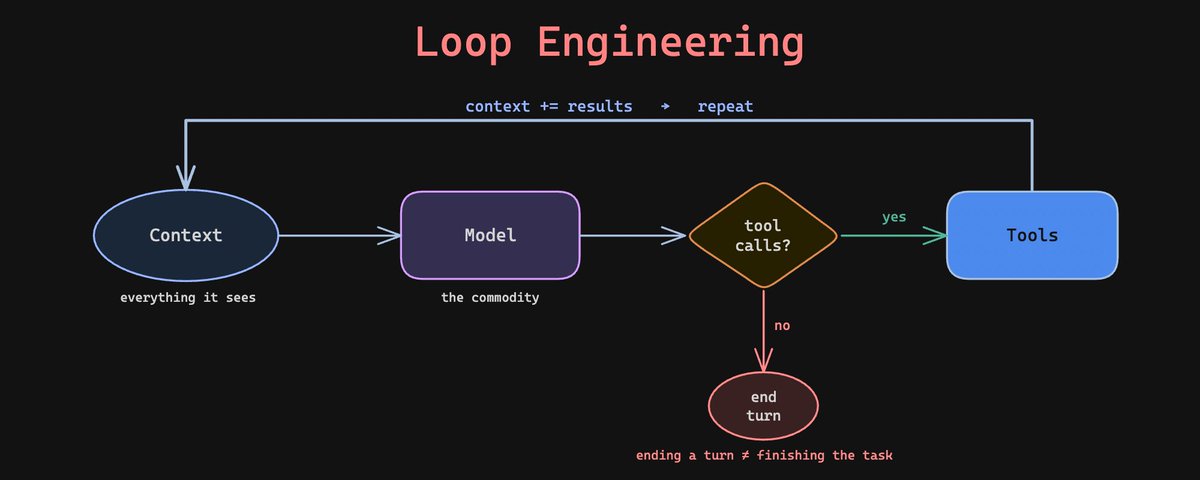
loop engineering is the exact thing that gets you there.
in a hand-run session you do two things. you decide what the agent runs next, and you check its output before the next step. both are manual, and both are the ceiling on how far the agent gets without you.
loop engineering moves both steps into the system. the diagram below shows the operating structure that surrounds the loop:
→ a trigger decides what to run, whether that's a message, an event, or a schedule, so the agent starts without you there to kick it off.
→ the loop is the maker that produces the work, thinking, acting, and observing until it's done or the brakes stop it.
→ a separate checker grades the output, because a model grading its own work justifies what it already did instead of catching where it failed. the checker's findings return to the maker as the next instruction, and the cycle repeats until nothing is left to fix.
→ state lives on disk, not in context, since the model forgets everything between runs. an MD file or a knowledge graph holds what's done and what's still open, so a loop can pick up again days later.
for that state layer, Zep's Graphiti is a clean open-source option, a temporal knowledge graph that invalidates stale facts and returns context through vector, full-text, and graph search in one call.
repo: github.com/getzep/graphiti
two things decide whether an unattended loop holds up.
the exit has to be set before the loop runs, not while it's running. a loop with no stop condition burns tokens, and the cost climbs fast once sub-agents and long runs stack up. a clean exit reads like "all tests pass and lint is clean, stop after two passes."
and the checker only catches failures inside a run. the harness around the loop, the prompts, tools, and checks wrapped around the model, still drifts and breaks in production as models change. catching that needs observability on every run, not a green checkmark.
Comet's Opik is built for that layer, an open-source tool that traces every call and turns a failing production trace into a regression test so the same break can't recur.
repo: github.com/comet-ml/opik
your job stops being the hands inside the loop. it becomes designing the machine that runs without you, then watching the traces closely enough to trust it.
the model is becoming a commodity. the loop around it is where the real engineering lives now.
I wrote the full breakdown. the article is quoted below.
stay tuned for more on this!

DevRel As Service retweeted

New in-progress skill: /loop-me
Interviews you about your work and finds opportunities for delegating your day-to-day work to AI

DevRel As Service retweeted

Watch me control my computer with just my voice. This is the future of operating systems.
No hands.
GPT-Realtime 2.0 is very, very underrated.
Demo:

DevRel As Service retweeted

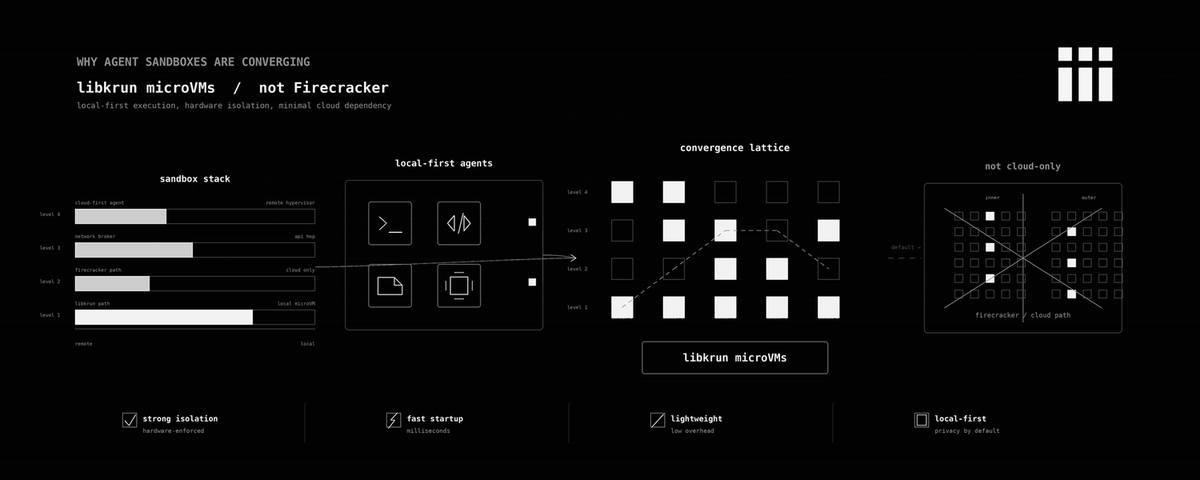
Almost everyone is building agent harness systems the wrong way.
The default move: pick LangChain or LangGraph or the OpenAI Agents SDK, accept the loop, the tools, the memory, the orchestration, the policy engine, the credential store, the budget tracker, all of it, as one decision.
Mike, wrote a long piece today on why this shape is wrong, and why every long-running agent team eventually ends up rewriting its harness from scratch.
His argument: a harness isn't one thing. It's fifteen separate concerns bundled together because the surrounding ecosystem didn't give you a way to compose them. Turn state machines, provider routing, credential vaults, policy engines, approval gates, budget trackers, hook fanout, context compaction, session trees, OpenTelemetry tracing. Frameworks ship them as one block because that was the only shape available a year ago.
It isn't anymore.
When every layer is a worker on a shared bus with a typed function contract, "build your own harness" stops meaning "fork a framework." It means swap a worker. Don't like the model catalogue? Write one that hits a live API. Don't like file-backed credentials? Plug in your secrets manager. Want approvals routed through Slack instead of a console? Add a worker that calls approval::resolve. The rest of the stack does not change.
The framework era picked a position for you and locked you in. The worker model leaves the choice in your hand.
Worth reading in full.


DevRel As Service retweeted

18k ⭐️ on a GitHub repo. Organically.
My friend @ghumare64 is a great example of building in public for the community. The guy is genuinely passionate about what he does and builds open-source projects that get serious traction.
His latest project, agentmemory, a persistent memory layer for AI coding agents based on real-world benchmarks, and hit the number 1 trending spot. Incredible milestone.
Check it out here: github.com/rohitg00/agentmem…

DevRel As Service retweeted

Today we reduced headcount by 22%. The business is the strongest it's ever been. So I think it's important to be direct about what I'm seeing and why.
First, I made this decision and I own it. I did it because the way to operate at the highest level of productivity is changing, and to win the future, ClickUp needs to change with it.
Second, this wasn't about cutting costs. Most savings from this change will flow directly back into the people who stay. We'll be introducing million-dollar salary bands. If you create outsized impact using AI, you'll be paid outside of traditional bands.
Most importantly, I have the deepest gratitude for those affected. We're doing this from a position of strength specifically so we can take care of people properly. Everyone affected receives a package aimed at honoring their contributions and easing the transition.
I only see two options: wait for this to play out gradually in the market or be honest about what I'm seeing and act proactively.
THE 100X ORGANIZATION
The primary change is that we're restructuring around what I call 100x org. The goal is 100x output. The roles required to build at the highest level are fundamentally different than they were a year ago.
Incremental improvements to existing systems won't get us there. We need new ones. That means creating enough disruption to rebuild rather than iterate on what's already broken.
The common narrative is that AI makes everyone more productive. It doesn't. Many of the workflows of today, if left unchanged, create bottlenecks in AI systems.
These roles will evolve. But waiting for that to happen naturally means falling behind now.
The 100x org is actually heavily dependent on people - infinitely more than today. This is only possible with 10x people that have embraced and adopted new ways of working.
THE BUILDERS, AGENT MANAGERS, AND FRONT-LINERS
— THE BUILDERS: 10X ENGINEERS
I don't think most companies have internalized what's actually happening with AI in engineering. The common narrative is that AI makes all engineers more productive. That may be true in isolation, but at an organization level - that is the farthest thing from reality.
Here's what we've validated recently at ClickUp: the great engineers, the ones who can orchestrate, architect, and review, are becoming 100x engineers. They're not writing code. They're directing agents that write code. The skill is judgment.
AI makes the best engineers wildly more productive, and everyone else using AI slows these engineers down.
Think about it - the bottlenecks are (1) orchestration - telling AI what to do, and (2) reviewing - what AI did. Everything is leapfrogged and no longer needed.
So who do you want orchestrating and reviewing code?
And how do you want your best engineers to spend their time?
If your best engineers are spending time reviewing other people's code, then this is inherently an inefficient bottleneck. These engineers can review their agent's code much faster than reviewing human code.
The new world is about enabling your 10x engineers to become 100x.
The wrong strategy is to push every engineer to use infinite tokens. Companies doing this are celebrating 500% more pull requests. But customer outcomes don't match the volume of code being generated.
I call this the great reckoning of AI coding, and every company will face this soon if not already.
More code is just another bottleneck to the best engineers, and ultimately to your company's impact as well.
— THE BUILDERS: 10X PRODUCT MANAGERS
Product management and design roles are merging.
Designers that have customer focus, become more like product managers.
And product managers that have intuition for UX become more like designers.
The bottleneck of user research is gone. It takes us just one mention of an agent to kickoff research and analyze results.
The bottleneck of product <> design iteration is also gone. The product builder iterates on their own, along with agents and skills that ensure alignment with quality and strategy.
Also controversial today - I believe that the wrong strategy is to have your PMs shipping code - that just introduces another bottleneck that the best engineers will waste their time on.
To be clear, PMs should be coding but they should do this in a playground to iterate, validate, and scope. That code should not go to production.
Everything outside of managing systems, orchestrating AI, and reviewing output becomes a bottleneck.
That's why the other roles that are critical along with these are the systems managers (to reduce bottlenecks) along with a bottleneck you can't replace - customer meeting time.
— THE SYSTEM MANAGERS
Ironically, the people that automate their jobs with AI will always have a job. They become owners of the AI systems - agent managers. We have many examples of these people at ClickUp.
The underlying systems in which we operate are absolutely critical to get right. I think most companies are delusional to think they can iterate on existing systems and compete in this new world.
You must create enough disruption so that old systems are deprecated entirely. If there's any definition for 'AI native' that's what it is.
— THE FRONT-LINERS
In a world that will become saturated with AI communication, the human touch will matter more than anything to customers.
This is a bottleneck that you shouldn't replace - even when agents are high enough quality to do video meetings.
One-on-one meeting time with customers is something that shouldn't be automated. The systems around the meetings should be - so that front-liners spend nearly 100% of their time with customers.
REWARDING 100X IMPACT
In a world where companies are able to do so much more with less, where does that excess money go?
In our case, much of the savings in this new operating model will flow directly back to those that enabled it.
We must reward people that create productivity accordingly. This aligns incentives on both sides. Plus, in a world where your best people create 100x impact, you can't afford to lose them.
You should aim to retain these employees for decades. The context they have and their ability to efficiently orchestrate and review will be nearly impossible to replace.
Compensation bands of today should be thrown out the door. We're introducing $1 million cash/year salary bands with a path available to nearly everyone in the company if they produce 100x impact by creating or managing AI systems.
THE FUTURE
Nearly every company will make changes like these. The ones that do it proactively will define what comes next.
The future is not fewer people. It's different work, new roles, and better rewards for those who embrace it. We're already seeing entirely new roles emerge, like Agent Managers, that didn't exist a year ago.
ClickUp is positioning to lead this shift, not just internally, but for our customers too. I've never been more certain about where we're headed.



DevRel As Service retweeted
RAG vs. CAG, clearly explained!
RAG is great, but it has a major problem:
Every query hits the vector DB. Even for static information that hasn't changed in months.
This is expensive, slow, and unnecessary.
Cache-Augmented Generation (CAG) addresses this issue by enabling the model to "remember" static information directly in its key-value (KV) memory.
In fact, you can combine RAG and CAG for the best of both worlds.
Here's how it works:
RAG + CAG splits your knowledge into two layers:
↳ Static data (policies, documentation) gets cached once in the model's KV memory
↳ Dynamic data (recent updates, live documents) gets fetched via retrieval
This gives faster inference, lower costs, and less redundancy.
The trick is being selective about what you cache.
Only cache static, high-value knowledge that rarely changes. If you cache everything, you'll hit context limits. Separating "cold" (cacheable) and "hot" (retrievable) data keeps this system reliable.
You can start today. OpenAI and Anthropic already support prompt caching in their APIs.
I have shared my recent article on prompt caching below if you want to dive deeper.
Have you tried CAG in production yet?
Below, I have quoted an article that I wrote on prompt cashing and how Claude Code achieves a 92% cache hit-rate. Give it a read.
