

WIP. Couldn't become a tennis player so chose the next best thing - B2B SaaS
daydreams
Joined March 2024
- Tweets1.3K
- Following249
- Followers124
- Likes1K







Devansh Tripathi retweeted

Your browser knows exactly why your app broke.
Yet somehow, we're still digging through 200 network requests and console logs to figure it out.
That seemed ridiculous.
So I built What the Fetch.
Live on Product Hunt today. 🚀
producthunt.com/products/wha…
Devansh Tripathi retweeted

Look at the opposite also bud Vijay. Cronyism is growing by the day. Corruption too. Institutions weakened. So if we need to really build a thriving ecosystem of folks like us (who build), we also need the pillars to be right. Else one Adani can come and gobble all airports by using the institutional power. Why would anyone then want to build here?
Devansh Tripathi retweeted

i've been long trying to seat, collate, and share my learnings on the nuances around pricing an ai-native platform/software. finally, here it is. hope it adds value to founders and operators.

Devansh Tripathi retweeted

S2S voice models are supposed to hear how you say things. Most of them still just read the transcript.

Devansh Tripathi retweeted
{3/3}
some of what i learned during Vertical Velocity '26 happened after sessions ended each day.
six cohort founders, Jofin (@jofinjo) and i shared an airbnb in Palo Alto. after dinner, laptops would open again as teams in India started their day. conversations moved from product and sales to visas, families and plans for the next quarter.
speakers kept telling us to spend time in the market we were building for. living with the founders helped me understand the commitment behind that advice. there were customers to serve, teams back home and personal decisions to work through.
at 25, on my first US trip, i was trusted to manage a week with more than 25 speakers across multiple locations. getting everyone to sessions, handling changes and keeping things moving was a responsibility i was grateful to take on.
thank you, Avinash (@avinashraghava) and Keerthi (@keerthiaditya21), for trusting me with it, and to my team @letscompport for supporting my time volunteering with @AIBoomi.
i came back with more respect for these founders, and more confidence in myself.
p.s. see you on the next trip, friends (Dheeraj (@irkDheeraj), Jaskaran (@jasgrowth), Justin, Mayank, Senu (@senusam), Siddu). five minutes to get into the car still means five minutes!

Devansh Tripathi retweeted

The question I probably get asked the most: how do you know your voice agent is actually working in production?
I think of it like blood work.
One marker tells you very little. Grouped, they show a pattern, and the pattern points to what needs fixing.
Voice just has more layers.
Devansh Tripathi retweeted
Is there a GTM tool where you can define your own signals and it just gives you leads based on them?
And I don't mean the standard “raised a round, hiring SDRs” stuff. Signals specific to my market.
What are you all using?


Devansh Tripathi retweeted
We mapped 16 voice AI companies building in automotive retail.
Then we pulled the 5 failure modes we see most in live dealership calls at @SuperBryn_AI.
Most of them sound fine on the call. The damage shows up later.
Full company list in the thread blow.
Bookmark this and let me know if we missed someone.


Devansh Tripathi retweeted

if anyone here has ever tried registering / listing / working with artificial analysis in any capacity - can you pls DM me? (urgent ‼️)
Devansh Tripathi retweeted
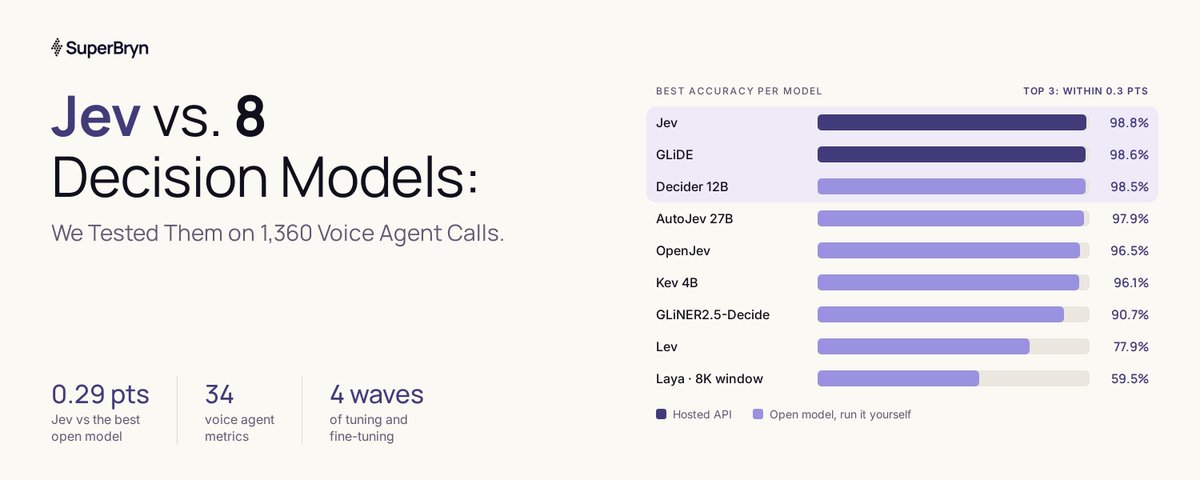
We benchmarked 9 decision models on the same 1,360 voice-agent calls.
Jev: 98.75%
Decider 12B: 98.46%
Just 0.29 points apart.
While, fine-tuning helped some models by 10–16 points. It also broke others like Lev.
Self-hosting gave more control, but wasn’t cheaper in our tests.
Full benchmark below.
Bookmark it, send it to someone building evals, and ask us anything about the experiment :)

Devansh Tripathi retweeted
Building something of our own, together.
Gandhi Jayanti spent well 🙏
#theusualSuperBrynshenanigans
@devanshtrip @parthjain_1 @DrNeethuJoy
Devansh Tripathi retweeted

We tracked raises from 53 agent observability startups this year. 10 you should check out:
@dash0hq - agentic observability ($110M)
@LassoSecurity - agent security ($30M)
@covaldev - voice agent evals ($28M)
@sazabi - AI log observability ($8M)
@orq_ai - agent ops platform ($5.8M)
@FriskAI - agent runtime monitoring ($3.6M)
@modiqoai - reliable agent workflows ($3M)
@OvermindLab - agent supervision ($2.7M)
@lemma_ - agent failure detection ($2.3M)
@SuperBryn_AI - voice agent QA ($1.2M)
A thread...

Devansh Tripathi retweeted
A lot of you have found me here over the last couple of weeks, so probably a good time to introduce myself properly :)
I'm Nikkitha, co-founder and CEO of @SuperBryn_AI.
We're building the reliability layer for voice agents, and these days I split my time between Bangalore and SF.
A few things on how I got here.
> Was born in Kerala and grew up in the Middle East.
> After graduating, I decided I wanted to become a civil servant and spent 3 years preparing for the UPSC.
(failed pretty miserably, btw 😅)
> During my final year of preparation, I joined a startup, and somewhere along the way, I fell completely in love with the world of startups.
> Eventually started Shoppre, an ecomm cross border tech comapany and grew it to ~$2M in annual revenue.
> Shoppre was profitable and scaling, but I knew I wanted to build in AI.
So I stepped away from operations (the team runs it beautifully on their own) and chose to start from 0 again.
> For almost a year, @DrNeethuJoy and I went through the whole 0→1 mess.
> After a lot of iterating, that became SuperBryn.
> Raised $1.2M from @Kalaari and angels, and today we work with companies around the world on making their voice agents reliable.
> Outside work, I like to dance, make art when I get the time, and give an unreasonable amount of attention to my dog, Django :)
If you're new here, hello 👋
I mostly write (or at least try to) about what I'm learning while building SuperBryn: Voice AI, enterprise AI, startups, customers, and occasionally the strange career decisions that got me here.

Devansh Tripathi retweeted

Has to be so tiresome when your entire personality is downstream of what SF was into 2 years ago (and therefore, NYC was into 5 years ago)


Devansh Tripathi retweeted
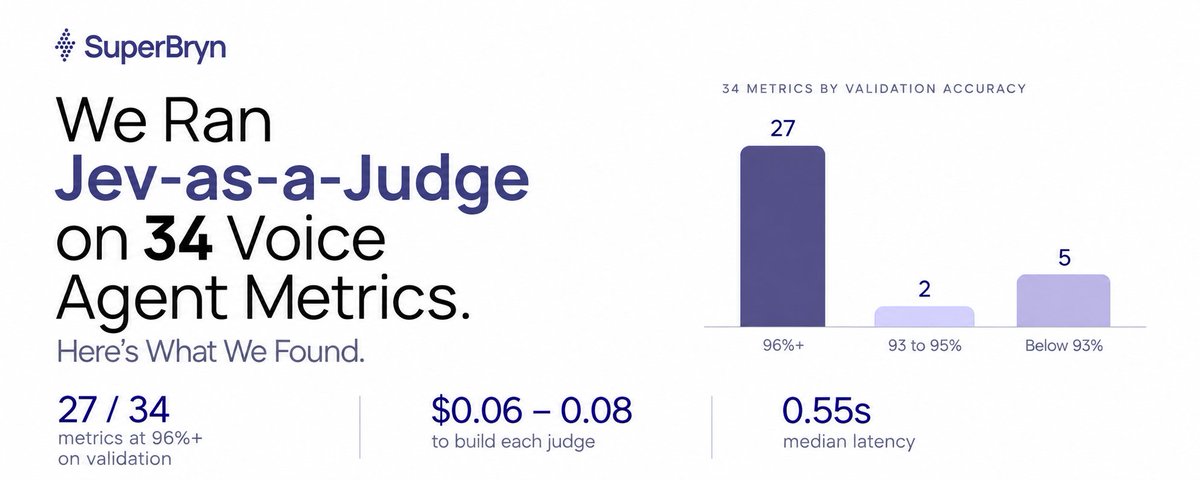
We used Jev as a judge on 34 voice agent metrics, with a codex harness(GPT 5.6 Sol+Terra) writing each judge. 27 hit 96%+ on a validation set it never tuned against, at about $0.07 of reasoning per metric. 7 didn't converge. Bookmark it for the weeked :)
Devansh Tripathi retweeted
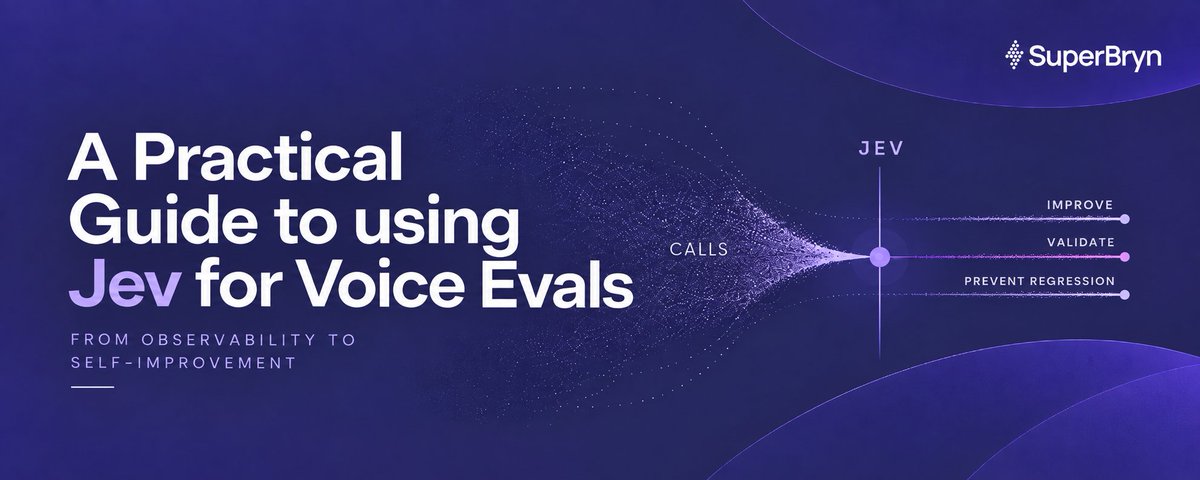
We tested Jev ourselves: 0.55s median latency from India, too slow to check every turn of a live call.
So where does it fit in voice AI? Risky actions mid-call, screening every call after, catching fixes that break what worked.
And where it doesn't.
Devansh Tripathi retweeted
Outbound voice agents are going to be the next big revenue unlock for voice AI.
And if you're building one, there is a chance your conversion rate is lying to you.
Let me explain:
If you give the world's best sales rep a list of dead leads, their close rate will look terrible.
But, no one who's run a good sales org would look at that number and conclude the rep is bad.
We understand sales depends on more than the rep: lead quality, offer, pricing, brand, timing.
But when a voice agent goes live, I often see teams forgettining the same distinction.
Conversion drops, the agent gets blamed.
Conversion = Lead Quality × Offer × Brand × Timing × Agent Performance
Change any one of these and conversion moves.
A great voice agent can't make an uninterested lead care.
It can't make an expensive offer affordable.
And it can't create demand for a product people don't want.
The interesting part is that most of these signals are visible inside the conversations themselves.
> Are customers objecting to price?
> Were leads already disengaged before the agent started selling?
> Are certain intents converting better than others?
So when conversion drops, you shouldn't be asking what's wrong with the agent?" but instead asking "which variable changed?"
Conversion tells you something changed. The conversations tell you why :)

Devansh Tripathi retweeted
Every week, I see a new company claiming its agent “self-improves.”
But that phrase can mean anything from tuning a prompt to a system changing its own behaviour.
Those are very different things, with very different RISKS.
Once a system can modify itself, a bad improvement loop doesn’t just make one bad decision. It can keep reinforcing it.
That’s where things get interesting - and potentially dangerous.
So I thought why not try to unpack the research behind self-improvement and recursive self-improvement: what’s real, what’s hype, and what we actually need to worry about.

