

A crypto developer and defi specialist. Founder of @apusindustries . Builder of @supacore_xyz and @supadaofi
- Tweets6.3K
- Following1.5K
- Followers968
- Likes11.8K



ALT Dev Apus illustrated graphic on a cream background. Headline: Offset pagination can show a row twice. Subline: One new row shifts everything below it by one. A line illustration shows a row of eight cards with the first four bracketed as page one and the fourth card dark; below, a new dashed card is added at the front, every card shifts right by one, and the dashed page-two bracket now starts on the same dark card, with a dashed arrow linking the two. Signature includes the Dev Apus portrait and four handles.

ALT Dev Apus illustrated graphic on a cream background. Headline: Old and new code share one database. Subline: During a rollout, both must work with the schema. A framed diagram: old code and new code both lead to both columns, which leads to rollout done, then, on a heavy arrow, drop old column. Signature includes the Dev Apus portrait and four handles.

ALT Dev Apus illustrated graphic on a cream background. Headline: A time without a zone is a guess. Subline: Store UTC. Convert only when people type it or read it. A line illustration shows one solid clock face at two o'clock with three dashed copies behind it, their hour hands at different positions. Signature includes the Dev Apus portrait and four handles.

ALT Dev Apus illustrated graphic on a cream background. Headline: One status. Allowed moves only. Subline: List the transitions. Reject the rest. A framed state diagram: created to submitted to settled on heavy arrows, submitted to failed, and settled to refunded. Signature includes the Dev Apus portrait and four handles.

ALT Photograph of a laptop screen showing the SupaCore backend in VS Code, with the routing-engine main.go file open and a file tree of backend services visible.

ALT Dev Apus illustrated graphic on a cream background. Headline: Append entries. Derive the balance. Subline: Overwriting a number loses the story behind it. A line illustration compares one cell with an overwrite arrow looping into it and earlier values left as dashed outlines, against a growing stack of entry rows running off the edge as a new row slides in. Signature includes the Dev Apus portrait and four handles.

ALT Dev Apus illustrated graphic on a cream background. Headline: Write down what must stay true. Subline: Then let a fuzzer try to break it. A line illustration shows a curved line on two axes with the area beneath it hatched, and a zigzag path of points that stays above the curve. Signature includes the Dev Apus portrait and four handles.
ALT Dev Apus illustrated graphic on a cream background. Headline: Write down what must stay true. Subline: Then let a fuzzer try to break it. A line illustration shows a curved line on two axes with the area beneath it hatched, and a zigzag path of points that stays above the curve. Signature includes the Dev Apus portrait and four handles.

ALT Dev Apus illustrated graphic on a cream background. Headline: An external call hands over control. Subline: Assume it can call you back. A line illustration shows a contract box with a filled balance bar sending an arrow to a dashed box of external code, and a dashed arrow curving back into the contract. Signature includes the Dev Apus portrait and four handles.


ALT SupaCore graphic on a near-black background. Headline: Accepted is not settled. Subline: Two words. Two different states. A line illustration shows an instruction card just past an open gate, with a long dashed track past hollow rings leading to a solid block. Qualifier: industry research, not a product claim; SupaCore is pre-production.

ALT SupaCore graphic on a near-black background. Headline: Match it or explain it. Subline: An unassigned break only gets older. A conceptual framed diagram: compare two records, amounts differ, classify the break, assign an owner. Qualifier: industry research question, not a product capability claim.


ALT Apus Industries graphic on an off-white background. Headline: Ship the build you tested. Subline: Promote it to production. Don't rebuild it. An isometric line illustration shows the same striped parcel on two pads joined by a cyan arrow, and below it a dashed detour through a gear leading to a parcel with different stripes, crossed out. Qualifier: general software-scoping guidance, not a client case study.

ALT Dev Apus illustrated graphic on a cream background. Headline: Round in the pool's favour. Subline: Rounding should never pay the caller extra. A line illustration shows a value between two whole units on a number line, an arrow rounding it down, and the leftover remainder flowing into a pool. Signature includes the Dev Apus portrait and four handles.

ALT Dev Apus illustrated graphic on a cream background. Headline: One exchange. Three pool types. Subline: A singleton is not simpler by default. Three distinct modules, a cube, a taller block and a cylinder, dock into one larger volume. Signature includes the Dev Apus portrait and four handles.

ALT Dev Apus illustrated graphic on a cream background. Headline: A testnet is not a launch. Subline: Be precise about the stage. A horizontal scale has a filled marker early along the line; later marks stay empty. Signature includes the Dev Apus portrait and four handles.

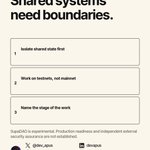
ALT Dev Apus typographic graphic on a cream background. Headline: Shared systems need boundaries. Three numbered cards: isolate shared state first; work on testnets, not mainnet; name the stage of the work. Qualifier states that SupaDAO is experimental and that production readiness and independent external security assurance are not established. Signature includes the Dev Apus portrait and four handles.