



Pinned Tweet
We self-published a history of biochemistry book.
The Molecule Hunters is 133 profiles of the people who decoded life, from a physician weighing a willow tree in the 1640s to structural biologists predicting protein folds with AI. 190 scientists, eleven parts, four centuries.
Here is how it got made. Last spring I gave my biochemistry students an AI assisted extra-credit project: pick a scientist, do the deep research, write a profile. Then about six months of editing from Abbie and I. More than 500 students are co-authors.
This is something that didn't exist, and now it exists (with lots of help from Claude et al). This is a book I wanted to read and I'm happy with how it turned out. I love thinking about science through the personalities of the discoverers.
It's free. The full PDF and EPUB are on our site, and the audiobook, about eleven hours, is free on Spotify. It will be free in most outlets. Amazon charges $3 for the Kindle right now and I'm working on getting that to zero as well.
Read, download, or listen: deppmannlab.com/book
Hope you enjoy it.

I spent part of today wandering around Berlin, looking for the places where modern biochemistry and experimental medicine were born.
One of my favorite discoveries was an inscription on the back of Robert Kochs statue, unveiled in 1916. The inscription comes from a speech Koch gave at the International Medical Congress in 1890:
"I hope that, in the war against the smallest but most dangerous enemies of humanity, nations will continually strive to surpass one another."
Koch, who identified the bacteria responsible for tuberculosis and helped establish the experimental foundations of infectious disease research, understood that nations could compete through scientific discovery rather than military conquest.
Theres a painful irony in the dates. Koch said this in 1890. His monument was unveiled in 1916, in the middle of World War I (notice the bullet holes). And less than two decades later, Germany would begin driving some of its greatest scientists out of the country because of their ancestry, religion, or political convictions. The United States and Britain would benefit enormously from that exodus, while Germany dismantled much of the scientific culture that had made it an international leader.
Koch's own legacy is complicated, particularly his ethically troubling research in colonial Africa. But I find the aspiration expressed in this inscription remarkably powerful. Imagine what science might accomplish if countries competed as fiercely to cure disease as they In other less productive endeavors.
Robert-Koch-Platz (outside of Humboldt University), Berlin.


Gertrude Elion's Nobel Prize was announced on this day in 1988, shared with George Hitchings and James Black, "for their discoveries of important principles for drug treatment." It was a prize for a way of thinking, and it went to someone who never earned a PhD.
She was 15 when her grandfather died of cancer, and she decided that was the disease she would work against. She graduated from Hunter College in chemistry in 1937, in the middle of the Depression, and no graduate program would fund her. Labs asked why a woman would want to be a chemist. She taught high school, did quality control for a food company, and finished a master's degree at NYU at night.
In 1944 Hitchings hired her at Burroughs Wellcome. His idea, considered naive at the time, was to stop screening compounds at random, figure out what a diseased cell needs, and build a molecule to block it. Dividing cells need DNA bases, so Elion built fake ones, close enough to be taken up and wrong enough to jam the works.
What came out of that lab: 6-mercaptopurine, one of the first drugs to put childhood leukemia into remission. Azathioprine, which made organ transplants practical. Allopurinol for gout. And acyclovir, a decoy that only a herpesvirus can switch on. After she retired, the program she built produced AZT, the first HIV drug.
She worked into her eighties. Her story is in Part 10 of The Molecule Hunters: deppmannlab.com/book

Rosalyn Yalow's Nobel Prize was announced on this day in 1977, for radioimmunoassay. She was the second woman ever to win in Medicine. Her partner of 22 years, Solomon Berson, had died in 1972 and couldn't share it, so she renamed their lab the Solomon A. Berson Research Laboratory. His name stayed on every paper she published after that.
They met in 1950 in a converted janitor's closet at the Bronx VA hospital: a nuclear physicist and a medical resident who played blindfold chess. In 1955 they showed that diabetics treated with insulin make antibodies against it. The journal rejected the paper because insulin was supposedly too small to provoke antibodies, and they had to call them "insulin binding globulin" to get it published. Years later, Yalow put the rejection letter on a slide in her Nobel lecture.
Then they turned those antibodies into a measuring tool. Think musical chairs. There is a fixed number of antibody "chairs," and a known amount of radioactive insulin competes with the patient's own insulin for seats. Count how much radioactive insulin is left standing and you can work out how much insulin was in the blood, at levels no chemical test could reach. The same idea soon spread across endocrinology, blood banking and newborn screening.
They refused to patent it and mailed their antibodies to any lab that asked.

The 1992 Nobel Prize in Physiology or Medicine was announced on this day, to Edwin Krebs and Edmond Fischer, for a discovery that started with a piece of filter paper.
In 1953, working across a hallway at the University of Washington, they tried to repeat Carl and Gerty Cori's recipe for phosphorylase, the enzyme that breaks down glycogen, and couldn't get active enzyme. The difference looked trivial. The Coris filtered at one step where Krebs and Fischer had been centrifuging. They switched to filtering, and the enzyme came out active. Wash the filter paper first, and it didn't.
The secret ingredient was calcium leaching out of the paper. Calcium was needed to turn on a second enzyme, which clipped a phosphate from ATP onto phosphorylase and switched it on. Another enzyme took the phosphate back off and switched it off.
That reversible phosphate switch turned out to run almost everything. The human genome has hundreds of kinases and phosphatases, controlling cell division, immunity and how neurons answer signals. My own lab studies the Trks, a family of receptor kinases, so all of our work sits downstream of the switch that filter paper revealed.
Two things I love about these two. They traded first authorship from paper to paper and never cared who went first. And Krebs spent his career being congratulated for the Krebs cycle, which was a different Krebs. Once a department chair assumed he was that Krebs, and he didn't correct him.
Their profile in The Molecule Hunters was researched by UVA undergraduate Emily Bloom. The enzyme regulation lesson at Biochemistrypedia covers the switch: biochemistrypedia.com

The 1994 Nobel Prize in Physiology or Medicine was announced on this day, to Martin Rodbell and Alfred Gilman, for G proteins: the switches that carry a hormone's message from a receptor on the outside of a cell to the machinery inside.
Rodbell drew the idea first, on a tablecloth in a Washington bar: a receptor, a hidden relay, then the enzyme that makes cyclic AMP. At NIH in 1970 he found that a trace of GTP switched the system on. As a grad student he had once been fooled by a contaminated batch of ATP, so this time he made ultra-pure ATP to prove the effect really came from GTP. So, the relay was inferred.
Gilman Gilman figured it out.. He liked to say he was "named after a textbook," since his father co-wrote Goodman & Gilman, the pharmacology bible. Here at the University of Virginia in the 1970s, he and his postdoc Elliott Ross took a mutant cancer cell line that couldn't respond to hormones, added back an extract from normal cells, and restored the response, but only with GTP present. His UVA lab then purified the protein, Gs, before he moved to UT Southwestern in 1981.
That's the second Nobel story from Charlottesville this fall, after Ferid Murad and nitric oxide.
Eighteen years later to the day, Robert Lefkowitz and Brian Kobilka won chemistry for the receptors that hand the signal to G proteins.
Both men are in The Molecule Hunters, and the signaling lessons at Biochemistrypedia walk through the G-protein on/off cycle: biochemistrypedia.com

G. N. Ramachandran was born on this day in 1922, on the Kerala coast. In 1963, at the University of Madras, he and two colleagues asked a question nobody had put so precisely: of all the ways a protein backbone could twist, which ones are physically possible?
Each amino acid in a chain has two bonds that can rotate. For every pair of angles, they calculated whether atoms would run into each other. With no computer available to them, a student spent a full year doing the calculations on a mechanical desk calculator, copying trig values out of printed tables.
When they plotted what survived, nearly the whole map was forbidden except a few compact islands, chiefly one for the alpha helix and one for the beta sheet.
Sixty years later, every protein structure, from crystals, NMR or cryo-EM, gets laid against that plot before anyone believes it. The Nobel committee never called.
A busy birthday, too. Jens Skou (1918), who found the sodium-potassium pump in crab nerves, and Roy Vagelos (1929) were born on October 8, and the 2003 Nobel to Peter Agre and Roderick MacKinnon for membrane channels was announced on this date. Agre found the water channel at Johns Hopkins, where I trained, by injecting its RNA into frog eggs and watching them swell until they burst.
Ramachandran's story is in The Molecule Hunters: deppmannlab.com/book

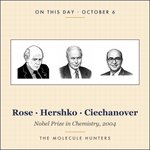
The 2004 Nobel Prize in Chemistry was announced on this day, to Aaron Ciechanover, Avram Hershko and Irwin Rose, for working out how a cell decides which of its proteins to destroy.
The puzzle was ATP. Breaking a peptide bond releases energy, so why does a cell spend ATP to break down its own proteins? Hershko had chosen to study protein destruction when the subject was, in his words, "distinctly unfashionable." A visiting biochemist once told him he shouldn't have most of his lab working on a hopeless problem.
In 1978, at the Technion in Haifa, Hershko and Ciechanover split an extract of immature red blood cells into two fractions. The protein-destroying activity died in both. Put them back together with ATP, and it returned. One fraction, red with hemoglobin, held a small factor that survived boiling, which one expert told them proved it couldn't be a protein. It was a protein. They called it APF-1. The work soon had a second home in Irwin Rose's lab at Fox Chase in Philadelphia, where Hershko spent sabbaticals, and Keith Wilkinson in Rose's lab showed that APF-1 was ubiquitin, a small protein already known from other tissues whose purpose nobody understood.
Its purpose is a tag. The cell spends ATP to stitch chains of ubiquitin onto proteins it wants gone, and the proteasome destroys whatever carries the tag. The ATP pays for choosing and tagging, not for breaking the bond. That one system turned out to drive the cell cycle, the response to low oxygen, and which protein fragments the immune system gets to see.
None of them treated the prize as the point. Rose went back to enzyme mechanisms three days a week. Hershko was still at the bench at the Technion into his late eighties.
Their story is in The Molecule Hunters, free to read or listen to: deppmannlab.com/book

Christopher Deppmann retweeted

In today's Microdose: What happens when GLP-1s mix with psychedelics? 5 Questions with neuroscientist Ali D. Güler themicrodose.substack.com/p/…
Christopher Deppmann retweeted

Tu Youyou became the first mainland Chinese scientist to be awarded a #NobelPrize in a scientific field - for discovering artemisinin, a malaria cure that’s saved millions. Today we reveal the 2026 medicine laureate. Stay tuned.

ALT A portrait of Tu Youyou in front of a dark grey background. The light is on the left side of her face leaving the right side slightly in shadow. She is looking directly into the camera with a small smile.
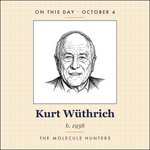
Kurt Wüthrich was born on this day in 1938. On his 79th birthday, in 2017, the Nobel committee gave the chemistry prize to cryo-electron microscopy. Both are answers to the same problem: how do you see a protein that won't sit still in a crystal?
For most of the 20th century, seeing a protein meant crystallizing it and shooting X-rays through it. Plenty of proteins refuse to crystallize, and the ones that do are frozen in a single pose.
Wüthrich went after the ones that won't, using NMR on proteins tumbling free in water. The spectrum looked like a storm of overlapping peaks, none of them labeled. He named them by walking the chain one amino acid at a time, then used the distances between neighboring hydrogens as measuring tapes to fold the chain into a shape. In the mid-1980s his group solved the first complete protein structure in solution, no crystal at all. Nobel, 2002. He also played serious competitive football.
Cryo-EM came at it from another direction. Jacques Dubochet froze molecules so fast the water turned to glass instead of ice. Joachim Frank worked out how to average thousands of noisy images into one clear one. Richard Henderson spent decades pushing the microscope toward atomic resolution. Today a large share of new structures come from cryo-EM.
Nobel week starts tomorrow. Whatever wins, every structure in it will still be checked against a single page G. N. Ramachandran drew in Madras in 1963. More on him Thursday.
If you want to rotate some of these structures yourself, the structure lessons at Biochemistrypedia load them live from the Protein Data Bank: biochemistrypedia.com

Wüthrich, Dubochet, Frank and Henderson are all in The Molecule Hunters, free to read or listen to: deppmannlab.com/book

Louis Pasteur died on this day in 1895, at Villeneuve-l'Étang outside Paris, in a plain room above stables where his institute was making diphtheria antiserum. The work went on below him to the last.
He started as a chemist. At 25 he sorted tartrate crystals by hand under a microscope and found they came in mirror-image forms, which was the discovery of molecular handedness. He turned to wine and beer and showed that fermentation is the work of living yeast, not a spontaneous chemical breakdown, winning a long fight with Justus von Liebig. His swan-neck flasks finished off spontaneous generation, and gently heating wine to stop spoilage gave us pasteurization. Then came the leap: if specific microbes cause fermentation, specific microbes cause disease. That logic ran through silkworms, chicken cholera, anthrax (the public sheep trial at Pouilly-le-Fort in 1881) and, finally, rabies.
Here is where biochemistry comes in. Pasteur held one of vitalism's last lines: some chemistry, fermentation above all, needed an intact living cell. Two years after his death, Eduard Buchner ground yeast with sand, filtered out every cell, and the juice still turned sugar into alcohol. Enzymes, not life itself, were doing the work. Pasteur had been right against Liebig and wrong about the cell, and modern enzymology grew out of both.
France gave him a state funeral at Notre-Dame and wanted him in the Panthéon. Marie Pasteur said no, and he lies in a crypt at the Institut Pasteur. His profile in The Molecule Hunters can be found here: deppmannlab.com/book

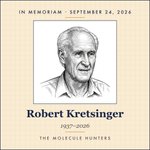
Bob Kretsinger died this week at 89. In 1973, at UVA, he found how cells read calcium: two helices cradling a single ion. He drew it as a hand, forefinger and thumb, and named it the EF-hand. It's in every biochemistry textbook. He also sculpted, and built his own house.

Louise Johnson was born on this day in 1940. As a grad student she helped solve lysozyme, the first enzyme structure anyone had ever seen. When it ran in Nature in 1965, her paper was printed right behind it, showing where the enzyme grabs hold of its substrate. She was 24.

I tell the lysozyme story in The Molecule Hunters. If you want to spin the real structure yourself, it's on biochemistrypedia.com.
You can read her story and dozens of others at deppmannlab.com/book

Friedrich Wöhler died on this day in 1882. He trained a generation of chemists at Göttingen, but history remembers him for one flask.
In 1828, at 27, he heated ammonium cyanate, an ordinary lab salt, and found crystals of urea. The science of his day said urea could only come from a living kidney, because life ran on forces beyond chemistry.
He knew exactly what he had. He wrote to his mentor Berzelius that he could now make urea without a kidney, whether of man or dog.
One experiment didn't kill vitalism. That took decades, and the last blow came in 1897, when Eduard Buchner fermented sugar with cell-free yeast juice. But after Wöhler, the burden of proof had switched sides. Life's chemistry was chemistry.
We turned that whole story, from Wöhler's flask to Buchner's juice, into an interactive opening chapter at Biochemistrypedia. It's free for anyone teaching or learning biochem: biochemistrypedia.com

For the full book, check out The Molecule Hunters for free to read or listen to: deppmannlab.com/book/
Beneath a field of clover, something extraordinary is happening. Bacteria living in the plants’ root nodules take nitrogen from the air and convert it into ammonia—the first step toward making that nitrogen available for proteins, DNA, and growth. The plants provide fuel for the work. An enzyme called nitrogenase performs the chemistry at ordinary temperatures and pressures. It’s a biochemical feat that still astonishes me.
Fritz Haber found another way to make ammonia from nitrogen and hydrogen. Carl Bosch and his team turned that laboratory achievement into an industry, using tremendous heat and pressure. In 1913, the first industrial Haber–Bosch ammonia plant opened at Oppau, Germany. The fertilizer made possible by that breakthrough now helps feed roughly half the world.
But fixed nitrogen also supplies the raw material for many explosives. During World War I, Bosch helped Germany produce nitrates for munitions. Haber separately became a leading architect of poison-gas warfare.
Their later histories resist easy summaries, too. Haber, who was Jewish, left Germany after the Nazis came to power. Bosch opposed the persecution of Jewish scientists while leading IG Farben as it developed ties to the regime.
And there was Oppau. At 7:32 a.m. on September 21, 1921—105 years ago today—stored fertilizer exploded there during blasting intended to loosen the hardened material. More than 500 people died.
This was an industrial disaster, distinct from the deliberate use of chemistry in war. Both belong in the history of this extraordinary achievement.
I teach the Haber–Bosch process every year, and I try to teach it whole: the biology that preceded it, the ingenuity that made it possible, and the human decisions that shaped its consequences.
I hear an echo in today’s conversations about AI. The technologies are very different, but the question feels familiar: how do we make the most of a powerful capability while taking seriously the harm that deliberate misuse—or failures in ordinary use—can cause?
On this anniversary, I’m thinking about the people of Oppau, whose lives are also part of the story of the chemistry that feeds us.

Haber, Bosch, and the chemistry that changed how we feed ourselves are part of the story I tell in The Molecule Hunters.
I explore their achievements and complicated legacies in Part 5.
deppmannlab.com/book