

Deep research spanning AI, robotics, and adjacent technologies.
Joined April 2025
- Tweets35
- Following1
- Followers1.8K
- Likes73


Delphi Intelligence retweeted

2026 is going to get weird(er)
delphiintelligence.io/resear…




Delphi Intelligence retweeted

1/9 - The end of the year is a glorious time for reflection, and I love reading all the year in review + forecasting pieces all the firms put out. It's interesting to see how the stochastics converge, when they're largely developed in isolation.
A common thread that I've seen from financial analysts is that 2026 is the year of capex buildout for scaling transformer models, but to me, it's the year of the architecture renaissance. The lens is increasingly incomplete.
The next wedge isn’t just more parameters; it’s different architectures + different economics, pushing toward ambient, abundant intelligence.
The full essay is at delphiintelligence.io/resear… , courtesy of @Delphi_Digital and blog.hack.vc/ambient-and-abu…, courtesy of @hack_vc
Delphi Intelligence retweeted
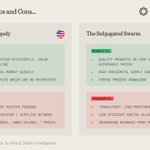
Who will win the AI race?
The US and China are running fundamentally different races that could both be necessary in the long term.
One prioritizes frontier advancement and individual freedoms while China prioritizes rapid diffusion and societal harmony.
The tension between this may be exactly what's needed to navigate what Rawson calls "AI's narrow corridor."
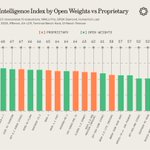
America dominates in compute, but China graduates 5x more STEM students annually. Qwen is now the most downloaded open source model globally with the Chinese stack becoming increasingly more competitive.
The US approach involves trillions in capex funded by anticipated monopolistic profits, aiming for superintelligence and breakthrough science.
China uses AI to solve demographics through robotics, reduce education gaps with AI tutors, and keep manufacturing onshore as wages rise.
Can both approaches coexist?


Delphi Intelligence retweeted

On investing in AI:
I'm confident AI is ushering in a golden era of venture, and will lead to the creation of multiple new $100b companies over the next few years. I’m also confident that the best way for most crypto ppl to get exposure to this is not via ad hoc direct investments, but through fund of funds exposure
And this isn’t because I don’t think crypto ppl can get up to speed on AI and pick winners. I think it’s definitely possible for at least some crypto ppl to pick good AI companies. A lot of ppl in crypto are extremely smart, experienced investors who have learned how to get up to speed on new fields fast. The problem is that picking is <50% of what makes up edge in venture. The rest is sourcing and winning deals and this is much harder to build
In my experience, it’s almost impossible to gain edge here unless you’re willing to move to SF and grind for a few years to build up your network and brand. If you don’t do this, you will face severe negative selection on the deals you see via SPVs and your network. They’ll be the lemons that the best investors don’t want, and it doesn’t matter how good a picker you are if you’re selecting from a sample of shitty deals
You can try and mitigate this by hiring someone in SF, but again you’ll face negative selection as the majority of people who have edge will either be hired elsewhere or building their own funds
This is why we decided to go the FoF route, and why I’ve been spending most of my time speaking to the best emerging fund managers I can find. While trad venture returns have historically been pretty mid, I believe:
a) this time is different due to the disruption of AI and the tailwinds it’s provided across tech
b) most venture investors suck, and underperformance can be mitigated by simply picking better managers. Specifically, by doing the opposite of what most FoFs do and picking smaller funds, with highly concentrated approaches, and a unique and clearly differentiated source of edge
Overall, having spent ~3 months speaking to 100+ managers, I’ve been insanely impressed with some of the talent we’ve found. We’ve made 4 commitments to funds so far, and I can truly say these are some of the most impressive people I’ve ever met, who are not just well pedigreed/insanely capable/hungry, but have also thought deeply and have unique answers about the source of their edge. Crucially, none of these are people you could’ve hired, and recreating their edge would’ve either been entirely impossible or taken multiple years of concerted effort on our part
Our goal is to select 5-10 managers with distinct focuses and minimal overlap, netting ~200 investments per year. Investing into the right managers also makes direct investment far easier, because we get access to their pre vetted dealflow and can double down into winners from this cumulative portfolio. We’re already seeing this strategy beginning to bear fruit
I’ve learned a lot by going through this process and feel it’s made me a better investor too. With this in mind, I’ll be doing a series for @PodcastDelphi where I interview some of the best managers I’ve met and try and tease out what makes them so good
Hoping to do many of these in person and to get the first few out in October. Stay tuned :)
Delphi Intelligence retweeted

if you read this article, you knew this time was coming.
h/t @delphi_intel

Delphi Intelligence retweeted

An absolute pleasure hosting @philipjohnston to talk through @Starcloud_Inc1's plans for shifting heavy compute off-world.
• Why orbital compute is the end-game
• Building a 5GW data center in space
• Radiation shielding H100s
• The Era of Starship
• Matrioshka brains


Delphi Intelligence retweeted
I enjoy @lex_feeds pieces because he is well-read enough to articulate the big picture & place takes in context, yet also has the product experience to deliver developer level insights
I'm clearly biased but outside of perhaps Seminanalysis, I think @delphi_intel long-form research is some of the best available, delivered for free
Link: delphiintelligence.io/resear…


(1/8) In previous report, I explored how AI models are fascinating contradictions—brilliant yet random, knowledgeable yet perceptually limited, powerful yet unconscious.
Today I'm publishing 2nd report, "Abundant Intelligence and Scarce Experience," which addresses how to harness this newly abundant intelligence effectively. We need a new collaboration playbook: align consciousness, grant autonomy, verify outputs, provide feedback, and enable continuous improvement.
In simpler terms, applications must put AI into experience
See below for detail:
Delphi Intelligence retweeted
2035 Episode 1: Chinese vs American AI, the Rundown.
@ZeMariaMacedo & I had a chance to sit down with @moonshot6666 to discuss all things US vs Chinese AI.
Alex is currently Co-Founder of @get_truenorth & has a very unique perspective having worked at large chip companies, tech companies, and investment firms on both sides of the Pacific.
One of the more informative episodes available on US vs Chinese AI dynamics and the future of computing more broadly.
2035 is a new @delphi_intel podcast. Links below:

Delphi Intelligence retweeted

excellent read on the future of video model technology - highly recommend to all
kudos @delphi_intel
delphiintelligence.io/resear…

Delphi Intelligence retweeted

AI will replace 75% of Fortune 500 companies 👀
The rise of AI means the churn rate of Fortune 500 companies will be sky high
@anildelphi of @Delphi_Digital breaks it’s down in 60s on this weeks guest episode!
Delphi Intelligence retweeted
My first essay with @delphi_intel, a two-part series on AI’s jagged intelligence and its impact on apps. Part I covers foundation models; Part II (coming soon) explores the application layer.
Summary below (1/9)

Delphi Intelligence retweeted
I thought humanity is safe just 2 days ago, it’s literally counting in days…
Some context: This isn’t the first time AI has medaled at the International Math Olympiad (IMO). Last year, Google’s AlphaProof won silver—but that model was trained specifically for math.
This time, OpenAI used a general-purpose model (likely an internal GPT-5 prototype?), and it won gold. That’s a huge leap in significance.
To put this in perspective: solving an IMO-level problem typically takes elite human competitors about 100 minutes. Just 2 years ago, top AI models were still struggling with grade-school word problems (GSM8k), which take humans about 10 seconds to solve.
As OpenAI’s Dan Roberts shared at Sequoia’s AI Ascent 2025, the length of tasks AI can handle is doubling every 7 months. By late 2025, GPT-5 may very well be operating at hour-long human task levels.
One caveat: This year’s IMO reportedly had a flaw in difficulty balance—problems 1–5 were relatively easy, while problem 6 was unusually hard. As a result, many scores clustered between 28–35 (each problem is worth 7 points). The AI scored a 35—just enough for gold. A bit of luck, but the trajectory is undeniable.
Last not least, the math competitions will undoubtedly be a race between Chinese in China, Chinese in U.S., and AI models (built by Chinese in the U.S. and China)

1/N I’m excited to share that our latest @OpenAI experimental reasoning LLM has achieved a longstanding grand challenge in AI: gold medal-level performance on the world’s most prestigious math competition—the International Math Olympiad (IMO).
