

Building @VoiceMOAT, the Personal Brand OS for LinkedIn and Twitter. One system to write, schedule, engage and grow. Try it here: https://xitter.cf/t.co/s8hNCpRCwG
Remote
Joined April 2020
- Tweets25.8K
- Following1.6K
- Followers15.2K
- Likes14.1K


Pinned Tweet
Everyone got faster at posting.
Nobody got more recognisable.
That's the problem I'm building @VoiceMOAT to fix. Here's the full story, pinned so you don't have to scroll for it.
The problem
A personal brand on @LinkedIn and @X / Twitter comes down to one thing: people know it's you before they see your name.
AI was supposed to help with that.
Instead:
→ Everyone writes with the same AI, so every feed reads the same
→ It copies your tone, then says things you'd never say
→ Your routine is split across separate apps: one to write, one to schedule, one to reply, one for analytics, and a notes app full of half ideas
→ None of them know how you write, so you start from zero every time
→ What works on Twitter flops on LinkedIn, and the other way round
So most people pick one of two bad options. Post rarely, in their own words. Or post often, in words that aren't theirs.
Why I built VoiceMoat
I've spent years running social media and influencer campaigns. The founders and creators who grew were never the loudest. They were the ones you could recognise in two lines.
I wanted AI that protects that instead of draining it. So I built VoiceMoat, the Personal Brand OS for LinkedIn and Twitter.
What's inside
One system to write, schedule, engage, analyse and grow, built around your voice:
→ audenAI learns how you write from your own posts, then drafts posts, threads and replies that read like you
→ Style and Stance check every draft: does it match your habits, and does it say what you'd actually say
→ Grow: set a goal, and audenAI plans your month and writes the posts for you to review
→ Calendar: schedule and publish to LinkedIn and Twitter from one place
→ Replies: find conversations worth joining and reply in your own words
→ Analytics: see what's working on both platforms and what to post next
→ Inspiration: a library of strong posts by category, so you never start from a blank page
Why you need it
Your personal brand isn't your posting schedule. It's how you think and how you say it.
Generic AI can make you faster. It can't make you recognisable. VoiceMoat is built to do both, because everything in it starts from your voice.
It's for founders, creators, consultants and ghostwriters who want to show up every day without blending in.
Try it for $1 for 3 days at voicemoat.com
Or DM me and I'll set it up with you.
Your voice is your moat.

2027 is the year of vibe sales.
The world gets louder, faster, more commercial. More places start to feel like NYC or Shenzhen.
Your inbox gets spammed. Your phone gets called. Founders build new companies and markets to deal with agentic outbound ramping up.
Until then, make hay while the sun shines.
Opus 5.5 has pretty much broken the model landscape. 😤
For a model to be interesting now, it has to do something novel. The "15% worse but way cheaper" pitch doesn't work anymore. I think 5.5 made it worse, because it's so good on every metric.
That's why I kept defending Muse Wonderful and still use it a lot.
What it has is a voice. It's close enough to frontier to be usable, but it doesn't feel like a watered-down Claude. So I kept using it.
A model outside OpenAI and Anthropic needs a novel capability to matter. And to get attention, that capability has to be easy to show, like the 3D work from Astra.
The voice of Muse Wonderful is hard to show in a catchy way. You only feel it by paying for the $50/mo Meta sub, and almost nobody will do that. So nobody cares about the model.
That sucks, because I like it. But they did this to themselves. The Wonderful drop was botched: bad model names, and the good model locked behind the sub.
Fable 5.5 probably drops tomorrow. 🚀
Rumors, for what they're worth:
• Better at reasoning and intuition
• Infers intent instead of taking instructions word for word
• Ask it to fix a bug and it goes after the root cause
• Does creative thinking that actually lands
• Invents its own algorithms to predict stocks
• Gives you complete and eternal enlightenment on the first reply
And I'd bet on major efficiency gains, like Opus 5.5.
The icing would be access for every sub.
Prepare yourself in mind, body and spirit.
AI is a bubble, but not for the reasons you usually hear.
It's a bubble because it forces a question nobody wants to answer:
What is intelligence? 🤔
Knowledge? Wikipedia has knowledge. It isn't intelligent.
IQ? Plenty of people with high IQs can't function in their own lives.
Money? Plenty of rich people are dumb as a rock.
Intelligence is one of the most wanted traits a person can have, right up there with beauty, health and talent.
But it's the hardest one to measure.
So it's always been coveted and resented at the same time. A perfect setup for sour grapes.
Except now machines produce PhD-level answers in seconds. 🤯
And AI is splitting people into two groups:
Those who can use it well.
Those who can't.
Anthropic's model lineup is about to get very clean, right before the IPO.
fable 5.5
opus 5.5
sonnet 5.5
haiku 5.5
This is the Jobs playbook. You were rarely, if ever, confused about what Apple was selling.
Fewer names, clearer choice. Most products get this backwards.
Most people stay stuck at Stage 1.
The Head of Content job sits at Stage 6.
Here's the 2026 path, stage by stage 👇
Stage 1: The Writer
→ Write on X or LinkedIn consistently
→ Break down 50 viral posts: hook, structure, CTA
→ Goal: write things people actually stop and read
Stage 2: The Distributor
→ Learn how each platform's feed picks what to show
→ Turn one idea into a thread, a carousel, a short video and a newsletter
→ Goal: get the same idea seen 5x more
Stage 3: The AI Operator
→ Use Claude or ChatGPT for research, outlines and drafts
→ Make visuals with Ideogram, decks with Gamma and clips with Opus Clip
→ Goal: do the output of a 3 person team alone
Stage 4: The Systems Builder
→ Build a content calendar, idea bank and approval workflow
→ Write SOPs so a freelancer can run it without you
→ Goal: content ships even when you're offline
Stage 5: The Growth Owner
→ Tie content to signups, pipeline and revenue
→ Learn SEO, landing pages, email and small paid tests
→ Goal: prove content makes money
Stage 6: The Head of Content
→ Use your own account as a live case study
→ Show 2 to 3 case studies with real numbers
→ Pitch startups: "Here's what I'd do with your content in 30 days"
→ Goal: get hired to own the whole engine
Stage 1 is where you learn to write.
Stage 6 is where someone pays you to own the engine.
A personal brand is not your logo or your headshot.
It's the claims you keep repeating.
Readers don't remember a style guide. They remember a stance. The line they could quote back to a friend without looking it up.
So here's the test I use. Is this a claim I would defend in the comments, with a stranger pushing back on it? If yes, it goes in. If I'd back off the second someone disagreed, it's just a nice sentence.
Mine are simple. AI writing optimizes for being right. Human writing optimizes for being believed. And posting every day is not a strategy.
I'll defend all 3 to anyone who wants to argue.
Pick the few you'll keep repeating. 2 or 3, not 10.
Then say them until you're bored of them. That's usually right about when someone else starts to remember them.
The wrapper era is over.
Here are 10 things real AI engineers are building instead 👇
→ A model router that sends most requests to a cheap, fast model and only escalates the hard ones
→ A raw MCP server written from scratch, so other agents can safely call your product
→ Typed handoffs between agents, so Agent A passes structured state to Agent B instead of messy text
→ A durable workflow that resumes from the exact step after a crash or a 3 day human approval
→ Constrained decoding, so your agent returns valid JSON every time
→ Delegated auth, where the agent acts for a user without the model ever seeing the raw token
→ A circuit breaker that stops runaway tool loops before one query burns $400
→ A fallback chain (frontier model, then mid tier, then local, then cache) so users never see an error
→ A trajectory grader in CI that blocks the PR when your agent takes the wrong path
→ One public benchmark showing your agent against a naive baseline on cost, speed and success
None of this is prompt engineering.
All of it is engineering.
A wrapper is a prompt with a logo.
A system is what keeps working when the model, the user or the network doesn't.
The systems era pays.
Ritik Kumar left a comment on my last newsletter that put the whole problem in one line
"starting from zero every chat is what kills it for me. i keep pasting the same 3 old posts every time lol"
Then the question: does it pull in everything I've posted, or do I pick?
You don't pick, and you don't paste
When you connect your account, audenAI reads your past posts and builds your voice profile from them. On LinkedIn, the Chrome extension brings your posts in from your own login
Then, with VoiceMoat connected to Claude, you just ask. Claude pulls that profile itself, and your posts and numbers when it needs them
If it ever picks up a line you'd never say, mark it "Not me" in Voice Lab and it won't use it
Thanks Ritik. That comment explained the problem better than my newsletter did

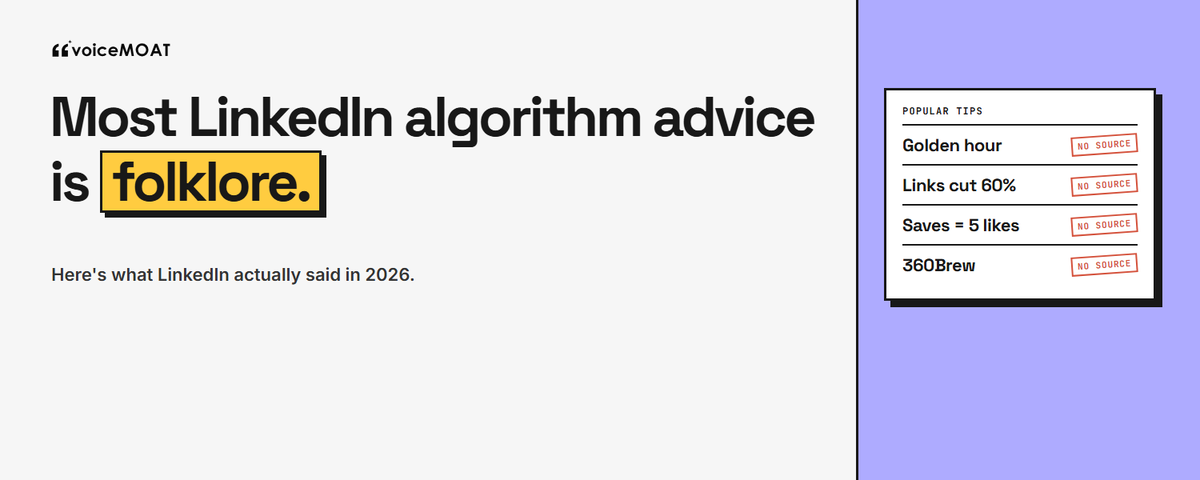
Most LinkedIn algorithm advice is folklore.
Golden hour. 60% link penalty. "Saves = 5 likes." 360Brew.
I traced each one. None has a LinkedIn source.
What LinkedIn actually changed in 2026, dated, & what it means if you post on both Twitter and LinkedIn
Two founders launch the same AI app on the same day.
Founder A spent 6 months perfecting the product.
0 followers. 0 email list.
Launch day: 40 signups, mostly friends.
Founder B spent those 6 months posting about what they were building.
8,000 followers. 1,200 people on the waitlist.
Launch day: 900 signups.
Same idea. Same tools.
Founder A's app is better.
Nobody will ever find out.
I shipped the first version of VoiceMoat in a weekend, then sat waiting for people to find it.
They didn't.
The code takes a weekend. The audience takes a year.
Building in silence isn't humble. It makes you harder to find.
Post the ugly version. Share the numbers. Start now 👇
How to quit your corporate job and build apps without gambling your savings (the 6 phase plan) 👇
Phase 1: Build while you're still employed
→ Don't quit yet. Your salary is your first investor
→ Pick one painful problem you or your coworkers deal with every week
→ Talk to 20 people who have it
Phase 2: Ship ugly, ship fast
→ Build an MVP in 2 to 3 weeks with Cursor, Lovable or Bolt
→ One core feature. No dashboards, no settings pages
→ Put a payment link on it from day one
Phase 3: Get your first 10 paying users
→ DM people who have the problem, not "friends who might like it"
→ Post your build journey on X consistently
→ If nobody pays, change the problem, not the paint
Phase 4: Find what's working
→ Track signups, activation, paid
→ Double down on the one channel that brings users
→ Raise prices. Most first apps are underpriced
Phase 5: Build a portfolio, not one bet
→ Launch app #2 using the same stack and playbook
→ Reuse auth, payments and landing pages
→ Small apps with multiple wins beat one perfect app
Phase 6: Quit with proof, not hope
→ Quit when app revenue covers 6 to 12 months of expenses
→ Not when you're "motivated"
Nobody makes millions by quitting first.
They make it by building first. 🚀
"Software isn't dead. It's solved. Nobody will hire software engineers by 2028."
That's the take going around. Here's what it misses 👇
→ Writing code is being automated
→ Defining what to build isn't
→ Debugging production at 3 AM isn't
→ Owning broken systems isn't
→ Solving vague business problems isn't
AI didn't kill software engineers.
It cut the ones whose only skill was typing code.
The role is moving from "write code" to "own the outcome."
That's the engineer who ends up managing 10 agents.
ChatGPT agrees with everything you say.
That's why your "great idea" still failed. 😅
Here's how to make it stop agreeing with you 👇
1. Make it argue against you
→ "Argue against this idea as if you're a competitor trying to kill it."
2. Ban flattery
→ "Don't compliment me. Don't say 'great question.' Only give me problems."
3. Ask for the failure first
→ "Assume this failed in 6 months. Write the post-mortem."
4. Give it a harsh role
→ "You're a skeptical investor who's rejected 1,000 pitches. Tear this apart."
5. Force a score
→ "Rate this 1 to 10. Anything above 7 needs proof."
6. Hide which side you're on
→ Don't say "I think X." Ask "What are the strongest cases for and against X?"
7. Make it change its own answer
→ "What did you get wrong in your last answer?"
8. Save it as a custom instruction
→ "Be direct. Disagree when I'm wrong. Never agree just to be nice."
AI that agrees with you feels good.
AI that disagrees with you is the one that's useful.
Every AI tool says it writes in your voice.
Almost none show you how to check.
On Twitter it matters most: in 280 characters every word is a tell, and replies are shorter still.
7 tests to run on any tool, ChatGPT and Claude included:

Posting every day is not a strategy.
It's a schedule.
Most feeds repeat the same claim: consistency wins, so show up daily and the algorithm will reward you. Everyone nods. Almost nobody asks what they're showing up with.
Volume without a system is just noise. 7 posts a week on 7 unrelated ideas gives a stranger 7 reasons to scroll past and zero reasons to follow.
A strategy decides things before the posting starts:
→ who this is for
→ what you want them to believe after a month of your posts
→ which 3 or 4 topics you will keep returning to
→ what a post has to do before it's allowed to go out
Notice what's missing from that list. How often.
Frequency is the last decision, not the first. Once you know who you're talking to and what you keep saying, the schedule almost picks itself. Without that, daily posting just makes you tired faster.
Compounding only works on something that stays the same long enough to stack.
A calendar is not a plan.
Most people's content setup is five apps that have never met
The scheduler doesn't know your voice. The analytics tool doesn't know what you were trying to say. The AI writer forgets you the moment you close the tab
It's a group project where nobody has read the brief.
The actual work is one loop:
write → schedule → engage → analyse → grow
When each step sits in a different app, nothing carries over from one to the next, so you re-explain yourself five times a week
@VoiceMOAT runs the whole loop in one place, with one AI across every page. audenAI knows your voice in Studio, in chat, in Grow and in Replies, and it gets better the more you use it

Your personal brand runs on five tools that don't talk to each other.
The chatbot forgets your voice. The scheduler doesn't know why a post exists. Your numbers never reach next week's plan.
So you're the integration.

I've helped 2,000+ creators and 20+ brands grow on Twitter, and I kept running into the same problem
The people with the most to say posted the least. They knew their stuff, they just never had time to write it down
The ones who did post got faster once AI arrived. Then their posts started to read like EVERYONE else's, same openers and the same tidy lesson at the end
That part honestly frustrated me
Schedulers only move posts around, and AI writers start from the internet's average, so neither knows how one person writes or what they'd never say
So I built @VoiceMoat, the Personal Brand OS for LinkedIn and Twitter
It learns from your own posts first, checks every draft against how you write and what you believe, and keeps the routine in one place: drafting, scheduling, replies and analytics
Over the next few weeks I'll walk through it here, one page at a time