

▫️Building @theholding_ in public ◽️DCA | BTC | DeFi diary ◻️Started with tea bought from DeFi yield
Joined January 2026
- Tweets1.6K
- Following516
- Followers566
- Likes21.3K





👀 One sAERO dashboard. Seven chains. And suddenly an entire universe of markets to allocate capital toward.
I've started experimenting with Predictive Allocation on the new @aeroxyz – and I'm genuinely excited about where this is going.
Look at my screenshot:
🟢 1,939 sAERO allocated to USDG/NVDA on Robinhood Chain — a liquidity pool for tokenized NVIDIA shares.
🟢 565 sAERO allocated to WETH/fBOMB on Base.
🔥 And here’s my little experiment with WETH/fBOMB.
I have a feeling things could get pretty hot around this pool soon.
That’s why I allocated 100% of this sAERO position’s power to it – not because of today’s displayed APR, but because of what I anticipate might happen next.
Let’s see if my intuition pays off over time. That’s Predictive Allocation in action!
And here’s where timing becomes everything. If this pool heats up, early allocators can capture trading fees before the crowd arrives.
Once everyone piles in, future revenue gets shared across more sAERO, potentially diluting returns.
The real edge? Anticipating where the money will flow before everyone else sees it.
✔️ So, USDG/NVDA & WETH/fBOMB
Two completely different markets. Two different networks. One place to manage the allocation of my staking power.
And here's the important distinction: I'm not buying these assets or providing liquidity to the pools. I'm directing AERO liquidity rewards toward markets I want to support.
As those pools generate exchange revenue, active sAERO allocators earn their proportional share. Additional liquidity incentives can make certain markets even more interesting.
That's the beauty of the new model.
Before, I voted with veNFTs in weekly epochs. Now, with sAERO and Predictive Allocation, revenue can accrue continuously and allocations can respond to changing demand – subject to a cooldown between changes.
On my screen, the NVIDIA pool shows 26.1% estimated APR. WETH/fBOMB shows 71%.
But those are estimates, not realized returns. The 48-hour reward estimates still show $0. I'll be tracking actual claims, not chasing beautiful numbers on a dashboard.
And the bigger picture is what really blows my mind. 🤯
Tokenized equities. Bitcoin and Ethereum. Stablecoins. Gold-backed assets. Emerging onchain FX markets.
Imagine coordinating liquidity for stock markets, commodity markets and currency pairs across multiple blockchains – from one interface.
Markets are appearing, new incentives are being added, and the infrastructure is starting to feel less like isolated DeFi farms and more like a living, interconnected financial exchange.
For someone who has spent nearly 20 years fascinated by markets and capital, watching this evolve in real time is extraordinary.
I'll keep testing manual allocations, Autopilot and the real revenue each strategy generates – and sharing the actual transactions, rewards and lessons with you.
This is DeFi Lego growing into financial infrastructure. And I'm loving every minute of it. ✈️


🛫 AERO IS LIVE. And my first upgrades are complete!
Today I successfully migrated my veAERO and veVELO positions into sAERO on the new @aeroxyz.
Both upgrades went smoothly. My new staked positions are already visible in the Aero dashboard. Screenshots attached!
But this is much more than a token migration.
🌐 Aerodrome and Velodrome are becoming one unified liquidity network, with a new economic engine: Predictive Allocation, real-time revenue distribution, and opportunities across multiple chains.
And now the fun begins.
I'll be exploring this new system in public, sharing real positions, transactions and cash-flow experiments.
Just a few days ago, I shared a BTC/stablecoin concentrated-liquidity experiment displaying over 60% annualized returns within a narrow price range.
Of course, these rates fluctuate with trading volume, market conditions and incentives.
Now I'm excited to go even deeper:
• Concentrated liquidity strategies across different assets and chains.
• Manual allocation: finding productive pools and directing sAERO power toward them.
• Autopilot: testing automated allocation and compounding.
• Predictive Allocation: exploring how positioning liquidity ahead of market demand can generate revenue.
The goal isn't to chase impressive APR numbers. It's to understand the machinery, follow actual fee flows and build productive capital systems.
And I'll share the practical side with you, step by step.
If you're upgrading too, take your time. Check the official guides and announcements from @aeroxyz. The migration process is straightforward, and there's no need to rush.
New protocol. New mechanics. A whole new playground for DeFi Lego.
Wishing everyone a great day and plenty of energy!
More live experiments coming soon. ✈️
👀 Yesterday I shared a DeFi Lego idea: vote for a tokenized Tesla pool, collect fees in Tesla shares, deposit them on Aave, borrow USDC and put that capital to work again.
Today I'm showing the actual transactions. Four screenshots, step by step.
1️⃣ Voting rewards → Tesla + USDC
From one veAERO lock voting on @aeroxyz USDC/TSLAc pool, I claimed 6.46666 USDC + 0.01752 TSLAc in trading-fee rewards.
About $13.40 earned on $4,238 in locked AERO. That's 0.316% for the week, or ~16.44% annualized APR at that weekly pace. Variable, of course – not a guaranteed yearly rate.
And this is just ONE lock. I collected rewards across several positions, converted the USDC portion into TSLAc, and consolidated the proceeds into tokenized Tesla shares.
2️⃣ Tesla shares → Aave V4
As promised, I deposited those tokens into @aave Pro's Coinbase Stocks market.
The screenshot shows ~$27.90 in TSLAc, now displaying 3.04% APY in USDC incentives. A temporary promotional rate, not a Tesla dividend.
Trading fees became tokenized equity. Tokenized equity became another potential cash-flow stream.
3️⃣ Tesla collateral → USDC loan
Next, I borrowed 10 USDC, using my Tesla tokens as collateral. The displayed borrowing rate? 1.90% variable APR.
That's the cost of borrowing – and the price of unlocking liquidity without selling the shares.
4️⃣ The full position in Rabby
The final screenshot shows it all together: Tesla supplied, USDC borrowed, and the loan's health factor.
So what happens to those 10 USDC now?
They can power another strategy: stablecoin pools, BTC/stable pairs, ETH/stable pairs, concentrated BTC/ETH liquidity, or another productive asset.
Some setups display 10–20%+ APR from trading fees and temporary boosts, depending on volume and range selection.
Those are opportunities to research, not guaranteed returns.
Look at the architecture:
veAERO voting revenue → TSLAc → USDC incentives → collateral → borrowed USDC → another income engine.
👀 Yield on yield on yield. Capital building on capital.
I've been building DeFi strategies for years. This isn't about impressing anyone with a $10 loan. It's about showing the mechanics openly, in simple terms, with real transactions.
🌍 Even a few dollars can open the door to an entire onchain financial universe – 24/7, from anywhere with internet access.
And after the original veAERO position, I haven't needed to add fresh cash to build these layers. The loan is still debt, and collateral, interest and strategy risks still need managing. That's part of the game.
Next stop: upgrading my veAERO and veVELO → sAERO positions and exploring the new Aero protocol in real time.
More practice. More experiments. Real receipts.
🏄♂️
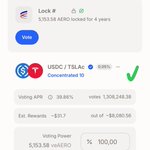
👀 I just voted on @aeroxyz for the USDC/TSLAc liquidity pool, where traders and investors swap USDC and tokenized Tesla stock.
Before upgrading my veAERO lock to sAERO, I allocated 100% of its voting power to this market. The vote is already onchain – 5,153.58 veAERO working for me.
Tomorrow I'll collect voting rewards in tokenized Tesla shares (TSLAc) and USDC.
Not from providing liquidity. Not from buying Tesla stock. From directing my voting power toward the pool.
Here's the beautiful part:
Aerodrome distributes 100% of its eligible exchange revenue to voters.
Each voter receives a proportional share of the fees and incentives associated with the pools they support.
I've been doing this for years on Aerodrome and Velodrome, collecting tokens, stablecoins and trading-fee revenue. That was already fascinating.
But now tokenized equities are part of the equation. A completely new dimension opens up. 🔥
And this is where my next DeFi Lego experiment begins.
Step 1: Collect TSLAc and USDC as voting rewards.
Step 2: Take those Tesla tokens to @aave Pro V4 and deposit them. Its Coinbase Stocks market currently advertises roughly 3% annualized in USDC rewards through Merkl.
That's a temporary incentive, not a Tesla dividend – but it's another income stream built on top of the first one.
Step 3: Borrow USDC against the tokenized Tesla shares. I'll do this as a small public experiment and share the actual borrowing cost.
Step 4: Deploy that borrowed liquidity into another productive strategy. A DeFi pool? A cash-flow token? Something else? Plenty of possibilities.
Just look at this sequence:
veAERO voting power → trading fees → tokenized Tesla shares → USDC rewards → collateral → borrowed capital → another cash-flow engine.
Yield on yield on yield. Capital building more capital.
☝🏻 And the most exciting part? After the original veAERO position, I don't need to inject fresh cash from my pocket to create these additional layers.
I'm putting the value generated by one productive position back to work – with the loan, of course, remaining a liability to manage.
It almost feels like printing new layers of capital. This is what I love about DeFi Lego. 🤯
I've been fascinated by stocks, exchanges and investing for almost 20 years.
And seeing @coinbase bring equities onchain, Aerodrome turn their liquidity into a market for voting power, and Aave make those assets usable as collateral is simply incredible.
We're still so early.
I'll keep sharing the actual rewards, transactions and results as I build this in public.
👀 Aerodrome @aeroxyz is printing fees.
Trading volumes in tokenized stocks are growing.
And while traditional stock markets are closed for the weekend, onchain stock markets keep trading.
And this is still just a handful of stocks.
Aerodrome is expected to expand its tokenized stock markets significantly.
The upcoming Aero rollout is also expected to expand beyond Base into Ethereum and the Optimism Superchain ecosystem.
That could open the door to a much larger market.
☝️ Here's the part I find especially interesting.
Trading fees generated by eligible pools are distributed to voters under Aerodrome's rules.
Today, that's veAERO voters; soon, the new model is expected to use sAERO.
And the fees can be paid in the tokens associated with those markets.
So if you're voting for a tokenized stock pool, you may earn fees from its trading activity without having to buy the stock or provide liquidity yourself.
And trading fees aren't the only potential income stream.
Some pools can also attract external incentives on top of their trading fees.
Then you can put those assets to work in different ways:
• Sell them for stablecoins.
• Hold them for potential long-term appreciation. Where the token structure supports dividends, those may be reflected in the token's value rather than paid out as cash.
• Provide liquidity to a pool and potentially earn trading fees and AERO incentives.
• Use eligible tokenized stocks as collateral on Aave V4 to borrow USDC, subject to market parameters and eligibility.
• Explore other strategies as the ecosystem develops.
And if you earn AERO, you can potentially stake it in the sAERO system to access the voter economy and its associated income streams.
One market. Multiple ways to put capital to work.
That's the beauty of DeFi: assets don't have to sit in isolation. They can become building blocks in a wider financial system.
DeFi LEGO.
🌍 $9.5 TRILLION a day. And this giant is gradually moving onchain.
I'm talking about Forex – the largest financial market on the planet.
According to the BIS, daily FX trading volume has reached approximately $9.5 trillion.
That's not market cap. That's the value of currencies changing hands every single day!
And here's what's fascinating.
This enormous market still largely operates on traditional banking schedules.
⏰ Trading 24 hours a day, five days a week. Weekends, banking intermediaries, international settlement delays, fees, and FX spreads.
Now imagine a currency market that runs 24/7, settles transactions in seconds, and is accessible directly from your crypto wallet.
And this is no longer science fiction.
🔥 Frax, Curve, Polygon, Aero, and DFB are gradually building exactly that infrastructure.
In May 2026, @fraxfinance , together with Curve, DFB, and Polygon, launched onchain FX liquidity pools for national currencies.
And now similar markets have arrived on Base through Aero @aeroxyz
🇧🇷 BRZ — Brazilian real
🇨🇦 CADD — Canadian dollar
🇬🇧 tGBP — British pound
🇮🇩 IDRX — Indonesian rupiah
🇿🇦 ZARP — South African rand
🇦🇺 AUDF — Australian dollar
All six trade against frxUSD.
And this is where things get really interesting. 😁
frxUSD isn't just another digital dollar.
Its reserve framework includes institutional-grade dollar assets, including tokenized US Treasury funds such as BlackRock's BUIDL, Superstate's USTB, and other eligible reserve assets.
In other words, traditional financial infrastructure is helping support a digital dollar.
But Frax has introduced something particularly interesting.
💰 US Treasury securities generate interest income.
And Frax can use income from those reserves to incentivize liquidity in DeFi!
Think about this economic chain:
🇺🇸 US Treasuries → frxUSD reserve income → liquidity incentives → liquidity providers → deeper FX pools → trading activity → trading fees.
Cash flows from traditional finance are starting to power the development of onchain markets!
That's fundamentally different from a model where liquidity is endlessly subsidized through the issuance of new tokens.
Now remember our discussions about Curve Wars and DeFi voting power.
Launching a token representing a national currency isn't enough to create a functioning FX market.
You need liquidity, market makers, economic incentives, trading infrastructure, and mechanisms to direct capital where it's needed.
And DeFi already has the building blocks!
Curve provides specialized FX pools. Polygon enables low-cost settlement. Aero develops trading liquidity on Base. Frax provides the dollar foundation, while DFB helps organize these markets.
Meanwhile, Mento is expanding, tokenized euro-dollar markets are emerging, and new payment infrastructure continues to develop.
Of course, we're still at the beginning.
Onchain FX remains tiny compared with traditional Forex. Liquidity depth, issuer reliability, currency risks, and redemption into traditional banking money are all significant challenges.
But the direction is incredibly exciting.
Tokenization isn't just about turning stocks, bonds, and real estate into tokens.
It's about gradually building an entirely new financial infrastructure where currencies, capital, liquidity, and cash flows can interact within the same programmable environment.
And while most people are watching crypto price charts, markets of an entirely different scale are quietly being built beneath the surface.
The most exciting thing about DeFi isn't just what has already been created. It's the financial systems we can now begin to build.
🏄♂️

Defitea.eth retweeted

#Stablecoins are splitting into two clear categories: passive parking spots and institutional credit infrastructure.
Look at the plumbing behind @MidasRWA mF-ONE: outside of $USDC , @fraxfinance $frxUSD is the only stablecoin accepted as a native primary mint asset.
Why are managers like @FasanaraCapital and protocols like @GearboxProtocol using frxUSD as the debt layer for automated RWA leverage?
1- Institutional Reserve Quality: $frxUSD is 100% backed by cash equivalents and tokenized Treasuries with multi-custodian redemption rails.
2- #ReserveLink Economics: Instead of relying on mercenary, hyper-inflationary token emissions to subsidize borrowing, #frxUSD channels real reserve economics directly back into protocol liquidity.
3- Peg Stability Under Leverage: PegKeeper pools ensure that high-volume borrowing and looping don’t blow out the peg.
When real-world credit moves on-chain, high-quality collateral demands equally robust debt assets. frxUSD is becoming that default settlement rail.

1/ Frax and Gearbox are unlocking automated RWA leverage.
frxUSD is now the underlying stablecoin asset for @GearboxProtocol's new RWA market, bringing institutional-grade liquidity to one-click RWA leverage, starting with @MidasRWA mF-ONE.
Leave it to two DeFi OGs to unlock RWAfi.
👀 Convex Finance – BlackRock of DeFi, in a way?
At first glance, that sounds like a crazy comparison. But let's dig a little deeper.
BlackRock is the world's largest asset manager, overseeing around $15.5 trillion.
Just imagine the scale: shares in thousands of companies, bonds, funds, real estate, and entire investment strategies.
But the most interesting part isn't just the money.
It's economic influence.
By managing clients' assets, BlackRock also participates in corporate voting within the authority delegated to it.
And here's where an unexpected parallel emerges.
Convex Finance.
The two are nowhere near comparable in terms of capital. But there's a fascinating similarity in how their influence works:
Aggregating resources from many participants and turning them into significant collective power.
Convex has spent years accumulating locked CRV and now controls approximately 54% of Curve's voting power.
Through vlCVX, participants can influence which liquidity pools receive CRV emissions.
And what do those emissions mean for a DeFi pool?
Incentives for liquidity providers.
A way to attract capital, improve trading conditions, and grow a market.
Now, let's revisit the Curve Wars.
Protocols bought CVX, locked tokens, competed for votes, and offered incentives.
An entire market emerged where voting power acquired measurable economic value.
And Convex became one of the central pillars of that infrastructure.
And the story goes far beyond Curve.
Convex also participates in the voting economies of Frax, f(x), and Resupply.
Now imagine the future.
🌍 Tokenized stocks, bonds, real estate, commodities. Thousands of new onchain markets competing for liquidity.
Who will help direct economic incentives toward them?
Who will aggregate voting power?
Who will build the infrastructure through which projects can attract that power?
Perhaps Convex has already spent years building one of the answers.
And here's another fascinating detail: CVX has reached its maximum supply of 100 million tokens. A substantial portion of that supply is locked in vlCVX.
Meanwhile, the CVX chart has looked for years as if the market had almost forgotten it exists.
Of course, there's an important limit to the BlackRock comparison.
BlackRock manages real investment portfolios on behalf of clients, while Convex aggregates rights within DeFi protocols.
CVX isn't equity in Convex, nor does it represent ownership of its assets.
Still, the parallel is worth thinking about.
In traditional finance, giants manage capital.
In DeFi, giants are emerging that aggregate the power to influence where capital is incentivized to flow.
These are different forms of economic power. But both can play important roles in shaping markets.
And as tokenization expands, voting infrastructure could become significantly more valuable.
That's what makes Convex so interesting to me.
Not just the CVX price on a screen.
But the role this system has already established – and the role it could potentially play in the financial architecture of the future.
🟩 Defitea Yield Fund (part of @theholding_) is building its own kind of veGallery – a collection of fundamentally strong, cash-flow-generating tokens.
And CVX (vlCVX) holds a special place in it.
Always happy to share these kinds of creative deep dives and make complex DeFi concepts a little easier to understand.

👀 A quiet DeFi giant you could easily overlook if you only looked at the chart.
Convex Finance ethereum:0x4e3fbd56cd56c3e72c1403e103b45db9da5b9d2b
Just look at its history.
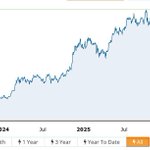
Back in late 2021, CVX was trading close to $50.
Today? Around $2.50.
Years of decline, endless sideways action, occasional rallies, and then... silence again.
For anyone chasing beautiful charts, there's seemingly nothing exciting here.
👀 But let's take a look under the hood.
On October 15, 2026, CVX reached a historic milestone: its maximum supply of 100 million tokens was fully minted.
That's it.
No more CVX will be created under the original emission schedule. Token inflation from new CVX issuance has officially come to an end.
And here's where things get even more interesting.
🔒 Around 46.3 million CVX are locked in the vlCVX voting system.
That's roughly 46% of the entire maximum supply!
And those tokens aren't just sitting there doing nothing.
They give holders a say in one of DeFi's most fascinating pieces of financial infrastructure.
Convex @ConvexFinance controls approximately 54% of all Curve @CurveFinance voting power. Through vlCVX, participants can influence how CRV emissions are distributed across liquidity pools.
But the story goes well beyond Curve.
Convex also participates in the economics and governance of Frax, f(x) Protocol, and Resupply.
Think about that for a moment.
While the CVX chart looked painfully boring for years, an enormous system for aggregating voting power and directing economic incentives was developing beneath the surface.
🏄♂️ And remember how we recently explored the Curve Wars?
How protocols compete for votes, how incentives attract liquidity, and how voting power can become a genuinely productive economic resource.
Convex has been right at the heart of that economy all along.
Now imagine the years ahead.
🌍 Tokenized stocks, real estate, bonds, commodities, and entirely new onchain companies.
Potentially thousands of markets that will need liquidity. 🌊
And infrastructure capable of concentrating voting power and directing economic incentives toward the markets that need them.
Of course, there's no guarantee that the future of tokenization will revolve around Curve or Convex.
But the potential scale of this kind of infrastructure is fascinating to think about.
Especially now that CVX emissions have ended and a substantial portion of the existing supply remains locked.
That doesn't automatically mean the price will rise. Tokens can unlock, competition isn't going away, and long-term value depends on real demand for voting power and the cash flows behind it.
But this is where real investment research gets interesting.
When you spend years accumulating through DCA, studying the protocol, following its economics, voting mechanisms, and infrastructure development instead of just waiting for the next green candle.
That takes patience. And the market certainly doesn't owe you a reward for it.
But sometimes these are exactly the stories that become fascinating when the market eventually starts reassessing their value.
Not when everyone is suddenly shouting about them.
But much earlier, when the chart is boring, attention is low, and a serious economic machine is already running beneath the surface.
Convex is one of those DeFi giants I find especially interesting to follow over the long term.
A token is a price on a screen.
But behind that price, there can be an entire architecture of capital.
Defitea.eth retweeted

"Over the past 30 days, we've generated more holder revenue than any other spot exchange.
That is true year-to-date.
That is also true all-time.
As we enter these new markets, we think we will have the ability to capitalize and redistribute a lot more of that value."
👀 A quiet DeFi giant you could easily overlook if you only looked at the chart.
Convex Finance ethereum:0x4e3fbd56cd56c3e72c1403e103b45db9da5b9d2b
Just look at its history.
Back in late 2021, CVX was trading close to $50.
Today? Around $2.50.
Years of decline, endless sideways action, occasional rallies, and then... silence again.
For anyone chasing beautiful charts, there's seemingly nothing exciting here.
👀 But let's take a look under the hood.
On October 15, 2026, CVX reached a historic milestone: its maximum supply of 100 million tokens was fully minted.
That's it.
No more CVX will be created under the original emission schedule. Token inflation from new CVX issuance has officially come to an end.
And here's where things get even more interesting.
🔒 Around 46.3 million CVX are locked in the vlCVX voting system.
That's roughly 46% of the entire maximum supply!
And those tokens aren't just sitting there doing nothing.
They give holders a say in one of DeFi's most fascinating pieces of financial infrastructure.
Convex @ConvexFinance controls approximately 54% of all Curve @CurveFinance voting power. Through vlCVX, participants can influence how CRV emissions are distributed across liquidity pools.
But the story goes well beyond Curve.
Convex also participates in the economics and governance of Frax, f(x) Protocol, and Resupply.
Think about that for a moment.
While the CVX chart looked painfully boring for years, an enormous system for aggregating voting power and directing economic incentives was developing beneath the surface.
🏄♂️ And remember how we recently explored the Curve Wars?
How protocols compete for votes, how incentives attract liquidity, and how voting power can become a genuinely productive economic resource.
Convex has been right at the heart of that economy all along.
Now imagine the years ahead.
🌍 Tokenized stocks, real estate, bonds, commodities, and entirely new onchain companies.
Potentially thousands of markets that will need liquidity. 🌊
And infrastructure capable of concentrating voting power and directing economic incentives toward the markets that need them.
Of course, there's no guarantee that the future of tokenization will revolve around Curve or Convex.
But the potential scale of this kind of infrastructure is fascinating to think about.
Especially now that CVX emissions have ended and a substantial portion of the existing supply remains locked.
That doesn't automatically mean the price will rise. Tokens can unlock, competition isn't going away, and long-term value depends on real demand for voting power and the cash flows behind it.
But this is where real investment research gets interesting.
When you spend years accumulating through DCA, studying the protocol, following its economics, voting mechanisms, and infrastructure development instead of just waiting for the next green candle.
That takes patience. And the market certainly doesn't owe you a reward for it.
But sometimes these are exactly the stories that become fascinating when the market eventually starts reassessing their value.
Not when everyone is suddenly shouting about them.
But much earlier, when the chart is boring, attention is low, and a serious economic machine is already running beneath the surface.
Convex is one of those DeFi giants I find especially interesting to follow over the long term.
A token is a price on a screen.
But behind that price, there can be an entire architecture of capital.

(1/5) $CVX is now fully minted! 🎉
On Oct 15, the @ConvexFinance token hit its hard-coded 100M max supply (block 26,200,161).
WHAT HAPPENED
- No new CVX can ever be minted
- The final 120.8 CVX went out in a batch of reward claims
👇

Defitea.eth retweeted

Oh, and aside from $CVX having literally zero token emissions/inflation moving forward, I forgot to also mention that 46.3% of all the CVX that will ever exist is locked and in-accessible (for 4 months at a time).
So if you don't have any $CVX and you want some- you won't get any from token inflation, you won't get any of the 46.3% of supply that is locked, the only way you can get some is to buy it off of the remaining 53% that isn't literally inaccessible.
Meanwhile, I've already made the case to argue that price could be 4x higher than it is today within a month.
So, good luck to those trying to accumulate a sizeable bag at this stage- it won't be easy 🫡


100% of all the $CVX that will ever exist has now been minted.
There will never be any new $CVX created and if you’re not holding any right now the only way to get it is to buy it off someone else on the open market...
And I speak for myself here but I think many other holders probably feel the same way- I’m not letting mine go for cheap 😤
Defitea.eth retweeted

$AERO 1M
Measured Move from the Swing Low
Bull Flag Break Out Target
STOCH RSI Going Parabolic from the Lows

Defitea.eth retweeted

Next question: how often should you move your sAERO?
It isn't live until Oct 22, so I ran 3 weeks of Aerodrome fees through my radar as if it were. Every 47h: $10 a day on 10,000. Once a week: $5.90.
Top pools cool off within a day. The lazy holder leaves 40% on the table.


Aero launches in two days. My radar is ready.
Four things changed today
Your income now counts YOUR sAERO after it enters the pool. Idea from @martijnde_boer. 10,000 sAERO in CL-USDC/FOLKS pays ~$14.62 a day. 100,000 pays ~$123.17, not $146. Your own money dilutes the pool.
Data refreshes every 4 hours instead of 6.
When the last veAERO vote closes (Oct 21, 22:59 UTC), the radar stops suggesting weekly votes and shows what to do with your lock.
And the link now shows forecast vs paid for the last closed week: $23.84 vs $22.61 per 10,000 votes. 95%.

🧪 My $10 LP experiment on @aeroxyz is getting interesting!
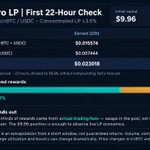
Almost 24 hours ago, I added $9.96 to the cirBTC/USDC pool on Arc, using a fairly tight ±3.5% concentrated liquidity range.
The APR displayed by Aero is dynamic and changes with market conditions. But I wanted to go one step further: measure the actual fees and Boost rewards earned by my own LP position over its first 22 hours.
So I ran the numbers. Here's the breakdown after 22 hours:
💰 Trading fees: $0.015574 → 62.0% annualized APR
🚀 Boost rewards: $0.007444 → 29.6% annualized APR
🔥 Total: $0.023018 → 91.6% annualized APR
Yes, we're talking about 2.3 cents. 😁
But that's exactly why I love these tiny experiments. Even with $10, you can watch the economics of a real liquidity pool in action.
And notice something interesting: roughly 68% of the earnings came from actual trading fees, not the Boost program.
Boosts may come and go. Trading fees are the underlying business model: traders swap, pay fees, and active liquidity earns its share.
Of course, 91.6% isn't some magical sustainable yield. It's simply the first 22 hours annualized.
Volume can change. Other LPs compete for the same fee flow. Price can leave your range. And concentrated liquidity brings its own risks, including divergence loss.
A tighter range concentrates your capital around the current price, potentially increasing fee earnings while you're in range. But it also means more time out of range and potentially more rebalancing.
Personally, I usually prefer wider ranges — sometimes ±10–20% – and fewer adjustments.
I'm generally happier targeting a more realistic 10–20%+ annualized fee yield over time than chasing a flashy three-digit APR for a day.
I also experiment with different token allocations, not just 50/50. That's another fascinating part of concentrated LP strategies.
And there's a second game here: when eligible, staking LP positions for AERO emissions instead of collecting swap fees directly. Similar incentive-driven liquidity models exist across DeFi, including Curve.
For tracking, I've used @revertfinance extensively with Uniswap. Love being able to study actual fees, PnL, ranges and position performance.
Hopefully we'll see full analytics support for the new Aero too!
By the way, what FREE tools do you guys use to track concentrated LP positions and their real performance?
Always happy to discover something new and share experiments along the way.
Tiny position. Real trading fees. Lots to learn. 🔥

🛫 Our little $10 LP experiment on Aero is getting interesting!
Remember the cirBTC/USDC position I opened on @aeroxyz in the Arc network? Bitcoin has moved up a bit, and our liquidity is already changing its shape.
Let me explain how this works in the simplest way possible.
Imagine you run a tiny shop.
Your inventory is Bitcoin. Your cash register holds USDC.
When customers come in to buy Bitcoin, you sell them some of your BTC and collect USDC in return.
That's basically what's happening inside our liquidity pool!
We started with roughly 50% cirBTC and 50% USDC, using a concentrated liquidity range of about ±3.5%.
Here's our actual price range:
📉 Lower: $78,813 per BTC
📈 Upper: $84,951 per BTC
As Bitcoin moved higher within that range, the pool gradually sold some of our BTC for USDC.
And look at the inventory now!
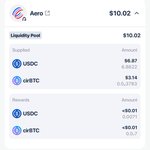
₿ cirBTC: ~$3.17
💵 USDC: ~$6.83
Our BTC shelves are getting emptier, while the USDC cash register is filling up. 😁
And here's the really fun part.
If BTC reaches our upper price boundary, the position will have converted entirely into USDC. If BTC instead falls through the lower boundary, we'll end up holding cirBTC.
That's concentrated liquidity in action: the pool automatically changes your asset mix as the market moves.
And while trades happen through our active liquidity, we're also collecting trading fees in cirBTC and USDC!
The screenshots show our first tiny fees accumulating, plus a separate USDC Reward Boost currently available on Aero Lite.
No huge numbers here. It's a $10 test, after all. 😂
One important detail: having more USDC after selling BTC doesn't automatically mean outperforming someone who simply held Bitcoin. LP returns depend on fees, price movement, the chosen range and the changing asset mix.
But this is exactly why I love experimenting with real positions rather than just staring at APR numbers.
And the mobile experience? Pretty sweet!
I've been testing Aero directly from my phone. Managing the position, checking the range, claiming trading fees and Reward Boosts – all right there. The screenshots also show how everything looks in Rabby Wallet.
Next time I'll gradually increase the position size so the fee flows are easier to observe.
And we'll go much deeper into the LP game!
BTC/stablecoin pools, ETH/stablecoin pools, stablecoin pairs, wider and tighter ranges, single-sided liquidity, and even directional long/short-style strategies.
Different assets. Different DEXs. Different ways of putting capital to work.
I'll also share what happens when this little position eventually moves outside its range, whether BTC breaks above or below it.
And with the full Aero rollout, tokenized stocks and more real-world assets coming onchain, there's a whole new playground opening up.
Liquidity strategies, tokenized equities, borrowing against eligible collateral, and putting that borrowed capital to work in other DeFi protocols – plenty to explore, with the risks and results documented along the way.
We're just warming up the engines.
Really enjoying sharing these little experiments, step by step, with actual numbers and real transactions.
More onchain adventures ahead!🔥
🛫 Yesterday I deposited a mighty $10 into the cirBTC/USDC liquidity pool on @aeroxyz, running on Arc.
And guess what? The first trading fees are already rolling in – paid in the pool's own tokens: cirBTC and USDC. 👏🏼
Yep, it's a tiny test position. But we're just getting started with these public experiments!
Now here's where things get interesting.
Who actually gets the trading fees – liquidity providers or voters? And how do they split the pie?
Turns out, it depends on whether your liquidity is staked.
Right now, Arc is running the early Aero Lite version. The full voting system isn't live yet, so LPs keep the trading fees.
But once the full Aero launches, the economics change.
💵 Keep your liquidity unstaked? On Arc, you'll receive 95% of the Smart Fees earned by your position. The remaining 5% goes to the voting side of the economy.
✈️ Stake your liquidity? Instead of collecting trading fees directly, you earn newly issued AERO tokens. Meanwhile, 100% of the trading fees generated by your staked position go to the sAERO voters directing rewards to that pool.
And that's not their only potential income stream!
Projects can also add incentives to attract more votes and liquidity.
Here's what I really like about this setup.
As an LP, you get to choose how you want to earn: collect trading fees directly or receive AERO emissions for providing liquidity.
Meanwhile, voters help direct those emissions toward different markets and earn their share of the revenue.
One big financial machine, with different roles and different cash flows.
My position is tiny for now, but there's something genuinely satisfying about testing these mechanics with real capital and sharing every step with you.
More experiments coming soon! I'll gradually scale things up, explore new pools and networks, and play around with some more advanced LP strategies.
👀 Looking forward to the full Aero launch!
P.S. And it's not just Aero. I'll keep exploring other protocols, sharing real strategies and breaking everything down in simple English.
Always happy to share the journey! 🤝

🌍 You know what I find especially exciting about DeFi and the modern internet?
The ability to watch your energy turn into something real, almost in real time.
💵 Take liquidity providing (LP), for example.
You put capital into a trading pool, and suddenly it becomes part of a massive global market.
Somewhere on the other side of the planet, someone is buying Bitcoin, selling ETH, swapping stablecoins... and now even trading tokenized stocks.
Trades flow through the pool, and you can actually watch the trading fees accumulate on your position in real time.
🚀 In other strategies, you can earn token emissions instead of trading fees, distributed according to the protocol's rules.
And I absolutely love that feeling!
Your capital is interacting with people you've never met, all around the world, while you're just going about your day.
🗳️ Now think about voting.
With the new Aero, we're waiting for Predictive Allocation – a mechanism that lets you direct your voting power toward markets where you expect trading activity to pick up.
You study the market, choose a pool, and allocate your voting power.
LPs get incentives to provide liquidity, traders come in and trade, and you can earn a share of the fees generated by that activity.
The whole system becomes much more dynamic.
Instead of voting once and waiting for the week to end, you get to watch the market evolve and see your decisions play out in real time.
I seriously can't wait to test this properly!
And you know where I get a surprisingly similar feeling?
Right here, writing posts on X (CT).
You share a thought, an experience, something you've learned.
Hit "Post" – and suddenly your idea is traveling around the world.
People from different countries read it, discuss it, ask questions, and share their own experiences.
You watch the views climb live, conversations unfold, and new connections happen right before your eyes.
It's funny how similar these experiences feel.
• In one case, you're putting capital into the market.
• In another, you're putting your voting power and market knowledge to work.
• And in the third, you're sharing ideas, knowledge, and creativity.
Three different ways to become part of a living global system that responds to you almost instantly.
That's what genuinely inspires me.
You're not just watching the world go by. You're participating, contributing something of your own, and seeing the response.
Capital goes to work. Ideas travel. People connect.
And it's all happening right now.
🏄 One beautiful idea connects all three:
You put your energy into a massive, living network and get to watch it interact with the world almost immediately.
Whether that energy is financial, intellectual, or creative.
There's something pretty damn magical about that. ✨
🛫 Yesterday I deposited a mighty $10 into the cirBTC/USDC liquidity pool on @aeroxyz, running on Arc.
And guess what? The first trading fees are already rolling in – paid in the pool's own tokens: cirBTC and USDC. 👏🏼
Yep, it's a tiny test position. But we're just getting started with these public experiments!
Now here's where things get interesting.
Who actually gets the trading fees – liquidity providers or voters? And how do they split the pie?
Turns out, it depends on whether your liquidity is staked.
Right now, Arc is running the early Aero Lite version. The full voting system isn't live yet, so LPs keep the trading fees.
But once the full Aero launches, the economics change.
💵 Keep your liquidity unstaked? On Arc, you'll receive 95% of the Smart Fees earned by your position. The remaining 5% goes to the voting side of the economy.
✈️ Stake your liquidity? Instead of collecting trading fees directly, you earn newly issued AERO tokens. Meanwhile, 100% of the trading fees generated by your staked position go to the sAERO voters directing rewards to that pool.
And that's not their only potential income stream!
Projects can also add incentives to attract more votes and liquidity.
Here's what I really like about this setup.
As an LP, you get to choose how you want to earn: collect trading fees directly or receive AERO emissions for providing liquidity.
Meanwhile, voters help direct those emissions toward different markets and earn their share of the revenue.
One big financial machine, with different roles and different cash flows.
My position is tiny for now, but there's something genuinely satisfying about testing these mechanics with real capital and sharing every step with you.
More experiments coming soon! I'll gradually scale things up, explore new pools and networks, and play around with some more advanced LP strategies.
👀 Looking forward to the full Aero launch!
P.S. And it's not just Aero. I'll keep exploring other protocols, sharing real strategies and breaking everything down in simple English.
Always happy to share the journey! 🤝
We've been deep in the veGame, but don't think I've forgotten about the LP game. 😁
I've spent years providing liquidity across DeFi, especially concentrated liquidity on Uniswap, Aerodrome and other DEXs.
And I finally got around to testing the new @aeroxyz as an LP!
First experiment: a mighty $10 in the cirBTC/USDC pool on @arc, with a ±3.5% concentrated liquidity range.
Yes, ten bucks. And that's intentional.
Whenever I explore a new protocol, I usually start with $10–$100. Before deploying serious capital, I want to understand the mechanics, test transactions, explore the interface and see how everything feels in practice.
And I have to say, Aero passed the aesthetic test beautifully.
Opened the position on my laptop, checked it on mobile, then watched everything appear in Rabby Wallet.
Smooth, clean and genuinely enjoyable to use.
A few things I particularly liked:
Arc is the first network available for these Aero tests. Plenty to explore already.
Gas fees on Arc are paid in USDC. Love that little detail.
₿ cirBTC is Circle's wrapped Bitcoin, bringing BTC liquidity into the Arc ecosystem.
🎨 And my favorite part: the concentrated liquidity position is represented by an NFT.
Yes, an actual transferable LP-NFT representing my position. Similar to what we've been using on Uniswap for years.
Which gets me thinking about the next layer of DeFi LEGO.
I've previously used @revertfinance to borrow against Uniswap v3 LP-NFTs.
Now imagine eventually being able to use these new Aero positions as collateral too. Your liquidity keeps working while unlocking additional capital.
Not supported for this new position yet, but definitely something I'd love to see.
The interface shows an attractive fee APR, but right now I'm not chasing headline yields. I'm testing the machinery.
After years of veVoting and concentrated LP strategies, there's still something ridiculously satisfying about opening a fresh $10 position and exploring a new market.
Tiny capital. Big curiosity.
More hands-on experiments coming soon. 🧪


Defitea.eth retweeted

Honestly, I lived it and it still doesn’t make sense.
But, the more time I spend in this crazy industry the more I realize how common this story is.
The internet made it possible to connect with anyone, blockchains to build with them (trustlessly).
The future is bright. 🛫

Alex Cutler says five anons who met on Discord built Velodrome into Optimism’s largest exchange, beating billion-dollar competitors
“Four years ago, when we first launched Velodrome, we were five anonymous guys who had met in a Discord…”
“When we launched Velodrome, we were up against billion-dollar incumbents.”
“And it was through the quality of the product, the combination of tech and economics that we were able to win dominant share, first on Optimism, becoming the largest exchange there.”
“And then, of course, launch and become the dominant exchange on probably the single most important chain of the last cycle.”
“For us, this moment of bringing these two exchanges together, unifying them around a single token… that represents a 100% claim on the current and future productive value of the exchange.”
“And now going from servicing about 15% of the addressable spot market to something four times larger, I think is super exciting.”
We've been deep in the veGame, but don't think I've forgotten about the LP game. 😁
I've spent years providing liquidity across DeFi, especially concentrated liquidity on Uniswap, Aerodrome and other DEXs.
And I finally got around to testing the new @aeroxyz as an LP!
First experiment: a mighty $10 in the cirBTC/USDC pool on @arc, with a ±3.5% concentrated liquidity range.
Yes, ten bucks. And that's intentional.
Whenever I explore a new protocol, I usually start with $10–$100. Before deploying serious capital, I want to understand the mechanics, test transactions, explore the interface and see how everything feels in practice.
And I have to say, Aero passed the aesthetic test beautifully.
Opened the position on my laptop, checked it on mobile, then watched everything appear in Rabby Wallet.
Smooth, clean and genuinely enjoyable to use.
A few things I particularly liked:
Arc is the first network available for these Aero tests. Plenty to explore already.
Gas fees on Arc are paid in USDC. Love that little detail.
₿ cirBTC is Circle's wrapped Bitcoin, bringing BTC liquidity into the Arc ecosystem.
🎨 And my favorite part: the concentrated liquidity position is represented by an NFT.
Yes, an actual transferable LP-NFT representing my position. Similar to what we've been using on Uniswap for years.
Which gets me thinking about the next layer of DeFi LEGO.
I've previously used @revertfinance to borrow against Uniswap v3 LP-NFTs.
Now imagine eventually being able to use these new Aero positions as collateral too. Your liquidity keeps working while unlocking additional capital.
Not supported for this new position yet, but definitely something I'd love to see.
The interface shows an attractive fee APR, but right now I'm not chasing headline yields. I'm testing the machinery.
After years of veVoting and concentrated LP strategies, there's still something ridiculously satisfying about opening a fresh $10 position and exploring a new market.
Tiny capital. Big curiosity.
More hands-on experiments coming soon. 🧪
Defitea.eth retweeted

PAXGy (28 Jan 2027 maturity), @paxoslabs’, gold-backed digital asset that grows in gold terms, is now live on Pendle.
Trade, speculate and fix RWA investment-grade gold yield onchain.
