

"Deep dives into power, money, and empire. Real history without the textbooks. Long-form threads and videos. New episodes weekly."
Las Vegas
Joined June 2026
- Tweets655
- Following92
- Followers78
- Likes210




My book has a companion volume. Here's what's in it.
The Companion Guide is a separate hardcover with the sources, the timelines, and a steelman of the main objections. Sold on its own or bundled with The Veil of the Square Mile:
theveilpress.com/library/vei…

Every American's share of the bill: US debt was $40.39 trillion on Oct 15 (Treasury). At the IMF meetings, Georgieva said growth "cannot deliver fast enough" the fix.
The modern national debt was born in London: the Bank of England, 1694.
theveilpress.com/desk/entiti…

London's model, America's terms.
1791: the First Bank of the United States opens with $10 million in capital. $2 million, 20%, belonged to the federal government. Foreign shareholders got no vote.
theveilpress.com/desk/why-ha…

The United States is 250 years old. The City of London Corporation is older than Parliament and older than the Bank of England.
It came through the Great Fire, the Blitz and the end of the British Empire. Governments changed the whole time. The Corporation kept running.

The book draws one line between the 1694 Bank of England and the American founding.
One treats the citizen as a source of future taxes to be collected. The other starts from rights the citizen already has before any government exists. America chose the second.

Veil Watch: the Bank of England was chartered in 1694 to fund Britain's wars. Hamilton copied the charter and cut its reach: 20% U.S.-owned, foreign votes barred, 20 years and done.
America's money started as a refusal to depend on London.
theveilpress.com/desk/why-ha…


1790: America is free, broke, and its war debt trades at 20 cents on the dollar.
Hamilton's fix came from London: the Bank of England's charter, rebuilt with an American twist. Foreign shareholders couldn't vote.
#1776 #Hamilton
1790: America won the war against Britain and was nearly broke. Its war debt traded at about 20 cents on the dollar.
London had the Bank of England. Hamilton built America's answer. 🧵

Then the bank. Hamilton used the Bank of England's 1694 charter as his model, and changed the terms:
• Government owned 20%
• Treasury could inspect the books
• Foreign shareholders: no vote
• 20-year charter
Washington signed it in February 1791. America would have its own credit, not a financial dependency on the empire it had just beaten.
Full story: theveilpress.com/desk/why-ha…

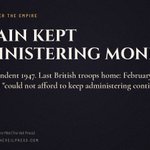
Why Americans should care how the British Empire ended: India became independent in 1947. In February 1948, the last British troops sailed home.
The book: Britain "could not afford to keep administering continents. What it could afford ... was to keep administering money."


The City of London Corporation didn't own it. The book is careful about that. They were two separate institutions in the same few streets, run by the same merchant world.
Getting that distinction right matters. A lot of what's online blurs it, and that's how bad theories get started.
theveilpress.com/library/vei…
1/ Alberta votes today on Question 10: stay a province, or have the Government of Alberta start the legal process toward a binding referendum on separation.
It's not independence tonight. It's the first step. Our opinion: Option 2.

2/ Why Americans should care: in 2025 the US imported 6.17M barrels of crude a day. 3.91M came from Canada (EIA). Alberta produced 83.8% of Canada's crude (CER).
Alberta pays in too: no equalization from Ottawa in any year from 2017-18 to 2026-27 (Finance Canada).
3/ Above Ottawa sits the Crown. King Charles III is King of Canada, and until 1982 only Britain's Parliament could amend Canada's constitution.
Albertans want their own road. Polls close 8 PM MT.
theveilpress.com/desk/albert…

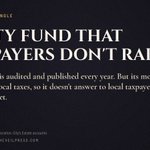
In the US, a city budget answers to local taxpayers. The City of London's private fund, City's Estate, is different. Its accounts are audited by an outside firm and published yearly.
But the money isn't raised from local taxes, so taxpayers don't control it.

1790: America is free, broke, and its war debt trades at 20 cents on the dollar.
Hamilton's fix came from London: the Bank of England's charter, rebuilt with an American twist. Foreign shareholders couldn't vote.
#1776 #Hamilton
