

Research & grantmaking @coeff_giving • Leave me anonymous feedback: https://xitter.cf/t.co/0YmbLhCA2R
New York
Joined November 2016
- Tweets782
- Following547
- Followers3K
- Likes7.1K




Pinned Tweet
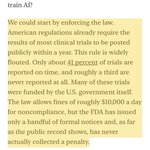
The US has a law requiring clinical trial results to be made public with a $10,000/day fine for breaking it. Despite poor adherence, the FDA has never collected.
I wrote for @DKThomp’s newsletter on what AI actually needs to cure disease (and the boring policy answers)

I'm hiring 2-3 Associate Program Officers or Research Fellows for my team at Coefficient Giving.
The job involves grant-making and research on AI x global health and development. We're aiming to spend ~$100M in the next year, on questions ranging from how LMICs can grow if AI eats the export-services path, to whether AI-read TB X-rays work in clinics without a radiologist.
Apply here by Oct 4 if it sounds interesting: jobs.ashbyhq.com/coefficient…
Unfortunately, I suspect the default path for AI's impact on developing countries is divergence, and not convergence, with rich ones - good piece on this in @ReadTransformer


Transformative AI could supercharge development for the world’s poorest countries
But only if governments act fast to lay groundwork that spreads AI’s gains rather than concentrating them, writes @FutureEconJacob ✍️
transformernews.ai/p/distrib…

Deena Mousa retweeted

We started a Substack! coefficientgiving.substack.c…
One of my favorite things about working at @coeff_giving is how much good public writing our staff produces. A few of my favorites from the past year:
1️⃣ @Lewis_Bollard's great end-of-year newsletter on big wins for farmed animals:
farmanimalwelfare.substack.c…
2️⃣ @deenamousa on why there aren't more AI radiologists, in @WorksInProgMag:
worksinprogress.co/issue/the…
3️⃣ Andrew Snyder-Beattie on four pillars for countering catastrophic biological risk, from our biosecurity team's new blog:
defensesindepth.bio/the-four…
None of those are on our website, so you would've had to know where to look. Now, posts like that will all be in one place.


NEW: If AI erodes paths to growth, like manufacturing and service exports, what can poor countries do?
I went through commonly-recommended contenders and came out skeptical that any are a truly comparable growth engine. Is sending people to rich countries the best bet?

This is, of course, sensitive to not only demand but also the politics of migration. And remittances aren't the same as a growing domestic industry; they mostly fund consumption and housing.
Unfortunately most of these recommendations end up having a flavor of giving up on building a growth engine at home and buying a small stake in growth that happens elsewhere, whether via attracting tourists or remittances. I hope I'm wrong.
Full piece: newsletter.deenamousa.com/p/…

Deena Mousa retweeted

This is one of the most important questions about AI and one that I've thought about. In countries like India, much of the economy is informal — heavily reliant on tacit knowledge that's not written down anywhere, processes never codified, "I know a guy who knows a guy" networks, and pervasive corruption. This underground economy is trapped in a vicious cycle: low wages + extreme illegibility → no incentive for private actors to build AI for their use cases → everything stays informal + low productivity. I don't know if governments and/or NGOs can help break this cycle, but if they can, its impact would easily exceed that of rural electrification. India has successfully built and deployed digital infrastructure for legibility in the past — Aadhaar and UPI — so there is hope.
Two important and depressing readings on related points:
Dispatches from India arjunramani.com/india-dispat… by @arjun_ramani3. There's a lot in there and I won't try to summarize it, but it helps explain why this project is not just a matter of building technology. "Many of the basic facts needed to operate in Indian society are not recorded anywhere, but rather sit inside the heads of various information brokers who live off the rents from keeping that information private." In other words, codification will be actively resisted by rent seekers who are adapted to the current system.
AI could keep poor countries poor newsletter.deenamousa.com/p/… by @deenamousa. Past waves of technology and globalization benefited poor countries because they got to export the products and services created through their cheap labor. AI probably won't have this effect — it substitutes cheap labor even more cheaply. (Implication: this makes it even more important for them to find ways to use AI to improve their local economies.)


Reading @random_walker made me think: one of the great (and most undersung) achievements of the 20th century was rural electrification. If "AI is the new electricity", what is "rural AIification"? "Rural" here is obviously a metaphor, though it has some literal elements too.
New: AI could keep poor countries poor by eliminating paths to economic growth.
Stocks in Indian IT firms and Philippines' call centers have been selling off, driven by fears about AI automation. In an age of AI, will the world need any of what poor countries sell?

But the same traits that make a job possible to offshore also make it especially automatable. While there's no sign of disruption looking at overall employment, new jobs in these fields are declining.
