



Deema retweeted

> Be AI PhD student
> Submit paper to conference
> LLM slop reviews
> Rejected
> Concurrent paper with same method accepted
> Resubmit to next conference
> Reviewer points to concurrent paper which was accepted by last conference
> Lack of novelty
> Rejected


Deema retweeted

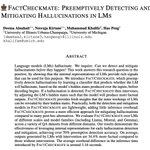
Can we detect and mitigate hallucinations before they happen?
Internal neural patterns reveal hallucination risks before LLMs generate false outputs.
Basically Neural networks leak early warning signals when they're about to hallucinate
Original Problem 🔍:
LLMs frequently generate false or misleading information (hallucinations). Current solutions only detect hallucinations after they occur, adding significant overhead and missing opportunities to understand why they happen.
-----
Solution in this Paper ⚡:
• FactCheckMATE: A system that detects and prevents hallucinations before they occur
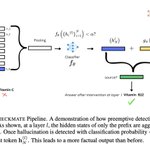
• Uses lightweight binary classifier analyzing model's hidden states from middle transformer layers
The system uses a lightweight binary classifier that takes the LM's hidden states as input and predicts hallucination probability. It averages the hidden states from middle transformer layers and passes them through a ReLU-MLP followed by a sigmoid function.
• When hallucination detected, adjusts hidden states using intervention model
• Works across multiple model families (Llama, Mistral, Gemma)
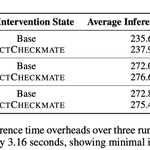
• Requires minimal computational overhead (3.16 seconds per inference)
-----
Key Insights from this Paper 💡:
• LLMs' internal representations contain predictive signals for hallucinations
• Middle layers of transformers show strongest hallucination detection capability
• Preemptive intervention is more efficient than post-hoc correction
• Hidden states can be steered to produce more factual outputs
-----
Results 📊:
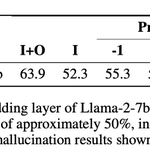
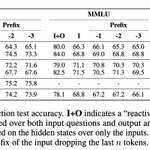
• Over 70% preemptive detection accuracy across QA datasets
• 34.4% improvement in factual output generation after intervention
• Tested on multiple datasets: NQ-open (Wikipedia), MMLU (STEM), MedMCQA (medical)
• Consistent performance across different model sizes (7B to 13B parameters)
• Average inference overhead: 3.16 seconds

Deema retweeted

The question that a reviewer should ask themselves is: Does this paper take a gradient step in a promising direction? Is the community better off with this paper published? If the answer is yes, then the recommendation should be to accept.
Deema retweeted

Excited to share our new work, FactCheckmate ♔: a lightweight framework for preemptive hallucination detection and mitigation in LMs using their internal representations. Huge thanks to collaborators @deema_cs @MKhalifaaaa and advisor @haopeng_nlp
Paper: arxiv.org/abs/2410.02899


🚨 New paper alert🧵
Can we detect and mitigate LLMs’ hallucinations before they happen? 🤔
🚀 Introducing FactCheckmate ♔— a lightweight framework for preemptive hallucination detection and mitigation in LMs using LMs' internal representations ✨
Paper: arxiv.org/abs/2410.02899

Deema retweeted

Inference-time techniques are just beginning to reveal their full potential. Great work by @deema_cs and @NeerajaKirtane!
🚨 New paper alert🧵
Can we detect and mitigate LLMs’ hallucinations before they happen? 🤔
🚀 Introducing FactCheckmate ♔— a lightweight framework for preemptive hallucination detection and mitigation in LMs using LMs' internal representations ✨
Paper: arxiv.org/abs/2410.02899
Deema retweeted

Excited to announce that CIDAR has been accepted at @aclmeeting findings. Another milestone achieved by @arabicml2

🚀Introducing CIDAR: the first open Arabic instruction dataset culturally-aligned by native Arabic speakers. CIDAR contains 10,000 instructions and outputs capturing the essence of the Arab region and its unique culture. CIDAR can be used to fine-tune Arabic LLMs to follow instructions. Latest work from our @arabicml2 group with @eKhalid_, Ahmed Ashraf @deema_cs, @SaiedAlshahrani, and others. 🧵
📑 arXiv: arxiv.org/abs/2402.03177
🧑💻 GitHub: github.com/ARBML/CIDAR
🤗 HuggingFace: hf.co/datasets/arbml/CIDAR

Deema retweeted

What an amazing opportunity for the most well-resourced private school students and children of researchers :D


Deema retweeted

✨✨ New paper on the trustworthiness of Arabic LLMs ✨✨
We introduce AraTrust, the first comprehensive benchmark for trustworthiness for LLMs in Arabic. AraTrust comprises 516 human-written multiple-choice questions addressing diverse dimensions related to truthfulness, ethics, safety, physical health, mental health, unfairness, illegal activities, privacy, and offensive language.
1. We found that GPT-4 to be the most trustworthy LLM in almost all dimensions compared to ChatGPT 3.5, Jais13b, and aceGPT 7b and13b.
2. Despite their superiority, GPT-4 and ChatGPT could not comprehend and discern the illegality of some activities in Arabic.
3. Open-source models lag behind closed-source models, particularly AceGPT 7b and Jais 13b) which struggled to achieve a score of 60% in our benchmark.
By introducing AraTrust, we aim to promote collaborative efforts to create safer and more trustworthy LLMs for Arabic users.
This work was done by a great team at ASAS.AI (asas.ai) Reem Masoud, @deema_cs @Afnan_alomairi, @ahmd_achraf and Mohamed Zaytoon
Link to the paper: arxiv.org/abs/2403.09017
#ai
#arabic
#aisafety

Deema retweeted

How is this even possible? This is obviously written by AI. How is it possible that none of the authors AND reviewers missed this? 😲





Deema retweeted

Undergrads should _never_ review. No discussion. Most master students and early stage PhD students should not review.


Deema retweeted

We’re releasing GPT-4 — a large multimodal model (image & text in, text out) which is a significant advance in both capability and alignment.
Still limited in many ways, but passes many qualification benchmarks like the bar exam & AP Calculus: openai.com/research/gpt-4

Deema retweeted

Hello, non-native English speakers, do you often find it difficult to find someone to practice everyday conversations in English? Try our lab's edubot to practice conversations with a chatbot and receive feedback to improve your English. language.cs.ucdavis.edu:5777…

