

A professional applied mathematician with quite broad interests in physics, mechanics, and even pure mathematics! Formerly at CNRS. Now at Khalifa University.
- Tweets164
- Following7
- Followers4
- Likes4




ALT Announcement card of Nature Communications, volume 17, article 10531, 2026, open access, published by Springer: the research article "Human-enhanced tsunami hazard in large lakes" by Muhammad Naveed Zafar, Pierre Sabatier, Denys Dutykh, William Rapuc, Raphaël Paris, Andrea Piccin, Pascal Vuillemin and Flavio S. Anselmetti. Beside the title, a figure of the paper shows the two slides of 1117 and 1222 in Lake Iseo, from their source at the delta to their deposits in the deep basin.

ALT Map of Lake Iseo coloured by the minutes before the water starts to rise, if the delta collapsed as it did in 1117: darkest at the northern end, reached within the first minute, then lighter bands of 1 to 2, 2 to 4, 4 to 6, 6 to 8 and 8 to 10 minutes down the lake, and the palest beyond 10 minutes at the south-western end. Labels give the time at the shore of each town: Pisogne under 10 seconds, Lovere 25 seconds, Riva di Solto 2 minutes, Marone 3, Tavernola 4, Sale Marasino 5, Sulzano 6, Iseo 6, Clusane 9 and Sarnico 12 minutes. The wave crosses the 250 m deep lake at about 50 metres per second.

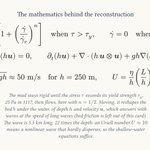
ALT Card of formulas titled "The mathematics behind the reconstruction". The law of the mud: the stress equals the yield strength times one plus the strain rate over a reference rate to the power n, and the mud does not move while the stress stays at or below the yield strength. The two shallow-water equations for the depth h and the velocity u of the water over a moving bed b. The speed of long waves, the square root of g times h, about 50 metres per second in 250 m of water, and the Ursell number, about 10, which says that the wave is nonlinear but hardly disperses.

ALT Announcement card of the journal JGR Solid Earth, of AGU and Wiley, May 2024, volume 129, issue 5: the research article "Numerical reconstruction of landslide paleotsunami using geological records in Alpine Lake Aiguebelette" by Muhammad Naveed Zafar, Denys Dutykh, Pierre Sabatier, Mathilde Banjan and Jihwan Kim. The card shows a green Alpine lake below wooded slopes, and a page of the paper with a map of the waves on the shores of the lake.

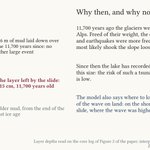
ALT Drawing of the 16 m sediment core: from the lake floor down, 8.6 m of mud laid down over the 11,700 years since the slide, with no other large event, then the 115 cm layer left by the slide, then older mud from the end of the last ice age. Beside it, the explanation: as the glaciers melted, earthquakes were more frequent and one most likely shook the slope loose; since then the lake has recorded no other event of this size, so the risk of such a tsunami there today is low; and the model shows where to look for traces of the wave on land, on the shore facing the slide.

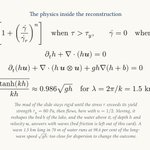
ALT Card of four formulas. The law of the mud: the stress equals the yield strength times one plus the strain rate over a reference rate, to the power n, and the mud does not move while the stress stays at or below the yield strength. The two shallow-water equations for the depth h and the velocity u of the water over a moving bed b. And the speed of a wave 1.5 km long in 70 m of water, 0.986 times the long-wave speed, the square root of g times h.

ALT Announcement card of PLOS ONE for the research article "Route to chaos and resonant triads interaction in a truncated rotating nonlinear shallow-water model" by Francesco Carbone and Denys Dutykh, DOI 10.1371/journal.pone.0305534. Beside the title, figures of the paper: the five wave vectors with the pushed one marked by a red star, the mean period of the motion falling as the force grows, and six loops of the motion in a space of energies, from a single loop to a tangle.

ALT Three columns, for C = 0.23, 4.9 and 7. Above, the coefficient of one wave of the surface in the complex plane over 150 rotation times: a straight line through zero at C = 0.23, a thick band at 4.9, a round cloud at 7. Below, that wave alone along the diagonal of the square, in time: fixed stripes that swap colour at C = 0.23, wavering stripes at 4.9, stripes drifting sideways at 7.

ALT Formula card titled "The equations we solved": the momentum equation of the rotating shallow-water model in units of the depth and of the speed of long waves, with the Coriolis term over the Rossby number, friction over the Reynolds number and the force F; the conservation of mass for the height η of the surface; and the expansion over five waves, with k3 = k1 + k2 and k5 = k4 + k2. A note explains the symbols, the Rossby number of about 1000, the Reynolds number 500 and the strength of the force C = |F0| Re.