
Liusloth retweeted

MATOPIBA is a name made from four Brazilian states.
MA for Maranhão, TO for Tocantins, PI for Piauí and BA for Bahia.
The region takes in all of Tocantins and only part of the other three.
Brazil's farm research agency drew its border in 2014.
The government made that border official in 2015.
Inside it sit 337 towns and cities.
Together they cover 73 million hectares, more land than Texas.
Most of it is Cerrado, a tropical grassland dotted with short, twisted trees.
The border was drawn mainly around that Cerrado land.
Tocantins holds the biggest piece of the region, at 38%.
Maranhão holds 33%, Bahia 18% and Piauí 11%.
Over the last few decades, farmers turned large parts of it from open cattle range into soy, corn and cotton fields.
Last season, the four states harvested more than 41 million tonnes of grain.
Most investors have never seen this border.
The full breakdown of what it means for every farm inside it is in the article below.


Liusloth retweeted

Spent years watching models ace a single image and completely whiff on anything that moves or changes angle. Today we’re fixing that.
Try Glimpse now, our first visual thinking model with competitive frontier performance compared to Astra on key public visual reasoning benchmarks.
Liusloth retweeted
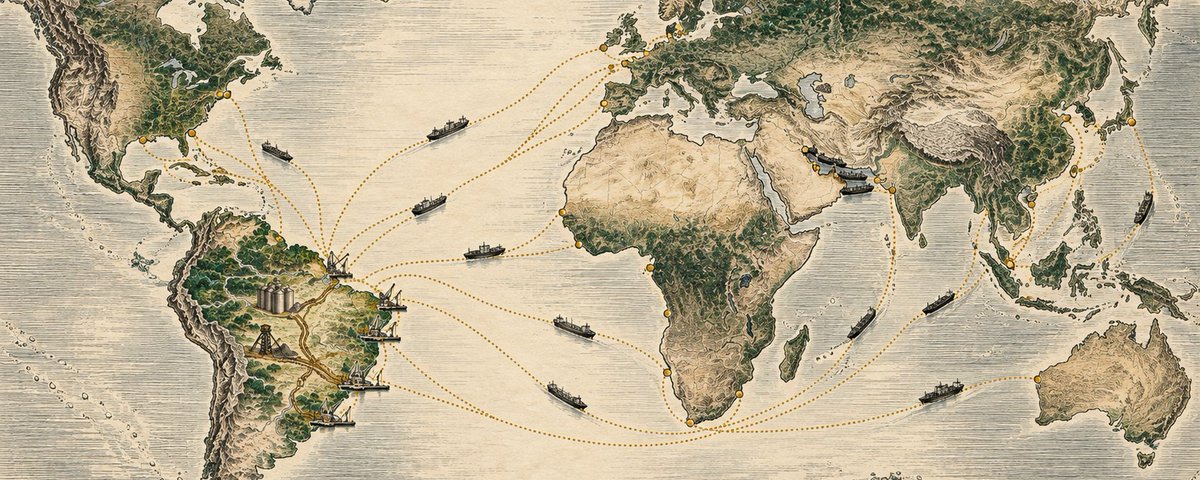
Brazil's next 25 years will be decided by three numbers almost nobody watches.
Most people judge Brazil by the currency, the elections and the headlines, and all three swing too much to show where the country is heading.
These three move slowly, and they show whether the country is actually being built.
The first is how much of Brazil's grain storage sits on farms.
A farmer who can store his crop sells when prices are good, and a bank can lend against the grain sitting in his silo.
In 2026, only about 16.5 percent of Brazil's storage sat on farms, against 53 percent in the United States.
Watch for that share to pass one fifth.
The second is how many kilometers of railway private companies build at their own risk.
In 2026, trucking a tonne of soybeans from Mato Grosso to the coast cost more than shipping it from the coast to China.
A new railway in Mato Grosso, built by a private company under a state permit, opened its first 162 kilometers in 2026 and is planned to run more than 700 kilometers to Lucas do Rio Verde.
Every kilometer it adds makes Brazil's longest and most expensive trip shorter.
The third is how much Brazil pays in interest compared with what it spends on its people.
In 2025, Brazil's public sector paid about R$1 trillion in interest, more than double federal spending on health and education combined.
When that gap shrinks, long-term money gets cheaper for everyone building a farm, a mine or a port.
If all three move the right way, Brazil in 2050 feeds and supplies a world that has run short of safe places to buy from.
I wrote an open letter on that future, and on the people and the capital it will take to build it.
Read it here:
Liusloth retweeted
A typical soybean farm in Brazil grows a tonne of beans for about a quarter less than a typical farm in Iowa.
In 2024, that tonne cost US$337 in Mato Grosso and US$448 in Iowa.
That gap is worth US$111 on every tonne.
Nearly half of the Iowa bill is the fixed cost of running the farm, and land is the biggest piece.
Iowa farmland shot up in value over the last few years, so the land part of the bill got heavier.
Brazil has a weak spot of its own.
It buys about 85% of its fertilizer from abroad, and that fertilizer is priced in dollars.
Fertilizer, sprays and other inputs make up more than 60% of the cost on the Mato Grosso farm.
Between 2020 and 2024, its cost per tonne nearly doubled to US$337 from US$172, led by fertilizer.
More than half of Mato Grosso's soybean fields get a second crop of corn right after the soy harvest.
That second crop helps pay for the land and machines, while an Iowa field gets one crop a year.
The Brazilian farm still made money every year from 2020 to 2024, while the Iowa farm lost money in 2020 and 2024.
The full breakdown of Brazil's farm costs is in the article below.


Liusloth retweeted
Brazil's biggest soybean state grows its crop on a margin that one dry spell can wipe out.
Take one hectare in Mato Grosso, about 1.4 soccer fields.
Counting everything, it costs about R$8,171 to farm this season.
About R$6,012 of that is cash the farmer spends during the season, including seed, fertilizer, fuel and labor.
A normal harvest is about 62 bags of soybeans.
In late September, next January's soybeans were quoted at R$116.15 a bag in Alta Floresta, a town in northern Mato Grosso.
At that price, a normal harvest brings in about R$7,252.
So even in a good year, the hectare falls short of its full cost.
It still covers the cash bill, with about 11 bags to spare.
Now take away 20% of the crop in a dry spell.
The hectare brings in about R$5,802, less than the cash it took to plant.
Take away 30%, and it falls about R$935 short.
At the statewide average price of R$121.18, a 20% loss leaves only about R$41 over the cash bill.
The costs are also sticky, because about 85% of Brazil's fertilizer is imported and priced in dollars.
Without insurance, a loss that size moves from the field to the farm's lender.
Full breakdown in the article below of who has been paying for Brazil's rain, and what one hectare earns in a dry year.


Liusloth retweeted

兄弟们快去抢 ID!Grok Bot 刚刚开放了专属独立邮箱,先到先得!
Grok 更新速度太离谱了,先是加了 Claude Opus 5.5,又自带 X 的实时搜索,现在直接给 Bot 加了专属邮箱。
这还要什么 muse、dots、cue......😅😅😅
很多人还没意识到这个邮箱的价值,它并不只是多了个收件箱:
1、丢给它一个新发现的 SaaS 工具,让它自己去注册试用、接收验证码激活,把体验报告发回给你。
2、做冷启动外联,让它去联络海外博主或播客谈合作,往来的邮件和排期都能在后台搞定。
3、把一堆高频推送的行业周报全改绑到 Grok 邮箱,让它每天帮你出精华简报,不用你手动清理垃圾邮件。
4、拿它当不同 Agent 之间的中转站,多个自动化脚本直接通过邮件互相丢任务。
认领方法:直接在 Grok Bot 对话框发:"claim email for me [你想要的名称]",确认一下就开通了。
这下又有的玩了~

Liusloth retweeted

EXCLUSIVE: US to grant sanctions waiver for flights between Iran and Iraq's Najaf, source says reut.rs/4hqTvmv reut.rs/4hqTvmv


Liusloth retweeted

In case you missed it, check out the 2nd episode of our Starship series. “Critical Path” follows SpaceX engineers through the final days before launch of the first Starship V3 and the challenges that come with development of the world’s most powerful and fully reusable rocket → spacex.com/content/starship/…
Liusloth retweeted
Our Starmind AI satellite constellation and Terafab advanced chip manufacturing center together represent a step toward a Kardashev Type II civilization by harnessing more of the Sun's power, supporting massive AI applications, and advancing humanity's multi-planetary future

Liusloth retweeted
US government rescinds $10 billion freeze for 5 states governed by Democrats reut.rs/450B0PY reut.rs/450B0PY


Liusloth retweeted

Fly like an eagle with this spectacular footage from a golden eagle soaring over Nebelhorn Peak in Germany.

Liusloth retweeted

"SpaceX transports almost ten times as many satellites to orbit as the rest of the world combined. SpaceX right now delivers ~85% of all the payloads orbit of Earth. Of the remaining 15%, most of that is China (8%) and roughly 7% is the rest of the world."
— Elon Musk
Liusloth retweeted

There are athletes who never acknowledge the fans, the kids that want to be just like them when they grow up.
Then there’s Haaland. ❤️
