

Operator, founder, dad. Tech that serves people, not platforms.
New York, NY
Joined May 2009
- Tweets2.5K
- Following992
- Followers78.9K
- Likes2.9K







Pinned Tweet
The most existential question in crypto: what will be the relationship between tokens and communities?
At stake: can DAOs bring virtue back to scaled organization? Or will they accelerate the economics-only mentalities that have been corroding society?
A way-too-long-🧵👇
Consumer AI converges on generalist agents, Enterprise AI models exit that stage to speciation, and I revisit my thoughts on where control collapses to.

Thanks to @SakanaAILabs @typesafeai @ttunguz @gradypb @jaredpalmer @vivekramaswami @DennisonBertram for supplying the ideas, language, research and products feeding my thinking
Danny retweeted

I’m sorry, it’s a fun product, but if you hand all your data to Muse and don’t expect it to be used for the most invasive things imaginable you are Charlie Brown with the football and you deserve whatever happens to you.


How soon can we sign the petition to ban this in schools?
@LetGrowOrg @JonHaidt


Is there literally anyone who reads this and doesn't roll their eyes at the irony and dishonesty?
It actually surprises me he can write this. That there's any constituency left still willing to believe a word.

Last month I wrote about how we can build a positive and safe future for everyone: meta.com/thefutureisforevery…
Every lab has the responsibility and incentive to move at the pace required to train its models safely, and the ability to take its own actions to ensure that happens.
The reality is:
- People won't want to use agents that are misaligned with them and that don't do what they ask, so labs have a strong natural incentive to make their models more aligned.
There is a lot of debate about slowing progress on capabilities until alignment catches up. My view is that trust and alignment are quickly becoming the most important capabilities that will differentiate agents and models. Any lab that doesn't focus on alignment will fall behind.
- Labs face significant liability if their models cause harm, so they have a strong incentive to prevent this as well.
Meta delayed shipping Muse for several months to focus on safety and security. We didn't call for everyone else to do this before we would. We just did it as part of our day-to-day work because it was clearly the right thing for people and for us. I'm proud of the security foundations we've built.
- Engaging independent evaluators and advisors is industry best practice. MSL already does this today in several areas because it helps produce better work. Other labs can just do this too. In general, it would be helpful for there to be a larger and more diverse ecosystem of evaluators.
- Committing the significant majority of compute towards serving people rather than racing towards recursive self-improvement is one of the best ways to ensure we develop this technology safely. Meta has made this commitment and other labs can do this as well.
I believe the key to building a positive future for everyone is maintaining the right balance of power. This is within our power to do.


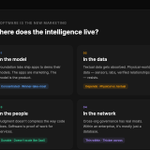
Spinning on @andrewhill_'s point that software is the new marketing.
And if software is the new marketing, what's the product?
In most cases, some form of Intelligence. 🧵

Intelligence in the network.
There's real value in coordinating across actors.
@jaminball 's framing on sources of truth captures this: "The more we automate, the more important it becomes that someone has done the unglamorous work of deciding what the correct answer is."
At root these are databases with software and governance on top, and the ability to extract for the software is eroding rapidly. Trust & the governance layer will provide some stickyness - especially in domains that cross organizations - but maintaining margins will be difficult.
Companies that figure out which intelligence is theirs will ship mind-blowing software at mind-blowing speed to market it.
Companies that don't may find themselves waiting in fear of each new Anthropic release.
Full piece: xitter.cf/dazuck/status/20350525…


