

I build AI products people actually use. Enterprise AI • Productivity tools • Applied automation • Talk to Tavi 👇 https://xitter.cf/t.co/WG80UO0RNu https://xitter.cf/t.co/s6tkvBoZ8F
Joined June 2014
- Tweets2.5K
- Following820
- Followers1.6K
- Likes4.2K







Pinned Tweet
Beyond grateful to attend the Swearing-in Ceremony of the Primer Minister of India, Shri Narendra Modi and other ministers at The Rashtrapati Bhavan, New Delhi 🇮🇳


1
11
1,617
Production planning looks simple from the outside.
Orders come in.
Machines have capacity.
People have shifts.
Materials have lead times.
So we make a schedule.
Except a real production plan is rarely solving one constraint.
It is balancing all of them at the same time.
Deloitte’s 2025 Smart Manufacturing Survey of 600 manufacturing executives found that 46% reported moderate-to-significant difficulty filling planning and scheduling roles. The same survey found advanced production scheduling was among the top system-investment priorities, selected as a first- or second-highest priority by 35% of respondents.
That tells us something important:
Production planning is not just an Excel problem.
It is a decision-complexity problem.
A planner may be balancing:
→ customer due dates
→ machine availability
→ material availability
→ operator skills
→ tooling and fixtures
→ setup and changeover time
→ maintenance windows
→ quality holds
→ rush orders
→ supplier delays
And then, at 10:30 AM, one machine goes down.
The “optimal” morning plan is already obsolete.
This is where AI and optimization can become useful.
Not by automatically taking over production planning.
But by helping the planner answer questions much faster:
“What happens if Machine 4 is unavailable for six hours?”
“Which orders are now at risk?”
“Can we move this batch without delaying a higher-priority customer?”
“What alternatives are available?”
“What trade-offs change if we use overtime?”
Instead of manually rebuilding the schedule from scratch, the planner can compare a small number of realistic scenarios and understand the consequences of each one.
If I were improving this workflow inside a manufacturing company, I would start with five things:
1/ Map the real constraints
Not just machine capacity. Include materials, people, tooling, maintenance, supplier issues and customer priorities.
2/Track why the plan changes
For two weeks, record every major reschedule and what triggered it.
3/Separate fixed rules from planner judgement
Some decisions must always follow a rule. Others depend on experience and trade-offs.
4/Start with recommendations, not autonomy
Let the system suggest scenarios. Keep the planner responsible for the final decision.
5/Measure schedule stability
Track late orders, emergency rescheduling, changeovers, idle time and planner hours spent rebuilding plans.
Deloitte also reported that manufacturers saw average improvements of 10–20% in production output and 7–20% in employee productivity across smart-manufacturing initiatives, although those gains cover broader initiatives rather than scheduling alone.
The opportunity is not:
“Let AI run the factory.”
It is much more practical:
Help the person already running the factory understand the consequences of a change before spending the next two hours rebuilding the plan.

53
A customer asks one technical question.
Why does the answer take 30 minutes?
Deloitte’s 2025 Manufacturing Industry Outlook cited research showing that 74% of surveyed manufacturers were already using or planning to use generative AI to improve customer experience.
That makes sense.
Because in many industrial businesses, answering a customer is not actually one task.
It often looks like this:
→ identify the exact model
→ find the right manual
→ search past service history
→ check technical bulletins
→ look through CRM or ERP notes
→ ask an experienced engineer
→ confirm the right procedure
→ finally reply to the customer
The customer asked one question.
Internally, it became a research project.
And this is where I think AI can be genuinely useful.
Not as a chatbot that “knows everything.”
But as a service assistant that knows where to look.
Imagine a service engineer asks:
“What normally causes low discharge pressure on this model?”
A useful system should retrieve:
- the relevant manual section
- the correct troubleshooting procedure
- previous incidents on the same equipment
- customer-specific service history
- relevant service bulletins
- the source behind every recommendation
That last part matters.
Don’t make AI the source of truth.
Make AI the fastest path to the source of truth.
A real example: Fisher & Paykel has described a field-service system where technicians can search approved technical documentation and more than 100 million CRM records while
staying inside the work order.
That is the kind of AI I find interesting.
Not AI replacing technical expertise.
AI removing the search work around technical expertise.
If I were improving this workflow inside an industrial company, I would start with five steps:
1. Collect the top 50 service questions
What do customers and technicians repeatedly ask?
2. Map where the answers live
Manuals? CRM? ERP? Service history? Email? Someone’s memory?
3. Define authoritative sources
Not every old document should influence an answer.
4. Require evidence with every response
Show the page, record, or procedure behind the answer.
5. Measure time-to-answer
How long does it take today versus after the change?
The objective is simple:
Help the right person find the right answer at the right moment.
That alone can improve response times, reduce dependency on a few experts, and make service teams much more effective.

3
1
72
Your company may already know the answer.
Your employee just can’t find it.
Microsoft’s Work Trend Index surveyed 31,000 people across 31 countries and found that 62% said they spend too much time searching for information during the workday.
In an industrial business, that usually doesn’t look like “search.”
It looks like:
A service engineer trying to find the correct manual.
A salesperson looking for the last quotation sent to a customer.
A procurement manager checking whether a supplier has provided a similar specification before.
A quality engineer hunting through old NCRs, CAPAs or inspection reports.
A plant manager asking:
“Do you remember where we documented this last time?”
The information often already exists.
It’s just scattered across:
→ PDFs
→ shared drives
→ ERP / CRM notes
→ emails
→ service reports
→ quotations
→ spreadsheets
→ people’s memory
So a 2-minute question becomes a 20-minute search.
And the real cost is not just the 18 minutes.
It is:
context switching
dependency on key people
slower customer response
duplicated work
repeated mistakes
lost productivity
This is one of the most practical places for AI inside industrial businesses.
Not “ask AI anything.”
A much narrower system:
Ask one business question → retrieve the right internal sources → show the answer with evidence.
For example:
“Which pump model did we recommend for this application last year?”
A useful system should not invent an answer.
It should find:
the previous quotation
the relevant datasheet
customer history
service notes
technical documentation
…and show exactly where the answer came from.
If I were fixing this inside a company, I would start with five steps:
1. Track repeated searches
What do employees keep asking colleagues to find?
2. Choose one workflow
Service knowledge, quotations, quality records, product information — not everything.
3. Define trusted sources
Which systems and documents are authoritative?
4. Make answers traceable
Important answers should always point back to the source.
5. Measure search time before and after
If it does not save meaningful time, it is not solving the problem.
The goal is not to give employees another AI tool.
The goal is to remove this sentence from the workday:
“Give me a few minutes. I know we have that somewhere.”
🤖 Made with AI

2
1
74
Your most valuable database may be a person.
Deloitte's 2026 research found that 92% of surveyed organizations fail to consistently capture knowledge from employees approaching retirement. (Deloitte)
In industrial companies, that statistic is particularly easy to recognize.
There is often one engineer who knows why a machine behaves differently in summer.
One service manager who remembers how an unusual fault was solved three years ago.
One salesperson who knows which configuration actually works for a particular customer.
One procurement person who remembers why a certain supplier should never be used for a particular component.
Ask them, and you get the answer in two minutes.
Remove them from the equation, and suddenly the organization starts searching.
Emails.
WhatsApp conversations.
Old service reports.
PDF manuals.
Shared folders.
ERP notes.
Sometimes the answer was never documented at all.
This is what I call the Human Search Engine problem.
And I don't think the solution is asking experienced employees to spend months documenting everything they know.
I would start much smaller:
1. Find the dependency.
List the 20 questions that only one or two people in the company can reliably answer.
2. Capture knowledge while real work happens.
When an expert solves an unusual problem, capture the explanation through voice, conversation or the existing service workflow.
3. Connect the evidence.
Link that knowledge to the relevant manual, drawing, service history, photograph, SOP or previous incident.
4. Make it searchable.
Allow employees to ask questions naturally instead of guessing filenames and folders.
5. Keep the expert in the loop.
For important technical knowledge, AI should retrieve and organize—not become an unquestionable authority. Show sources and let subject-matter experts validate critical answers.
Deloitte makes an important point in the same research: organizations shouldn't try to document everything. They should identify the knowledge that matters most and systematically capture it. (Deloitte)
That's where I think AI becomes genuinely useful.
Not because it replaces the person with 25 years of experience.
Because it helps make those 25 years of experience available to the next person who needs it.

1
1
470
I tried to explain why I am building Tavi using this video.
youtu.be/sFOzCmnMNHQ
This video again completely produced using AI.
Open to feedback.
#buildinpublic
4
3
237
Daxeel Soni retweeted

Some features:
• Triggers (crons, webhooks), memory, shared files
• Connectors for a company brain
• Agent browser support
• Shareable web app artifacts
• Multi-player projects
Like many things we do at YC, it’s an experiment. It’s early and has bugs. But it’s been surprisingly useful for us so far, and we’re excited to share it and get feedback from the community.
If you want to host it yourself, try telling your coding agent of choice to “deploy github.com/yc-software/qm”

Most teams compare AI models by asking:
“Which model is the smartest?”
I think the more useful question is:
“Which model notices the risk the others missed?”
For consequential decisions, disagreement may be more valuable than another polished consensus answer.
1
1
92
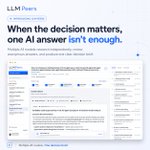
Anthropic’s Claude Opus 5 is now available on LLMPeers.com
But adding a powerful model is only part of the value.
On LLM Peers, it can research alongside models from other AI labs, challenge anonymized answers, and contribute to one structured decision brief.
The goal is not to find the “best” model.
It is to build a stronger decision process around the models available.
More intelligence matters.
Structured deliberation matters even more.
🤖 Made with AI

2
90
Most teams use AI to get an answer faster.
The bigger opportunity is using AI to challenge the answer before acting on it.
A strong decision workflow should expose competing options, hidden assumptions, disagreement, and the evidence that could change the recommendation.
That is very different from asking one model to sound more confident.
For consequential decisions, the goal is not maximum certainty.
It is better visibility into what might be wrong.
Is your AI workflow designed to confirm the first answer—or pressure-test it?
1
72
I stopped trusting a single AI answer for decisions that could cost us months of execution.
Not because AI is useless.
Because one confident answer can hide one very expensive assumption.
As a founder, I use AI to think through questions around:
Products.
Technology.
Pricing.
Positioning.
Growth.
The answers are often impressive.
They are structured.
They sound certain.
They make the decision feel obvious.
But ask another leading AI model the exact same question—
and you may receive a completely different recommendation.
Not a different writing style.
A different decision.
One model may optimize for speed.
Another may prioritize long-term defensibility.
A third may uncover a risk the first two completely ignored.
That led me to a difficult realization:
The problem was never getting an AI answer.
The problem was knowing whether that answer deserved to influence an important decision.
Opening five AI tabs did not solve it.
I still had to:
→ Repeat the same context
→ Compare inconsistent answers
→ Identify hidden assumptions
→ Verify questionable claims
→ Reconcile conflicting recommendations
→ Write the final conclusion myself
So we built LLM Peers.
You give it one difficult question.
Multiple AI models analyze it independently.
Their responses are anonymized.
The models peer-review each other against the same criteria.
Then a chairman model synthesizes the strongest reasoning into one decision brief.
The final brief includes:
→ A clear recommendation
→ Ranked alternatives
→ Points of agreement and disagreement
→ Assumptions being accepted
→ Material risks
→ The next practical action
The goal is not to generate more AI answers.
It is to create a better process for deciding which reasoning deserves your trust.
For low-stakes work, one helpful answer may be enough.
But when a decision can affect months of execution, capital, customers, or reputation—
one confident voice should not be the entire decision process.
What important decision would you never delegate to one confident voice?
🤖 Made with AI

52
Shipped serverless note sharing today for Browser Notes.
Problem: I want to send someone a note without uploading it to anyone.
Solution: the share link is the note — compressed into the URL. Open it and Browser Notes saves a local copy.
Useful for:
• quick handoffs (“here’s the brief”)
• cross-device without sync accounts
• sharing without creating a second copy on some company’s servers
Local-first + actually shareable. That’s the unlock.

6
1
173
This week in Browser Notes 🚀
We added:
✍️ Slash commands with /
✅ To-do checklists with /todo or [] + Space
⭐ Star favorites
🏷️ Tags
🧠 Obsidian-friendly export
The goal: capture thoughts faster, organize later, and keep everything local in your browser.
No signup. No forced sync.
browsernotes.xyz

1
96
We launched Browser Notes on Product Hunt.
The response was bigger than we expected. 🚀
In 24 hours time, we reached:
126+ upvotes
40+ comments
2,000+ users
4,000+ notes created
2,500+ sticky notes created
1,500+ mind maps created
Users from 55 countries
But the numbers are only part of the story.
The real win was seeing people use Browser Notes to capture ideas, organise thoughts and build mind maps without creating an account or sending their notes to the cloud.
We built Browser Notes around one simple belief:
Your thoughts should stay yours.
Thank you to everyone who tried it, supported the launch and shared honest feedback. ❤️
Try it now if you have missed it: browsernotes.xyz

7
10
278
People don’t need another notes app.
They need a simple place where their thoughts stay private.
Browser Notes is:
✅ No sign-up
✅ 100% local
✅ Text notes
✅ Sticky boards
✅ Mind maps
We’re still live on Product Hunt today.
Try it and share your honest feedback ❤️
LINK BELOW 👇👇👇
🤖 Made with AI

1
3
126

Thoughts rarely arrive in an organized format.
One idea gets written in a document.
Another ends up on a sticky note.
A bigger concept needs a mind map.
And later, you remember the idea - but not where you saved it. 😅
That everyday problem led us to build "Browser Notes".
It gives you three simple ways to think in one place:
✍️ Write detailed notes
🟨 Capture quick thoughts on sticky boards
🧠 Connect ideas through mind maps
No signup.
No onboarding maze.
No forced cloud sync.
Just open it, start writing, and let everything auto-save locally in your browser.
You can also search across everything,
work in focus mode,
use an infinite canvas,
switch to dark mode, and
export your work anytime.
Today, Browser Notes is live on Product Hunt 🚀
We would really appreciate your support, feedback, and honest thoughts.
👉 Support Browser Notes on Product Hunt:
producthunt.com/products/bro…
Which way do you usually think best - notes, sticky boards, or mind maps?
1
87
Most ideas don’t disappear because they’re bad.
They disappear because capturing them takes too many steps.
That’s why Browser Notes starts with no signup or setup.
Open. Write. Done. ✍️
Early access → browsernotes.xyz/
83