




Last week in Voice AI was nonstop. Models are getting more capable, but the race is shifting from what agents can say to what businesses can trust them to do.
Here's what stood out:
- @amazon launches Nova 2.5 Sonic with stronger reasoning and tool calling.
Amazon already had voice and tool calling, what's changing is how well they work together. The race is shifting from making agents sound human to making them capable of doing real work.
- @SierraPlatform launches Fleming-1 to detect AI voices in real time.
As AI agents start calling other AI agents, how does a business verify that an AI caller has permission to act for a customer? We need more than caller ID for the agent economy.
- @krispHQ makes Voice Isolation 2x faster without sacrificing quality.
2x more concurrent calls from the same CPU with one setting change... Making existing models cheaper to run might matter as much as making them smarter.
- @Google opens its SynthID detector to the public via @IndianIdle for @TechCrunch.
Demand is there with 1M requests a day, but competing watermark standards make AI verification fragmented and unreliable.
- @YourVoicePoint lawsuits against @Walmart and @Lowes raise new privacy concerns for contact centers.
AI vendors may be collecting biometric voice data without consent and contact centers need to know exactly what their AI vendors are collecting.
More in this week's digest: voice-ai-newsletter.krisp.ai…

Voice AI is getting close to a point where the tech isn’t the biggest constraint anymore.
I talked with @flip_cx's co-founder Sam Krut about the architecture behind CX voice agents and what it takes to automate contact centers.
Biggest takeaways:
1- Better models won’t fix weak APIs or broken workflow
2- An agent that can’t take action is still just a better IVR
3- 70–90% automation flips the model: AI does the work, humans handle the exceptions
4- Containment means little if the customer has to call back
5- The next moat is in workflow depth, integrations, latency, and orchestration
Voice AI is moving from “can it talk?” to “how much work can it actually own?”
Go deeper on what this means for the contact center, the voice AI stack, and where the market is heading in the full ep: voice-ai-newsletter.krisp.ai…
Davit @Krisp retweeted

Big one for us: Krisp ranked #2 out of 500 companies in @Cybernews’ 2026 AI Trustworthiness Ranking. 🔥
We earned a 97/100 overall score, including perfect scores in Security, Data Privacy, and Organizational Transparency.
Trust is built into the way our products work every day, from how data is handled to where processing happens and how clearly those choices are communicated.
Take a closer look at our approach to security and trust in Voice AI: krisp.ai/blog/ai-trustworthi…

Voice AI absolutely dominated headlines last week.
Things appear to be splitting into two races:
1 - making speech models faster, cheaper, and more capable
2 - owning what happens after someone speaks
Here's what stood out last week:
@ElevenLabs launched v4 and v4 Turbo with 90+ languages, expression control, and 10-second voice cloning
@Microsoft's new streaming transcription model hit 2.5% AA-WER
@Alibaba_Qwen launched Qwen-Audio 3.1 Realtime and cut voice API pricing by as much as 85%
@inworld acquired @ultravox_dot_ai to add real-time turn-taking and interruption handling to its agent stack
@Instinct raised $1B at a $10B valuation for a personal AI agent that calls and texts on users’ behalf
@tavus previews Griffin, a video-to-video model that sees, hears, and talks back, with 48% of testers thinking it was human
Speech itself is becoming easier to build and harder to stand out on. The more defensible layer is what sits around it - context, orchestration, workflow ownership, and the ability to turn a conversation into an action.
Full digest: voice-ai-newsletter.krisp.ai…

Davit @Krisp retweeted
💥Better turn-taking, more accurate speech recognition, and cleaner transcripts.
Japan-based wevnal is building voice AI agents designed to handle customer calls 24/7, from inquiries to account-related requests.
@wevnalinc uses Krisp’s VIVA SDK across both speech-to-speech and STT/TTS interactions. It’s improving their agents' turn-taking and real-time speech recognition, while cleaner audio gives its speech detection system a clearer read on when customers are speaking.
That carries through after the call too, improving transcript accuracy and timestamps.
Voice AI is global. The infrastructure underneath it has to work across languages, architectures, and real-world conversations.

Voice AI is moving closer to the source.
Models are getting faster, but the bigger shift is where they run: in earbuds, glasses, cars, contact centers, and other edge environments where latency, privacy, and messy real-world audio matter.
Here's what stood out this week:
- @Meta introduced camera-free @ray_ban
Meta Audio glasses with AI, translation, and calls
- @Qualcomm launched an audio chip that can run AI directly in earbuds and glasses without a phone
- @SoundHound introduced fully embedded voice AI that works locally, even offline
- @inworld pushed TTS latency down to 25ms
- @SarvamAI released sub-150ms speech recognition across all 22 Indian languages plus English
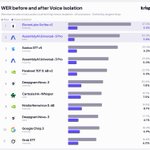
- @krispHQ published an open Voice Isolation benchmark showing 73% lower word error rate across 11 STT configurations when a second voice is present
That last result points to an important shift: as speech models improve, the bottleneck increasingly moves upstream.
The best model in the world still fails if it hears the wrong person.
Full digest: voice-ai-newsletter.krisp.ai…

Davit @Krisp retweeted

1/ Voice agents handle noise now. They still break when someone else in the room starts talking. Traffic, keyboards, AC hum: solved. A second voice near the mic: wrong speaker transcribed, wrong turn taken.
Voice AI took another step toward autonomy this week.
Models are reasoning while speaking. Speech systems are getting better at the errors that break agents. Voice is moving deeper into enterprise workflows. And fraud is getting harder to hear.
What stood out 👇
- @Google launched Gemini 3.8 Live, topping the Speech-to-Speech index
- @xai says Grok Voice Transcribe 2.0 is 2x more accurate than v1
- @ServiceNow integrated @krispHQ Voice Isolation into its Voice Agents
- @Speechmatics launched STT built around high-consequence agent errors
- @Apple rebuilt Siri around context, screen awareness, and app actions
- @GoogleDeepMind argues AGI will be spoken, not typed, making the case for one natively multimodal speech-to-speech model over cascaded pipelines
The interesting shift is how quickly these pieces are converging. Voice models are starting to listen, reason, speak, understand context, and take action inside the same experience.
That changes what a "voice product" can be.
Full digest: voice-ai-newsletter.krisp.ai…

Davit @Krisp retweeted
💥 @ServiceNow is building on Krisp's VIVA SDK.
Their AI Voice Agents handle IT, HR, and customer service calls on the Now Platform: authenticate the caller, retrieve their context, resolve the issue, kick off the workflow, hand off to a person when one is needed.
All of it runs on a transcript, and a transcript is only as good as the audio underneath it: clean speech gets you around 5% word error rate.
Add a warehouse floor, an open office, or one other person talking nearby and that jumps to 15-30%. Those errors don't stay in the transcript. They become the wrong record, the wrong action, the escalation that shouldn't have happened.
VIVA sits in front of the STT. Across 10 speech-to-text engines, voice isolation cut average WER by 46%, and by roughly 70% on calls with competing speakers.
Turn-taking and interruption handling come from the same layer, so the agent waits out the pause while someone digs up an order number instead of talking over them.
Enterprise calls don't happen in a studio so getting the voice layer right is what lets everything downstream work.
Voice AI is moving into a more ambient, embedded phase, signaling where we're headed.
This week, @Apple and @Meta pushed always-on listening into everyday devices, @OpenAI and @Microsoft made real-time speech faster and cheaper, and companies across media, contact centers, and enterprise software kept turning voice into a core product experience.
The privacy questions are getting harder at the same time the use cases are getting more practical.
voice-ai-newsletter.krisp.ai…

Davit @Krisp retweeted
10M+ call minutes a day. Voice quality has to hold up.
@telnyx helps developers scale real-time voice AI across 140+ countries, with Krisp’s VIVA built into the stack to help agents hear clearly, handle turns better, and avoid false interruptions.
At this scale, voice quality affects everything the agent does next. Telnyx is building the infrastructure to make those conversations work in production.


Voice AI moved fast on every front 🔥
- $430M flowed into dictation and freight automation
- speech models pushed sub 90ms and $0.01/min
- banks raised the alarm on voice fraud
- new integrations pushed voice AI deeper into enterprise workflows and more
Check out the full digest for everything shaping the industry this week: voice-ai-newsletter.krisp.ai…

80% of workers are on the frontlines, but most AI is built for desks.
I talked with @Samsara VP @podduturi about voice AI for physical operations' frontline workers.
From agents that keep drivers alert, automate dispatch and deliver real-time guidance, Samsara’s vision is to give every worker hands-free access to a super intelligent assistant.
Great discussion exploring voice AI out in the real world.
Full ep: voice-ai-newsletter.krisp.ai…
Introducing VIVA 2.5, with our most advanced models yet.
@krispHQ's Voice Isolation has been running in production for 2 years, across 1B+ mins of voice AI conversations a month, improving WER by focusing on primary speaker only.
As more teams ran voice isolation in front of their STT, we started seeing a subtle problem: on the hardest segments with most multi-speaker overlap, the model was removing too much signal which was resulting in WER degradation.
Voice Isolation 2.5 fixes that.
Across 10 STT engines from 7 vendors we saw:
– 46.4% fewer word errors
– 69.7% fewer on background speech, the hardest case there is
– No harm on clean audio. An important update from previous VI 2.1 model
– A 3.5x smaller version, comparable results
Full details: krisp.ai/developers/viva/
Voice AI had a huge week.
@xai launched @grok Voice Think Fast 2.0, @OpenAI cut transcription errors by 52%, @Alibaba_Qwen topped OpenAI on a leading speech-to-speech benchmark, and @polyaivoice introduced an audio-native model with sub-300ms responses.
At the same time, @FishAudio, Encore AI, and @smallest_AI raised a combined $95M.
The direction is clear: voice models are moving beyond transcription into real-time reasoning, direct audio understanding, and more natural conversation.
Latency, intelligence, and speech quality are improving in parallel.
Read the full digest: voice-ai-newsletter.krisp.ai…

AI’s biggest contact center impact may have little to do with replacing agents.
I caught up with Geoff Burbridge about where Voice AI is actually headed, it was one of those conversations that kept getting more interesting.
Most contact centers already have the signals to catch fraud, but can’t connect them fast enough to act. Voice fraud is becoming an AI-versus-AI fight, and humans can’t keep up.
There’s also a harder truth: the customer call companies are trying to automate may be the one where a human stops a major loss.
And if companies move too fast, the biggest risk isn’t just bad automation. It’s losing customer trust before the technology earns it.
Full discussion: voice-ai-newsletter.krisp.ai…
Voice AI had one of its busiest weeks yet, but the bigger story is where that activity is landing.
The market is expanding across desktop agents, edge devices, translation, accessibility, healthcare, CX, and public services.
Voice is rapidly becoming the interface connecting AI to everyday work, communication, and services.
Full digest: voice-ai-newsletter.krisp.ai…
