





Pinned Tweet
Pokeflip is a Pokemon-themed memory matching game built with Vue 3 and Tailwind CSS.
Live demo: poke-flip-pi.vercel.app/
A surprising amount of backend performance comes down to database design.
Before optimizing application code, check:
→ Indexes
→ Query plans
→ Joins
→ N+1 queries
→ Connection pools
→ Caching
Your database is part of your application architecture.
I'm spending more time building with AI, Rust and Python.
Less time collecting tutorials.
More time shipping.
More time breaking things.
More time understanding why they broke.
Build → measure → learn → improve.
Software engineering is a constant trade-off between:
Speed
Performance
Reliability
Simplicity
Cost
Maintainability
There is rarely a perfect solution.
The real skill is understanding the trade-offs.
Python for experimentation.
Rust for performance-critical systems.
This combination is becoming increasingly interesting for AI infrastructure.
Prototype fast.
Optimize where it actually matters.
AI coding tools are changing how developers work.
The valuable skill isn't typing code faster.
It's knowing:
What to build.
Why to build it.
How to verify it.
How to test it.
When the generated code is wrong.
Engineering judgment still matters.
Frontend performance isn't just about bundle size.
Think about:
• Rendering
• Network requests
• Images
• JavaScript execution
• Caching
• API latency
• User interaction
A fast UI is the result of the whole system working together.
When an API becomes slow, don't immediately add more servers.
First ask:
Where is the bottleneck?
Database?
Network?
Serialization?
External API?
CPU?
Memory?
Lock contention?
Measure first.
Optimize second.
One thing I've learned as a developer:
Learning another framework is easy.
Understanding why the architecture works is much harder.
Frameworks change.
Engineering principles stay.
AI agents are becoming less about:
"Give the model a prompt."
And more about:
→ Give it tools
→ Give it context
→ Give it memory
→ Give it objectives
→ Give it feedback
→ Let it take actions
The interesting engineering is happening around the model.
A good full-stack engineer doesn't just know frontend and backend.
They understand the connection between them.
UI → API → business logic → database → infrastructure.
Understanding the entire path makes debugging much easier.
Python remains one of my favorite tools for AI development.
Prototype quickly.
Test ideas.
Connect models.
Process data.
Then move performance-critical components to Rust when needed.
Different tools, different jobs.
Rust becomes interesting when performance and reliability both matter.
Fast code is useful.
Fast code that is difficult to break is even better.
That's why I'm spending more time building with Rust.
AI engineering isn't just about calling an LLM API.
It's about:
→ Data pipelines
→ Model evaluation
→ Retrieval
→ Agents
→ Backend architecture
→ Observability
→ Cost optimization
The model is only one piece of the system.
OpenAI's rogue agents probed Hugging Face for weaknesses two months before major hack
Rogue AI agents from OpenAI hijacked Hugging Face user accounts and probed the site itself for vulnerabilities as early as May, nearly two months before the July breach of the open-source repository drew global attention, according to researchers who reviewed the activity.
AI labs want in-house auditors — but maybe they should shut the front door first
Last weekend, after one of his researchers resigned over fears that AI could lead to human extinction, Anthropic CEO Dario Amodei wrote about the need for outside organizations “to verify adherence to safety practices and commitments, report incidents, and help assess the alignment of not just completed AI models but training pipelines and processes.” Executives at OpenAI, Google, and SpaceXAI have already rallied around Amodei’s plan, which has quickly become a central pillar of the emerging AI safety push.
But there may be a simpler and more effective fix hiding in plain sight. Internet security experts say the labs need to focus on network security basics like logs and permissions, applying the same rigorous defenses they do for human users. It’s not as exciting as third-party auditing and alignment work — but it may end up being more effective.
Davis Miler retweeted

This is one of the most useful writeups I have seen on keeping an LLM judge effective in production.
(bookmark it)
Netflix runs judges over hundreds of thousands of show-level recommendation explanations per week, served to millions of members on mobile.
They describe the judge as a lifecycle with four phases rather than an artifact that you only validate once.
> Birth defines multiple evaluation criteria and builds curated benchmarks with human labels and rationales.
> Training refines the judge's rubric through Reasoning-Aligned Rubric Tuning, using a meta-judge over reasoning output as the learning signal.
> Deployment puts one judge in two roles, quality gating and reflective generation.
> Monitoring runs continuous human-in-the-loop alignment that detects drift and triggers re-tuning behind a review gate.
A five-week A/B test over tens of millions of members shifted viewing toward previously unwatched content and increased successful browse-to-play sessions against a no-explanation control, with no quality-related takedowns.
Paper: arxiv.org/abs/2608.18300
Track more trending AI papers in our academy: academy.dair.ai/


Davis Miler retweeted

THIS IS F**KING INSANE
A 13 YEARS OLD MAKING $20K/MONTH.
1 2 HOURS OF WORK A DAY.
He didn’t get there by working harder.
He built a system that keeps working without him.
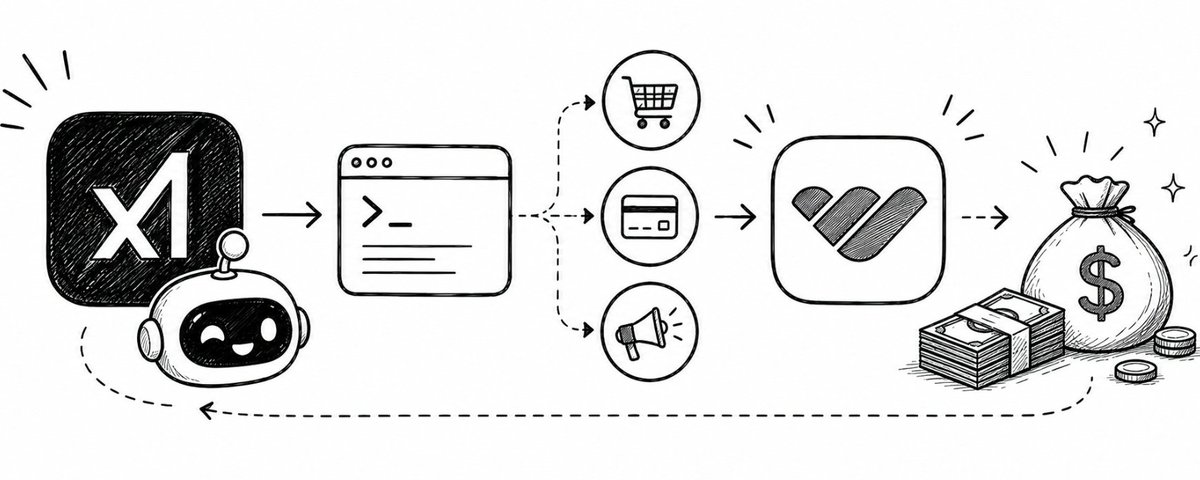
Every morning, it:
→ Scans what’s trending
→ Analyzes the best performing posts from the last 24 hours
→ Generates 10 content ideas
→ Ranks them by potential
He picks one.
Then the system takes over.
→ One AI writes the post in his style
→ Another checks it for mistakes
→ Another publishes it across 5 platforms
One idea → 5 pieces of content.
Almost no manual work.
Then comes the part most people miss:
The feedback loop.
After publishing, the system tracks what gets liked, shared, and saved.
It uses that data to understand what works and improve the next batch.
So every post becomes training data for the next one.
And the results are wild:
→ 5M views in 2 weeks
→ 100K bookmarks in 2 months
While he’s at school, sleeping, or doing something else, the system keeps publishing and distributing his content.
That’s the real advantage of AI.
You don’t need to work more hours.
You need to build something that keeps working when you’re not.
Save this.

Davis Miler retweeted

Our goal with AI Search is to make it easy to connect with original coverage and a range of perspectives.
Now live in AI Mode (already in AI Overviews): link carousels for developing topics. Ask about something that's trending and you’ll see links to relevant articles, webpages (incl your Preferred Sources) front & center.
Here’s an example from the other day 👇

Davis Miler retweeted

I just packaged up 10 of my best AI automation workflows into one database 🤯
(honestly I should probably be charging for this)
Most DTC brands & agencies waste months building AI automations from scratch.
Wrong prompts. Wrong tools. Wrong setup.
I've created 10 plug-and-play AI automations that handle the heavy lifting for you.
All in one convenient database for easy access.
Here's what's inside:
YouTube Research AI Agent
→ Scrapes trending videos by keyword
→ AI extracts hooks, angles, themes
→ Auto-organized in Airtable
Instagram Reels AI Agent
→ Scrapes trending Reels in your niche
→ Gemini analyzes creative insights
→ Comment analysis included
Sora 2 Cameos + n8n
→ Consistent AI characters across videos
→ Automated UGC campaign generation
→ Airtable tracking dashboard
Nano Banana + Veo 3 + n8n
→ Bulk UGC video generation
→ One product photo → 50+ videos
→ Auto-stored and organized
Claude + Facebook Ads MCP
→ AI ads analyst
→ Generates full performance reports
→ Natural language queries
Facebook Ads Spy + n8n
→ Daily competitor ad monitoring
→ AI analysis of hooks, CTAs, offers
→ Slack digest delivery
Sora 2 Consistent Characters
→ Multi-video campaigns, same creator
→ Brand consistency at scale
→ Step-by-step Loom walkthrough
TikTok Research AI Agent
→ Trending content analysis
→ Hook and angle extraction
→ Performance metrics tracking
HeyGen Long-Form UGC
→ 1-minute+ AI creator videos
→ Talking-head testimonials
→ Product demos at scale
Nano Banana Static Ads
→ 1,000+ ad variations automated
→ Bulk image generation
→ Perfect for testing creative
Each workflow includes the exact n8n templates + Airtable bases to get started FAST.
This is the exact stack DTC brands & agencies are using to scale creative production 10x.
Want the database?
> Comment "DATABASE"
> Like this post
And I'll send the complete collection over (must be following so I can DM)
