






David Wu retweeted

Great post both if you’re driving AI in an enterprise or building for an enterprise.
AI productivity gains are going to wildly vary - much wider than you think - because what you can do at the frontier is so significant if you fundamentally change your workflows to support agents. The challenge is that most people won’t or can’t naturally do this because of the complexity it entails.
Thus, a large amount of automation with agents is going to come from just getting agents wired up into a workflow that the user never ends up noticing or caring about:
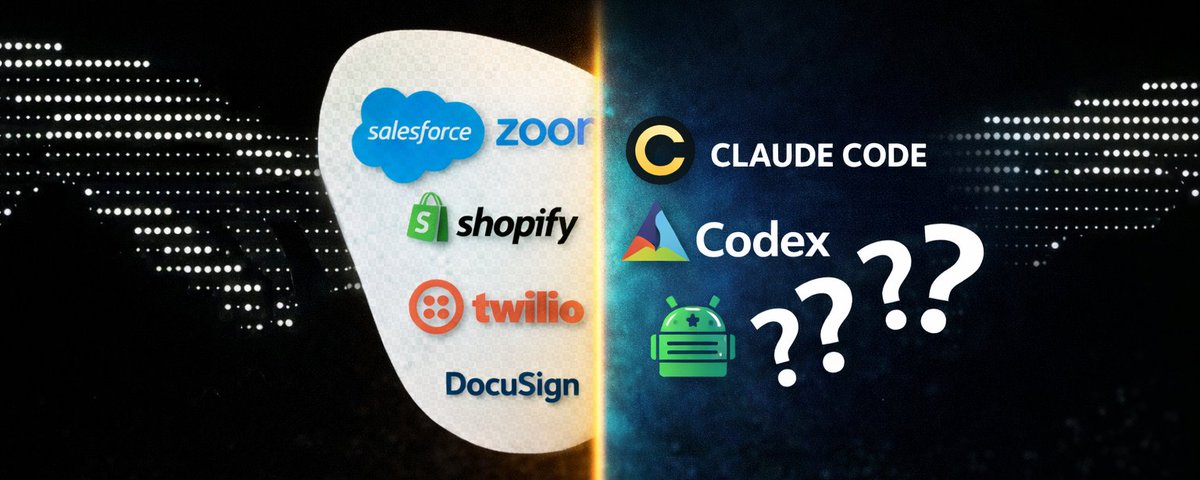
“For everybody else, the work has to get done without them changing how they work, which means the AI goes into the background. Why do you need AI to be prompted by a human anyway? Just figure out what the most repetitive processes are, build agents in your existing systems of record that employees are used to”
This is the real work ahead for most enterprises right now that want to get significant gains from AI. A lot less “let a thousand flowers bloom” and more “pick off the 10 highest leverage things in the enterprise and apply automation to them”. There’s no real shortcut here.

Northwest Spokane fire scenes this afternoon from friends who were stuck in the evacuation zone #OldTrailsFire #WAWildfire

Volleyball friends on the way out of the evacuation zone in Spokane on W Strong, after evacuating from Spike and Dig but then being trapped at the Indian Trail Safeway
#OldTrailsFire #WAWildfire



David Wu retweeted

⚡️Satya is describing the new balance sheet of the firm.
The old firm owned people, processes, software, customer relationships, brand, data, and IP.
The new firm will own a compounding cognition loop.
Every workflow becomes a training surface. Every decision becomes a trace. Every expert judgment becomes reusable signal. Every internal correction becomes model improvement. Every model run becomes a chance to turn human judgment into institutional intelligence.
That is what “token capital” really means.
It is accumulated machine-operable cognition. A company’s expertise becomes executable, queryable, evaluable, improvable, and portable across models.
That is a massive shift.
The most important line is the one about switching out the generalist model without losing the company veteran expertise. That is the entire enterprise AI war. Model providers want the firm’s knowledge to flow into the model layer.
Enterprises need that knowledge to stay inside their own loop.
Whoever owns the loop owns the future economic rent.
Satya is laying out Microsoft’s answer to the frontier-model monopoly problem.
If all company knowledge flows upward into a few foundation models, the foundation model labs become landlords of the entire economy. They absorb everyone’s expertise, commoditize every workflow, and capture the value created by every firm’s learning process. That equilibrium will trigger political backlash, customer resistance, regulatory pressure, and corporate revolt.
So Microsoft’s doctrine is: every company should build its own AI learning system on top of frontier models, while Microsoft owns the infrastructure where that happens.
That is elegant and self-serving.
Microsoft does not need to own the single best frontier model forever. It needs to own the enterprise control plane: identity, security, permissions, data, workflow, evals, agents, memory, developer tools, cloud, compliance, and model routing. If the model becomes swappable, the platform underneath the firm’s learning loop becomes the durable asset.
Satya is quietly saying the frontier model alone is unstable. A world of a few models eating every company’s expertise breaks the political economy. A world where every company builds firm-specific AI capital on top of models is more stable, more defensible, and much better for Microsoft.
The “human capital gets more valuable” line is partly true and partly corporate diplomacy.
High-agency humans become more valuable. People with taste, judgment, relationships, domain intuition, ambition, and the ability to direct agentic systems become much more valuable.
Routine cognitive labor loses bargaining power.
The future firm does not need every human equally. It needs humans who can generate high-quality signal for the loop. The human becomes a trainer, judge, strategist, relationship node, taste layer, and goal-setter. The work that cannot feed the loop or direct the loop gets compressed.
This also connects directly to the Anthropic crisis.
If frontier model access can be restricted, pulled, nationality-gated, or subordinated to state power, then enterprises cannot allow their intelligence layer to live entirely inside one external model. They need portability. They need private evals. They need internal memory. They need their own traces. They need model-agnostic learning systems.
The model can change.
The firm’s cognition loop has to survive.
That is the new sovereignty test.
A company that only buys AI access is a renter.
A company that turns its workflows, judgments, corrections, and outcomes into a private learning loop is building capital.
The deeper implication: the future economy splits between firms that compound cognition and firms that leak cognition.
Firms that compound cognition will get stronger every time they operate.

David Wu retweeted

A friend gave me a good analogy for this last week.
Every prior tech revolution ran this exact pattern.
The printing press didn't kill scribes by turning everyone into one... it produced authors, publishers and an entire civilization that read.
Power tools didn't end carpentry... they ended bad carpentry.
Spreadsheets didn't replace accountants... they turned accountants into CFOs.
Agents are the same pattern.
The floor rises and the ceiling rises faster.
Demand for judgment, taste, and context goes parabolic, because the cost of producing the thing collapses while the cost of producing the right thing stays human.

For everything we’ve seen about agents so far, it’s clear that they will make it far easier for people to get into previously extremely complicated fields. That will most certainly mean far more people will build software, explore creative work, research spaces they couldn’t do before, and so on.
Yet, equally, we’ve seen that people with experience in every one of those fields have a huge edge with the right judgment and historical context to leverage these tools in ways that exceed the output of the novices (if they choose to). They know when the agents are making catastrophic mistakes, can give the agents the right context to do the job better than they otherwise would have, and so on.
The combination of these two facts essentially means that we will continue to get the same lift as we’ve seen in any other technological revolution. More democratization, but similarly greater output from the experts. This then makes the experts continue to be in higher demand because over time our expectation for what we can get out of any field will just go up.
This is going to be true in essentially every important field. You’ll trust a lawyer using an agent for legal advice over someone who’s never had to experience how well a contract holds up. You’ll trust an engineer developing and running software over someone who’s never seen a production system. You’ll rely on the important instincts of a designer using agents over the average prompter.
The quality and volume of output we expect from these functions will certainly go up meaningfully, but the person with experience will always have a leg up, which is why the jobs don’t go away.

David Wu retweeted

AI-native software engineering teams operate very differently than traditional teams. The obvious difference is that AI-native teams use coding agents to build products much faster, but this leads to many other changes in how we operate. For example, some great engineers now play broader roles than just writing code. They are partly product managers, designers, sometimes marketers. Further, small teams who work in the same office, where they can communicate face-to-face, can move incredibly quickly.
Because we can now build fast, a greater fraction of time must be spent deciding what to build. To deal with this project-management bottleneck, some teams are pushing engineer:product manager (PM) some teams are pushing engineer:product manager (PM) ratios downward from, say, 8:1 to as low as 1:1. But we can do even better: If we have one PM who decides what to build and one engineer who builds it, the communication between them becomes a bottleneck. This is why the fastest-moving teams I see tend to have engineers who know how to do some product work (and, optionally, some PMs who know how to do some engineering work). When an engineer understands users and can make decisions on what to build and build it directly, they can execute incredibly quickly.
I’ve seen engineers successfully expand their roles to including making product decisions, and PMs expand their roles to building software. The tech industry has more engineers than PMs, but both are promising paths. If you are an engineer, you’ll find it useful to learn some product management skills, and if you’re a PM, please learn to build!
Looking beyond the product-management bottleneck, I also see bottlenecks in design, marketing, legal compliance, and much more. When we speed up coding 10x or 100x, everything else becomes slow in comparison. For example, some of my teams have built great features so quickly that the marketing organization was left scrambling to figure out how to communicate them to users — a marketing bottleneck. Or when a team can build software in a day that the legal department needs a week to review, that’s a legal compliance bottleneck. In this way, agentic coding isn’t just changing the workflow of software engineering, it’s also changing all the teams around it.
When smaller, AI-enabled teams can get more done, generalists excel. Traditional companies need to pull together people from many specialties — engineering, product management, design, marketing, legal, etc. — to execute projects and create value. This has resulted in large teams of specialists who work together. But if a team of 2 persons is to get work done that require 5 different specialities, then some of those individuals must play roles outside a single speciality. In some small teams, individuals do have deep specializations. For example, one might be a great engineer and another a great PM. But they also understand the other key functions needed to move a project forward, and can jump into thinking through other kinds of problems as needed. Of course, proficiency with AI tools is a big help, since it helps us to think through problems that involve different roles.
Even in a two-person team, to move fast, communication bottlenecks also must be minimized. This is why I value teams that work in the same location. Remote teams can perform well too, but the highest speed is achieved by having everyone in the room, able to communicate instantaneously to solve problems.
This post focuses on AI-native teams with around 2-10 persons, but not everything can be done by a small team. I'll address the coordination of larger teams in the future.
I realize these shifts to job roles are tough to navigate for many people. At the same time, I am encouraged that individuals and small teams who are willing to learn the relevant skills are now able to get far more done than was possible before. This is the golden age of learning and building!
[Original text: deeplearning.ai/the-batch/is… ]

David Wu retweeted
“There is a limit on human cognition. Even if you're not reviewing everything they're doing, how much you can hold in your head at one time.”
There’s a reason that at a certain scale, teams of people have a manager, and then there are managers of many teams, and so on. Companies don’t inherently love being inefficient. It’s because eventually you run into the limits of how much context you can hold on to produce useful work, so you have to delegate parts to someone else who can track their sub-context.
In a world where agents don’t need to be prompted or have their work reviewed, or where the agent can know perfectly when to escalate when something is going wrong, then agents can completely break free of these context limits of humans.
But for now, agents are generally only as effective as the context they’re provided, the tools they have access to, the human’s ability to keep them on track or review their work, and incorporate that work into a broader system.
For now, that will continue to take real (mental) work from the people managing agents. This is also generally why the jobs arguments from those who think people go away will be wrong.

"Using coding agents well is taking every inch of my 25 years of experience as a software engineer, and it is mentally exhausting.
I can fire up four agents in parallel and have them work on four different problems, and by 11am I am wiped out for the day.
There is a limit on human cognition. Even if you're not reviewing everything they're doing, how much you can hold in your head at one time. There's a sort of personal skill that we have to learn, which is finding our new limits. What is a responsible way for us to not burn out, and for us to use the time that we have?" @simonw