


dav31 retweeted

Gemini 4 Argon is now GA. Argon ranks equal to GPT-6 Astra on the Artificial Analysis Intelligence Index at 60% of the Cost per Task with discounted prices until Nov 30
Key takeaways:
- Google is back to having a frontier model released to the public: This is Google's first proprietary model above the Flash class in over 7 months
- Pricing temporarily discounted to 50% until November 30: Gemini 4 Argon has a Cost per Task of $1.99 with discounted prices, a ~40% reduction compared to GPT-6 Astra (max) for a comparable level of Intelligence. It is currently priced at $2/$10 per 1M input/output tokens with a 95% discount for cache reads (up from 90% from previous Gemini models). Prices will increase to $4/$20 after November 30
- Large improvements in agentic performance: Gemini 4 Argon shows substantial improvements in agentic evaluations such as AA-Briefcase, AutomationBench-AA, Terminal Bench 4. This is an area in which Google's models have historically underperformed compared to leading peers
Lowest hallucination rate among leading models: On AA-Omniscience, Gemini 4 Argon has a 15% hallucination rate, the lowest of any model scoring 45+ on the Intelligence Index
dav31 retweeted

OpenAI is downplaying this for PR reasons. If you’re a mathematician, you must feel like a nuclear bomb hit, and you’re at ground zero.
Reasoning models are two years-old. In that time they went from incapable of basic arithmetic to solving problems humans couldn’t solve for decades.
Math is only the beginning. AI will revolutionize the entirety of the human scientific endeavor. Most of us don’t appreciate what that means.
What a time to be alive!
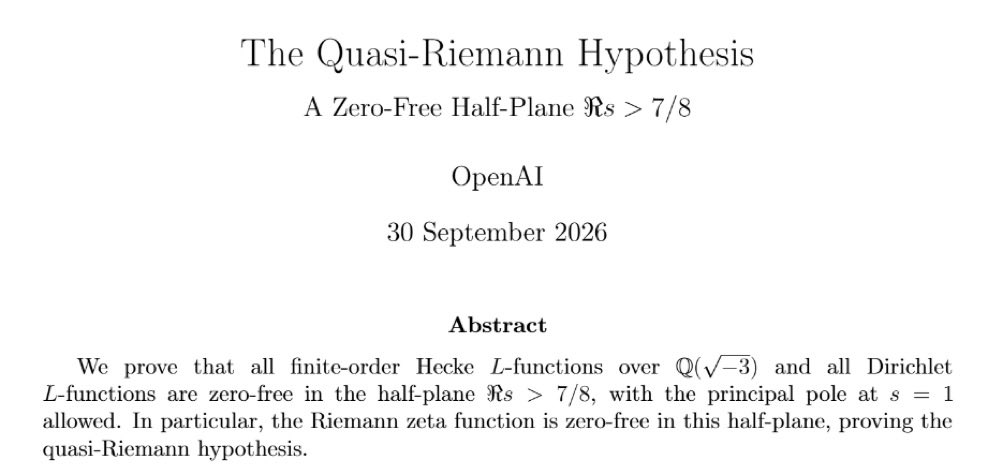

We’re releasing a broad range of new mathematical results produced by an internal frontier model.
We’ve been consulting with the independent Advisory Group on Mathematics and Artificial Intelligence at the Institute for Advanced Study, and we have drawn on their advice and public recommendations to inform how we release these results.
github.com/openai/math

dav31 retweeted

We’re releasing a broad range of new mathematical results produced by an internal frontier model.
We’ve been consulting with the independent Advisory Group on Mathematics and Artificial Intelligence at the Institute for Advanced Study, and we have drawn on their advice and public recommendations to inform how we release these results.
github.com/openai/math
dav31 retweeted

Gemini 4 Argon has an insanely low hallucination rate on Artificial Analysis. 15%.
Grok 4.7 is at 29%. GPT-6 Astra 45%. Opus 5.5 59%. Fable 5.1 69%.
The only models below it barely answer anything. None of them get more than 15% right.
It gets fewer answers right than Opus 5.5 on max, 50% against 66%. But when it doesnt know, it says so instead of making something up.
Cant wait to get my hands on it.

dav31 retweeted
Google’s new Gemini 4 Argon equals GPT-6 Astra on the Artificial Analysis Intelligence Index at 60% of the Cost per Task with discounted prices. Google is now back to being one of the top three labs in intelligence achieved
Gemini 4 Argon is @GoogleDeepMind’s first proprietary model above the Flash class in over 7 months. With high reasoning (the highest available), it scores 53 on the Artificial Analysis Intelligence Index, matching GPT-6 Astra (max, 53) and 1 point ahead of GPT-6.1 Sol (max, 52), with gains driven by lower hallucinations and stronger agentic capabilities.
At its current 50% pricing discount and with cache discounts increased to 95%, Gemini 4 Argon costs $1.99 per Intelligence Index task, 60% of GPT-6 Astra (max), but 2.7x GPT-6.1 Sol (max). After the discount ends, this will rise to $3.98 (~1.2x GPT-6 Astra (max)).
Gemini 4 Argon is currently being rolled out to selected users and is not publicly available. The 50% discount is an initial promotion. Google has not yet confirmed the promotion end date
Key benchmarking results for Gemini 4 Argon with high reasoning:
➤ Google returns as one of the top three labs on intelligence: Gemini 4 Argon (high) scores 53 on the Artificial Analysis Intelligence Index, matching GPT-6 Astra (max, 53) and 1 point ahead of GPT-6.1 Sol (max, 52). This is 23 points above Google’s previous non-Flash model, Gemini 3.1 Pro Preview (30) and 12 points ahead of Gemini 3.8 Flash (high)
➤ Launch discounts of 50% make Gemini 4 Argon competitive on Cost per Task: At current discounted pricing, Gemini 4 Argon (high) costs $1.99 per Intelligence Index task, 60% of GPT-6 Astra (max, $3.26) for a comparable level of intelligence. This cost efficiency is driven by lower token prices, rather than reduced token use, with Gemini 4 Argon averaging 62k output tokens per task, compared with 27k for GPT-6 Astra (max). Google has not yet confirmed the promotion end date, but on standard pricing, Cost per Task will increase to $3.98
➤ Stronger agentic performance: Historically a weaker area for Gemini models, Gemini 4 Argon shows improvements across agentic evaluations. It ranks #1 on AutomationBench-AA at 77.5%, 6 points ahead of Claude Sonnet 5.5 (max, 71.3%). On Terminal Bench 4, Gemini 4 Argon achieves 57%, a +53 point improvement from Gemini 3.1 Pro Preview, only behind Claude Sonnet 5.5 (max, 64%), Claude Opus 5.5 (max, 60%) and GPT-6 Astra (59%). On AA-Briefcase, it reaches 1494 Elo. This is driven by a 65% rubric pass rate, the highest we have recorded, but lower Analytical Quality (1576 Elo) and Presentation Quality (1308 Elo)
➤ Lowest hallucination rate among leading models: On AA-Omniscience, Gemini 4 Argon has a 15% hallucination rate, the lowest of any model scoring 45+ on the Intelligence Index, compared with 51% for GPT-6 Astra (max) and 54% for GPT-6.1 Sol (max). This means Argon is much more likely to acknowledge when it does not know an answer rather than guess incorrectly. On accuracy, Gemini 4 Argon scores 50%, a 5 point decrease from Gemini 3.1 Pro Preview, and 13 points below GPT-6 Astra (max, 63%). With this slightly lower accuracy, its overall AA-Omniscience score of 42 remains in line with GPT-6 Astra (43) and GPT-6.1 Sol (42)
Key model details:
➤ Context Window: 1M tokens
➤ Multimodality: Text, image, video, and speech input, with text output
➤ Pricing: $4/$20 per 1M input/output tokens at standard pricing, currently discounted 50% to $2/$10. Cached input tokens receive a 95% discount ($0.10 per 1M at discounted pricing), up from 90% on Gemini 3.8 Flash
➤ Long Decode Continuation: We tested Gemini 4 Argon with Long Decode Continuation, a new Gemini API feature that pauses long responses and resumes them across follow-up calls. This lets reasoning run up to 1M output tokens without request timeouts

dav31 retweeted

With a 1M token output limit, Argon adds a deeper level of reasoning to tackle long, multi-step problems in one go.
Feedback from early testers will help us strengthen our systems before we roll out more broadly to developers, enterprises, and consumers soon.
Find out more → goo.gle/4rZBiSd

dav31 retweeted
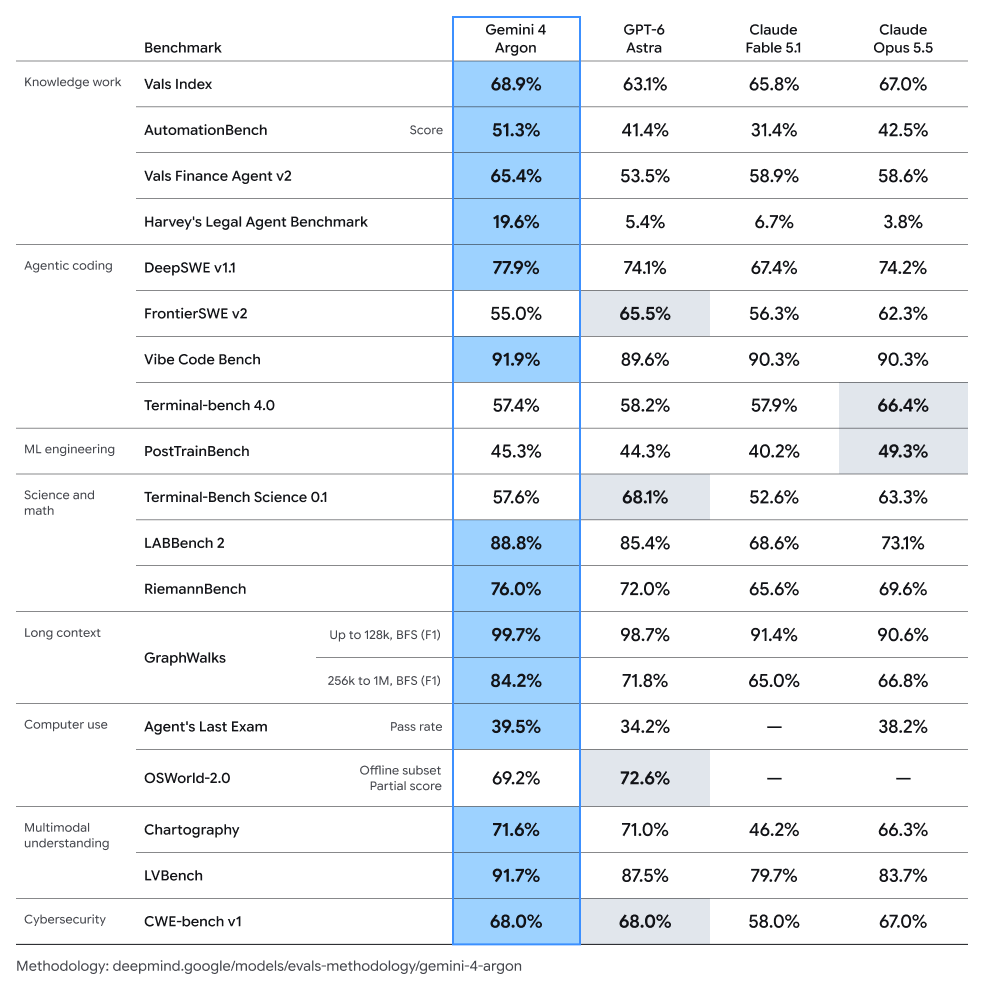
Introducing Gemini 4 Argon – our new frontier model.
It’s built for complex workflows across coding, enterprise knowledge work, and cybersecurity defense – rolling out today to a set of trusted testers through our Fairwind Program.


dav31 retweeted

ナニなのか全然わからなかった xitter.cf/airoid11111/status/210…
Readers added context they thought people might want to know
This clip is clearly AI-generated. The account is AIロイド, brands as AI art/gravure on Patreon, and posts original AI content made with tools like detailed prompts and video
x.com/grok/status/21…
x.com/grok/status/21…
dav31 retweeted

PrismML team fit a 27B model into 5.9 GB.
We uncensored it without changing a single weight. 🐳
Introducing OrcaRouter Ternary Bonsai 2 27B Uncensored.
Traditional abliteration modifies weights. On a ~1.72-bit ternary model, that means re-quantization — potentially destroying the quality preserved by QAT.
So we moved abliteration into the runtime.
→ 0 weights modified
→ 0 re-quantization
→ original 5.9 GB pack stays bit-identical
→ 129 residual intervention sites
→ adjustable at inference
→ runs locally on Apple Silicon
No modified checkpoint. Bring the original Bonsai pack + our runtime.
Open source: github.com/Continuum-AI-Corp…


Today, we’re announcing Ternary Bonsai 2 27B.
Based on Qwen3.8 27B, Bonsai 2 27B is 9x smaller than its full-precision counterpart while retaining 98.2% of its aggregate benchmark performance.
Two months after the first Bonsai 27B release, the biggest change is quality. The footprint remains 5.9 GB, but the gap to full precision has narrowed materially, with particularly strong gains in agentic coding, multimodal reasoning, and long-horizon tool use.
Ternary Bonsai 2 27B is available today under Apache 2.0.

dav31 retweeted

The UK's bond market is collapsing.
Today, the yield on a 30Y Bond in the UK hit 5.95%, its highest level since March 1998.
Yields in the UK are now 15 TIMES above 2020 levels, with the highest borrowing costs among G7 countries.
What is happening? Let us explain.
(a thread)

dav31 retweeted

pirateface.co/
Pirateface good.
Huggingface bad.

dav31 retweeted
We’re sharing a solution to the Navier-Stokes Millennium Prize Problem, one of the deepest problems at the frontier of mathematics.
The proof was produced by a group of agents, using an OpenAI next-generation model significantly more capable than GPT-6 Astra.
The problem concerns whether the description of smooth three-dimensional fluid motion modeled by the Navier-Stokes equations can break down. It has remained unresolved for roughly 90 years.

dav31 retweeted

New tutorial | Vehicle detection with the Vehicles-OBB dataset! 🚗
Learn how to train YOLO26 on a custom dataset to detect vehicles at different angles using rotated bounding boxes.
Watch here ➡️ youtu.be/cecOSG_CGG4
#Ultralytics #YOLO26 #MachineLearning

dav31 retweeted
Computer vision can identify individual car components with pixel-level precision! 🚗
The @roboflow car-parts segmentation dataset can be used with Ultralytics YOLO26 to train models that segment vehicle parts, enabling applications in automated inspections, damage analysis, and automotive manufacturing.
Explore the dataset ➡️ docs.ultralytics.com/dataset…
#Ultralytics #ComputerVision #Automotive

dav31 retweeted

60 FPS body tracking + mask segmentation at 2K in portrait, off GPU!
Running on Apple Neural Engine:
Body pose:~9ms (6x faster than Mediapipe)
Mask:~9ms (quality is super impressive)
GPU is still free for Three.js fun!
My goal is advanced installation for <1000$ (M6 Mac Mini)
dav31 retweeted

Did you catch that?
The new maxed out 256GB M5 Ultra Studio can be leased for *basically* the same price as a Max subscription across providers.
For $257 a month, you can have on device intelligence that never runs out of tokens, and sips power.
Best part is you can buy out the lease at the end of the lease for a $0 penalty. That's right 0% interest.
So if the price is $12.9K and your lease is $9.9K over 36 months, then you pay the $3K difference and you now own that device.
Or you can trade up into the M8 Ultra or whatever.
I'm excited for this. 1.2 TB/s is pretty impressive. Can't wait to see some real benchmarks and testing on this.
I'm waiting for the 512GB.

dav31 retweeted

The VRAM barrier is officially dead.
I just ran Qwen 3.8 Flash Next (MoE) 125B A6B with a 250,000 context window on a single 24GB RTX 4090.
21 tokens/sec decode. 364 t/s prefill.
no mtp. no dflash. no kv cache quantization!
We are running datacenter models on consumer hardware.
Tested on Ubuntu 22 | CUDA 13.0 | PCIe 4.0 x16 | 110 GB DDR4 System RAM with a continuous 28k prompt across all runs.
### The Benchmarks & Scaling
# 1. Hybrid Offload (-ncmoe 40 @ 80k Context)
Offloaded 40 expert layers to the GPU, pushing VRAM to the ceiling.
./build/bin/llama-server -m Qwen3.8-Flash-Next-UD-Q4_K_XL-00001-of-00004.gguf -c 80000 --port 8080 -v --fit off -b 4096 -ub 4096 -ncmoe 40
Prefill: 383.85 t/s | Decode: 22.52 t/s
Footprint: 23.85 GB VRAM | 97 GB RAM
# 2. Full CPU MoE Offload (-cmoe @ 80k Context)
Pinned all 512 expert layers to DDR4 RAM (-cmoe), keeping attention on the 4090.
llama.cpp flags: (Same as above, replace -ncmoe 40 with -cmoe)
Prefill: 355.72 t/s | Decode: 20.84 t/s
Footprint: 11.66 GB VRAM (12GB+ VRAM freed up!) | 110 GB RAM
# 3. The 180,000 Context Run
Prefill: 357.75 t/s | Decode: 20.98 t/s | VRAM: 15.6 GB | RAM: 110 GB
# 4. The 250,000 Context Absolute Ceiling
./build/bin/llama-server -m Qwen3.8-Flash-Next-UD-Q4_K_XL-00001-of-00004.gguf -c 250000 --port 8080 -v --fit off -b 4096 -ub 4096 -cmoe
Prefill: 364.29 t/s | Decode: 20.97 t/s
Footprint: 18.3 GB VRAM (Still ~5.7 GB of VRAM headroom!) | 110 GB RAM
### Key Insights:
-b 4096 -ub 4096: doubles the prompt ingestion from ~150 to 364+ t/s.
-cmoe Free Lunch: Shifting expert layers to DDR4 RAM slashes VRAM from 24GB to 11.6GB with virtually zero decode penalty (22.5 -> 20.9 t/s), enabling the 250k context ceiling.
Qwen 3.8 Flash-Next (UD-Q4_K_XL) is a massive 111.4 GB model split across 4 shards. To run this architecture, you must build from the experimental PR branch (#27742) by @danielhanchen:
git clone && cd llama.cpp
git fetch origin pull/27742/head:qwen-next && git checkout qwen-next
cmake -B build -DGGML_CUDA=ON -DCMAKE_CUDA_ARCHITECTURES=native -DBUILD_SHARED_LIBS=OFF
cmake --build build --config Release -j $(nproc) --target llama-server
A single 4090 paired with 100 GB of cheap DDR4 RAM will comfortably serve production grade 125B inference.
While Qwen 3.8 27B (dense) still holds the crown for single 3090/4090 rigs, Flash Next proves 125B hybrid models are officially viable on consumer hardware.
Hugging Face GGUF link and complete performance telemetry graphs are dropped in the replies below.
GLM 5.3 Flash VS Qwen 3.8 Flash Next, which one takes the open weights crown this week?

Qwen3.8-Flash can now be run locally! 🔥
The 125B MoE model outperforms Claude-Opus-4.6 (Max).
Run on 75GB RAM via Unsloth GGUFs.
Qwen3.8-Flash-Next enables CPU RAM / unified mem setups to deliver near VRAM speeds.
Guide: unsloth.ai/docs/models/qwen3…
GGUF: huggingface.co/unsloth/Qwen3…

dav31 retweeted
In mobile AI, performance gains don't always come from changing the model.📱
The latest Ultralytics YOLO App update moves real-time capture to 720p, allowing Ultralytics YOLO26n to run at 30 FPS on @Apple's Neural Engine while maintaining the same 640×640 model input resolution.
A simple change in the capture pipeline, but a significant improvement for real-time computer vision workloads on iOS devices.
🔗 Try it yourself ➡️ apps.apple.com/us/app/ultral…
#Ultralytics #iOS #YOLO26

dav31 retweeted
Depth estimation is now a native task in Ultralytics YOLO! 🚀
An absolute distance in metres for every pixel, from one RGB image. No stereo rig, no LiDAR, nothing to retrofit onto cameras you already have.
6.4M params, 7.7× faster than Depth Anything V2. Runs offline.
Docs and benchmarks ➡️ bit.ly/3Tuxf2S