







In some regions of Russia, the gap in life expectancy between men and women reaches a staggering 18 years. In 38 of the 85 regions this difference exceeds 12 years. Nowhere else in the world, with the exception of Ukraine and Gaza is there such a pronounced gender-based disparity

In 51 Russian regions (60%) TFR declined by >4% between 2024 and 2026. In 17 regions, the drop in TFR over a 21-month period exceeded 7%, while4 regions saw a decline of >10%; the median across federal subjects stands at −4.85%

Almost half of Russia’s regions(40 out of 85)have a total fertility rate (TFR) below 1.3 children. A rate below 1.50 is observed in 72 regions, or 85% of all constituent entities. 8 fall short of the 1.70 level; only 5сhave recorded a TFR above 1.7. Only Tuva and Chechnya >2.08

Europe’s demographic slump: in most countries, the TFR is one-third to one-half below replacement level. Spain has a TFR of 1.12, Italy 1.13, Greece 1.23, Poland 1.08, Lithuania 1.02, and Ukraine 1.03; meanwhile, in 2026, Turkey’s rate has fallen to 1.38 and Azerbaijan’s to 1.33

Colombia: over 43 years, the birth rate has dropped threefold; in 1986, 932K live births were recorded, whereas in 2025 just 442K a 2.1-fold decrease. Over the same period, the net population increase fell fivefold, from 785,610 to 157,283 people. TFR plummeting, now at 1.0

Turnout for the 9th State Duma elections was notably higher: 56.66% of voters nationwide cast their ballots, compared to 51.72% in 2021 and 47.88% in 2016. Chechnya topped the list with a turnout of 93.98%, while the Irkutsk Region recorded the lowest figure at 36.09%

In 2026, sales of high-proof alcohol in Russia plummeted by 27.4%. Compared to 2023, the drop was a full 35.4%. A noticeable decline in mortality from "natural causes"—primarily cardiovascular diseases—is to be expected in Russia

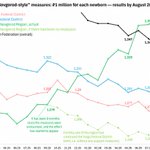
The measures implemented in the Nizhny Novgorod region boosted the local TFR by 0.132 children over an 11 month.If scaled to the national level, would translate to an increase of 114K births in Russia in 2026.For the first time since the 1920s region’s TFR rose above the national

The decline in the birth rate in Russia is accelerating: by the end of the year, the total fertility rate (TFR) will drop by 0.057 children to 1.304. Over the first eight months, the rate has already fallen by 0.038 children, with an average annual decline of 0.057

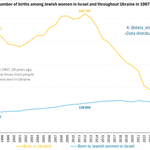
This year, the number of children born to Jewish women in Israel will be equal to the number born in all of Ukraine. Just 29 years ago, the latter had a five-fold advantage

How did the number of births in Ukraine change in 2021-2025 by region? For reference, the national average for 5 years was -38%

In Ukraine and Kyrgyzstan, approximately the same number of children will be born in 2026, while 35 years ago, there were 5 times more newborns in Ukraine, and 75 years ago, there were 15 times more births per year compared to Kyrgyzstan

In 5 years, the number of newborns in Ukraine has decreased by half, since independence – by 4 times, since 1940 – by almost 9 times

Over the past 66 years, more children have been aborted in Belarus than were born: 8.9 mln vs. 8.3 mln.However since the 1990s the proportion of pregnancies ending in abortion has decreased from 66% to 20%.The peak number of abortions was recorded in 1989—261K out of 142K births

The birth rate of migrant women in Bavaria is 36% higher than that of German women, while the latter's is at an 80-year low. Each subsequent generation of Bavarian Germans, if these figures continue, will account for approximately 60% of the number of their parents' generation

26% of babies in France in 2025 were born to mothers born outside the country (until the 2000s, this was no more than 18%.) When including the descendants of migrants, only 63% of births were to French women

Thanks to the measures introduced, the Nizhny Novgorod Region has surpassed the Russian average birth rate for the first time in over 80 years—in less than a year, the increase was more than 11% or +0.14 children. The program includes a payment of 1 mln rubles ($15К) per child

250 years of the US: from a 15-fold population growth in the 19th century to below-replacement TFR in the 1930s, then to a baby boom with an increase of 2.7 mln per year, and now—the countdown to the onset of depopulation


During Soviet times,there were 2 newborns in Azerbaijan for every 1 born in Armenia. In 2013, a record was set:there were 4.13 babies born in Azerbaijan for every 1 born in Armenia. The ratio returned to 2.99:1 by the end of 2025 — still significantly higher than it was just 35ya

