




working (well, trying to...) with gpt-6.1 sol on high and it's utterly slow in codex.
do we know why?
i get 10x more done with sonnet/opus.
@OpenAI @thsottiaux
🎮 jevvy: a local playground for typed AI decisions
🧠 One shared state, many questions
📊 Choice, Score or yes/no, each with probabilities
☁️ Jev (@typesafeai ) or 💻 Laya (local, @UnslothAI )
🚀 Bonus: Jev & Laya fly a space shooter from a text radar feed
🔗 github.com/darvat/jevvy

song by suno.com/@topchoir
assistant editor: #Anthropic #opus 5.5 (win, blender, optix )
#coldwave #postpunk #synthwave #darkwave #nightdrive #1980s #blender3d #musicvideo
A local web app for trying [TypeSafe AI](docs.typesafe.ai/introductio…) decisions. Build a request with one shared state and several independent questions, run it with your own API key, and inspect the typed answers.
The app also includes an arcade where Jev pilots a space shooter from a text radar feed.
GH: github.com/darvat/jevvy


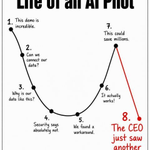
A new AI demo arrives. Leadership gets excited. Everyone declares it “transformational.” Someone asks for a pilot by next Friday.
Meanwhile, the previous pilot is still sitting in a corner with half-connected data, three security exceptions, no production owner, a manual workaround called “temporary_final_v7,” and one exhausted engineer who actually knows how it works.
Just as the team finally gets the data connected, security approved, monitoring in place, ownership agreed, and the thing starts producing real value...
The CEO sees another AI demo.
“Can we do this instead?”

ALT Life of an AI Pilot
MiniMaxH3 on an RTX 4090 - $0
@MiniMax_AI

Wan 3.0 VS Seedance 2.5
4.5 $ VS 1.8 $
Same prompt, different models, which one would you choose?
Create with flowith.io now.


FreeToken is the kind of AI progress I find exciting.
It doesn't magically fit a 20GB model into 16GB VRAM, it turns VRAM from a hard wall into a bandwidth problem, moving sparse MoE work across GPU, CPU and RAM.
The ~100 tok/s result is community-reported, so it's promising, not proven.
paper’s architecture: arxiv.org/abs/2608.16157
early reliability issues: github.com/FlashML-org/FreeT…


🤯 A 20GB model doesn't fit in this RTX 5080's 16GB VRAM. It still runs at ~100 tok/s.
🆕 NEW INFERENCE ENGINE!
FreeToken is a new open-source inference engine designed specifically to run huge MoE models on hardware that doesn't have enough VRAM to hold them.
... and there are new community tests to verify claims
🎮 RTX 5080 (w/16GB VRAM)
🧠 Ryzen 9 9950X3D
💾 64GB system RAM
🤖 Qwen3.6-35B-A3B NVFP4 (~20GB)
The model is larger than the GPU's VRAM.
Result:
🔥 ~100 tok/s
One example with a 1,028-token prompt reached roughly 🚀 110 tok/s
How?
FreeToken doesn't treat your PC as either GPU VRAM or system RAM. It treats the whole machine as an inference platform.
⚡ GPU-resident experts
🧠 CPU execution
💾 system RAM
🔄 dynamic expert caching
🚦 bandwidth-aware CPU/GPU scheduling
📚 dynamic KV-cache allocation
Because Qwen3.6-35B-A3B is an MoE, only a fraction of its total parameters are active for each token.
FreeToken exploits that sparsity instead of forcing the entire model into VRAM.
And the paper goes much further:
💻 8GB laptop GPU → 35B MoE
🎮 RTX 5090 → DeepSeek-V4-Flash 284B
🖥️ 96GB workstation GPU → GLM-5.2 753B
All on a single personal machine.
FreeToken is ...
🔓 Apache 2.0
🪟 Windows app
🐧 Linux
🖥️ GUI
🔌 OpenAI-compatible API
🤖 Claude Code / Codex / Hermes / OpenCode support
⚠️ The ~100 tok/s figure is a community result, not a benchmark reported in the FreeToken paper.
🔗 GitHub /FlashML-org/FreeToken

The US doesn't even crack the top 90. 😳
The 100 healthiest countries in the world, ranked by healthy life expectancy:
🥇 Singapore
🥈 Japan
🥉 San Marino
healthiest-countries-2023.da…
Where does your country rank? 👇
Source: IHME GBD 2023, published in The Lancet (2025).
doi.org/10.1016/S0140-6736(2…

ALT Countries ranked 1 to 25 by healthy life expectancy.

ALT Countries ranked 26 to 50 by healthy life expectancy.

ALT Countries ranked 51 to 75 by healthy life expectancy.

ALT Countries ranked 76 to 100 by healthy life expectancy.
16 healthiest countries in the world:
Healthy life expectancy at birth
🇸🇬 Singapore - 74.1 years
🇯🇵 Japan - 72.3 years
🇸🇲 San Marino - 72.2 years
🇰🇷 South Korea - 71.8 years
🇦🇩 Andorra - 71.6 years
🇨🇭 Switzerland - 71.6 years
🇮🇱 Israel - 71.5 years
🇮🇹 Italy - 71.2 years
🇲🇹 Malta - 71.2 years
🇱🇺 Luxembourg - 71.1 years
🇪🇸 Spain - 71.1 years
🇸🇪 Sweden - 70.9 years
🇳🇴 Norway - 70.6 years
🇮🇪 Ireland - 70.3 years
🇮🇸 Iceland - 70.2 years
🇫🇷 France - 70.1 years
Source: IHME, Global Burden of Disease 2023
Published in The Lancet, 2025
doi.org/10.1016/S0140-6736(2…
#healthplanet #statistics @stats_feed
Codex banked reset for paid users - confirmed
with a month expiry
fair enough, thanks @thsottiaux and @OpenAI :)

Building more is clearly part of the answer. But even the OECD says the causes are “multiple and context-specific”: land-use rules, yes, but also interest rates, building costs, migration and low public investment. More homes,especially affordable and social ones, not one magic fix. @levelsio
check here: doi.org/10.1787/60b5a398-en

I made a little page to illustrate my point
There is an extremely strong correlation between the price of housing and how many new homes are built
Countries that build more pay less rent
This seems completely obvious to anyone with a brain,
except governments and locals who scapegoat everyone except their own governments for not letting people build more homes
That anti-building regulation is pushed by existing home owners who want to keep their house prices going up, and they represent a considerable voting bloc in countries around the world (about 65% of people in EU/US are home owners)
So there is your problem!
A good litmus test to see if your government actually cares about you: does it let you build a home?
nomads.com/housing-affordabi…


ALT 118B local model: 19.2 tok/s stable, 65.8 tok/s peak on DGX Spark

I just ran #Poolside’s #Laguna S2.1 NVFP4 locally on an @NVIDIAAI #DGX Spark with @vllm_project and @NousResearch Hermes Agent.
The surprising result:
DFlash can make it 3x faster.
Or make it slower than normal decoding.
Real measurements below 🧵
I just ran #Poolside’s #Laguna S2.1 NVFP4 locally on an @NVIDIAAI #DGX Spark with @vllm_project and @NousResearch Hermes Agent.
The surprising result:
DFlash can make it 3x faster.
Or make it slower than normal decoding.
Real measurements below 🧵
But on less predictable reasoning and agent outputs:
• Acceptance fell to 2% to 8%
• Generation dropped to 10 to 18 tok/s
• Sometimes slower than the stable 19.2 tok/s baseline
The draft model was generating quickly, but most proposed tokens were discarded.
Speculation is not automatically acceleration.
My conclusion:
• General Hermes Agent use: run Laguna without DFlash
• Long, predictable code generation: use DFlash with 15 draft tokens
• Avoid blindly optimizing for peak tok/s
• Measure end-to-end performance on the actual workload
Local agents are becoming genuinely practical on a single DGX Spark.