

Chile
Joined August 2016
- Tweets1.1K
- Following390
- Followers364
- Likes4.8K




Que ingrato es el servicio público, ingresar por un concurso competitivo, dedicar años y parte de tu carrera profesional para ser desvinculado por no "congeniar". No es el momento para ser técnicamente pulcro y correcto en el estado, porque así no formas parte del lineamiento.
68
Daniel Pailañir retweeted

No es solo desempleo alto; el poco empleo que se crea es informal. En este gráfico desarrollado por @LaFirmaEstudio, se ve cómo en este 2026 se destruye mucho empleo formal y una parte (no todo) se compensa con nuevo empleo informal. Una dinámica opuesta a años anteriores

Daniel Pailañir retweeted

Pulmay (Curanto en Disco)
📍 Chile 🇨🇱
Taste Chile: tastestlas.com/chile
Originating from the southern Chilean archipelago of Chiloé, traditional curanto was historically prepared in a pit dug into the earth, cooked over red-hot stones covered with native leaves. Its modern kitchen adaptation, prepared in a heavy metal disk over an open flame, is known as Pulmay or Curanto en disco.
This coastal surf-and-turf staple blends land and sea into a massive communal dish. Giant ribbed mussels (cholgas), clams, and shrimp are layered alongside smoked pork, beef, and spicy longaniza sausage, together with onions and vegetables. A generous bottle of Chilean white wine is poured over the top, creating a steam bath that cooks everything together until the seafood releases its natural brine and fuses with the rendered fat of the meats to form a deep, aromatic broth.
Served straight from the skillet into deep bowls, it remains one of the most celebrated culinary traditions in Chilean culture.
Credit: @alsondelastradicionescl
Primera vez que veo esta posición (que comparto), una más crítica, basada en evidencia y metodologías claras, directamente desde la academia. Muchas veces se toma como verdad irrefutable estudios que no han pasado revisión de pares, lo que en la academia es un "desde".

Los autores de esta columna escrita para #CIPEROpinión hacen un detallado repaso del debate académico en torno al salario mínimo y sus consecuencias económicas. Esto, a propósito del informe del Banco Central que provocó revuelo en el mundo político ciperchile.cl/2025/09/20/que…

148
Gran trabajo acá 🙌

Forthcoming in the AER: "Managers and Public Hospital Performance" by Pablo Muñoz and Cristóbal Otero. aeaweb.org/articles?id=10.12…

1
135
Daniel Pailañir retweeted

A study by @LarrouletPilar, @DanielPailanir, Daniela Quintana, and Damian Clarke shows school closures hid child abuse rather than stopping it. In Chile, reports dropped sharply during COVID-19 closures and hadn’t fully recovered two years later.
jhr.uwpress.org/content/earl… xitter.cf/J_HumanResource/status…
Importantísima investigación!

En dos semanas, Damian estará en este increíble panel, presentando los resultados de nuestro paper sobre cierre de escuelas y caídas en denuncias de violencia contra NNA. Vemos el mismo patrón de disminución con Covid, vacaciones, y cierres por protestas estudiantiles. (1/3)

2
207
Daniel Pailañir retweeted

News on sdid_event:
- SDiD, DiD and SC can all be computed via the method() option;
- added placebo() option to estimate pre-trends;
- the package is now on SSC, so check it out by running
ssc install sdid_event, replace
Many thanks to @DanielPailanir and Damian Clarke!

Daniel Pailañir retweeted
I thrilled to share my first arXiv WP: "A short note on Event-Study SDID" . It comes with a Stata package, sdid_event, available on Github (see footnote 1)!
Many thanks to @DanielPailanir and Damian Clarke for their feedback and inspiring work on SDID!
arxiv.org/abs/2407.09565

Daniel Pailañir retweeted

Damian Clarke, @DanielPailanir y los académicos de @Stanford Susan Athey y Guido Imbens (Nobel de Economía 2021) contribuyen a la economía aplicada y la evaluación de políticas públicas al proporcionar una herramienta econométrica avanzada y accesible.
➡️bit.ly/3xJ5dGj

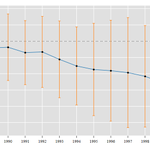
Acabo de sacar este plot preliminar y se ve interesante. Fuera de eso, pucha que es difícil dejar tiempo en la tarde/noche para investigar 🥴😴.

3
270
Stata users, Damian Clarke and I are excited to announce the launch of the 1st versions of two Stata packages designed to implement the two estimators described in 'When Should You Adjust Standard Errors for Clustering?' by A. Abadie, @Susan_Athey, @guido_imbens and @jmwooldridge
These are the causal cluster variance (ccv) estimator and the two-stage cluster bootstrap (tscb) estimator.
You can install them directly into Stata using:
ssc install ccv
ssc install tscb
We maintain these packages in our GitHub repository, where you can find examples and the most recent versions: github.com/Daniel-Pailanir/T….



Daniel Pailañir retweeted
Cola de Mono 🇨🇱 is the best cocktail in the world in 2023. View complete TasteAtlas Awards 23/24 lists: tasteatlas.com/best/foods-by…
It is not Christmas in Chile without a glass of Cola de Mono (lit. Monkey’s Tail). There are numerous versions of this beverage, but it typically consists of milk, sugar, coffee, cloves, cinnamon, and aguardiente – distilled spirits containing between 29% and 60% alcohol by volume.
Brandy or rum are among the most common types of alcohol used in Cola de Mono. All ingredients are first boiled, cooled, then combined with aguardiente. The drink can be served hot or cold, and it is traditionally paired with a slice of pan de pascua, a traditional Christmas bread.
Photo: instagram.com/pilarwoloszyn


Ojito con esto 👇

Our article demonstrates that you can indeed boost the impact of your publications by sharing and promoting your research on Twitter. authors.elsevier.com/sd/arti… (Open Access).
Note: This might generalize to X and social media more broadly.

1
304